Manchester City are once again heading to Wembley, and once again Pep Guardiola has found himself at the centre of controversy, debate, complaints, praise, anger, and emotion all mixed together. What should have been a simple night of celebration after another dominant performance has instead opened several talking points that stretch far beyond the pitch. From City’s comfortable semi final victory over Newcastle United, to Guardiola’s complaints about Wembley being in London, to his frustration over Marc Guehi’s ineligibility, this Carabao Cup story has become much bigger than just football.
The night itself was meant to be routine. Manchester City arrived for the second leg of their Carabao Cup semi final knowing the job was almost done. A 2 0 victory away at St James’ Park in the first leg had already placed them firmly in control. Newcastle needed something close to a miracle to turn the tie around, and very few people believed that miracle was coming. Pep Guardiola, who has seen almost everything in football, would have been desperate for a calm and professional evening. He got exactly that, and then some.
From the first whistle, Manchester City played like a team that knew their destination. There was no panic, no nervousness, and no sense of risk. Instead, there was control. The ball moved quickly, players found space easily, and Newcastle struggled to live with the pace. By the time the first half ended, the tie was completely over. Omar Marmoush scored twice, showing sharp movement and confidence in front of goal, while Tijjani Reijnders added another with a composed finish that summed up City’s dominance. At 3 0 on the night and 5 0 on aggregate, the stadium already felt like a training ground exercise rather than a semi final.
Newcastle did manage to pull one goal back just after the hour mark through Anthony Elanga. For a brief moment, there was a flicker of hope, a reminder of football’s unpredictability. But that hope disappeared almost instantly. City never lost their shape, never dropped their intensity, and never allowed Newcastle to build any momentum. When the final whistle blew, the aggregate score stood at 5 1, and Manchester City were heading to Wembley yet again.
For Guardiola, this marked another milestone. Five Carabao Cup finals in ten years is no small achievement. It speaks to consistency, focus, and the ability to treat domestic cup competitions with respect rather than seeing them as distractions. Guardiola has always valued trophies, even those some fans and pundits dismiss as minor. He knows that winning creates habits, and habits create dynasties.
However, instead of talking only about his players, Guardiola’s post match comments took a different direction. Very quickly, attention shifted away from Marmoush’s goals and Reijnders’ control in midfield. Guardiola began talking about Wembley, about travel, and about fairness. As always, his words divided opinion instantly.
Wembley Stadium, England’s national stadium, has long been the home of domestic cup finals. For many, playing there is a dream. For Guardiola, it is still a pleasure, but it is also a source of frustration. His issue is not the stadium itself, but its location. Wembley is in North London, and when Manchester City play Arsenal there, Guardiola feels the balance is not quite fair.
After the match, Guardiola openly spoke about the travel difference between the two teams. Manchester City will have to travel down from the north, while Arsenal will effectively be playing a final in their own city. Guardiola pointed out that City seem to travel south for finals far more often than teams based in London travel north. In his words, Arsenal will be waiting for City in London.
He was careful with his tone, but the message was clear. Guardiola feels that the location gives Arsenal a small advantage, whether people admit it or not. Familiar surroundings, shorter travel, and a fanbase that does not need to make a long journey all matter at this level. Even small details can influence big matches.
At the same time, Guardiola praised Arsenal heavily. He described them as the best team right now, not only in England but possibly in Europe. That praise was genuine. Guardiola respects Mikel Arteta deeply. He knows Arteta’s methods because he helped shape them. Their upcoming meeting at Wembley is not just a cup final, it is a clash of philosophies, generations, and shared history.
Guardiola also spoke about the emotional value of winning the Carabao Cup. He reminded everyone that the first trophy he won at Manchester City came in this competition. He believes that lifting silverware early helps teams build confidence and momentum. That belief has guided his approach to cups throughout his career.
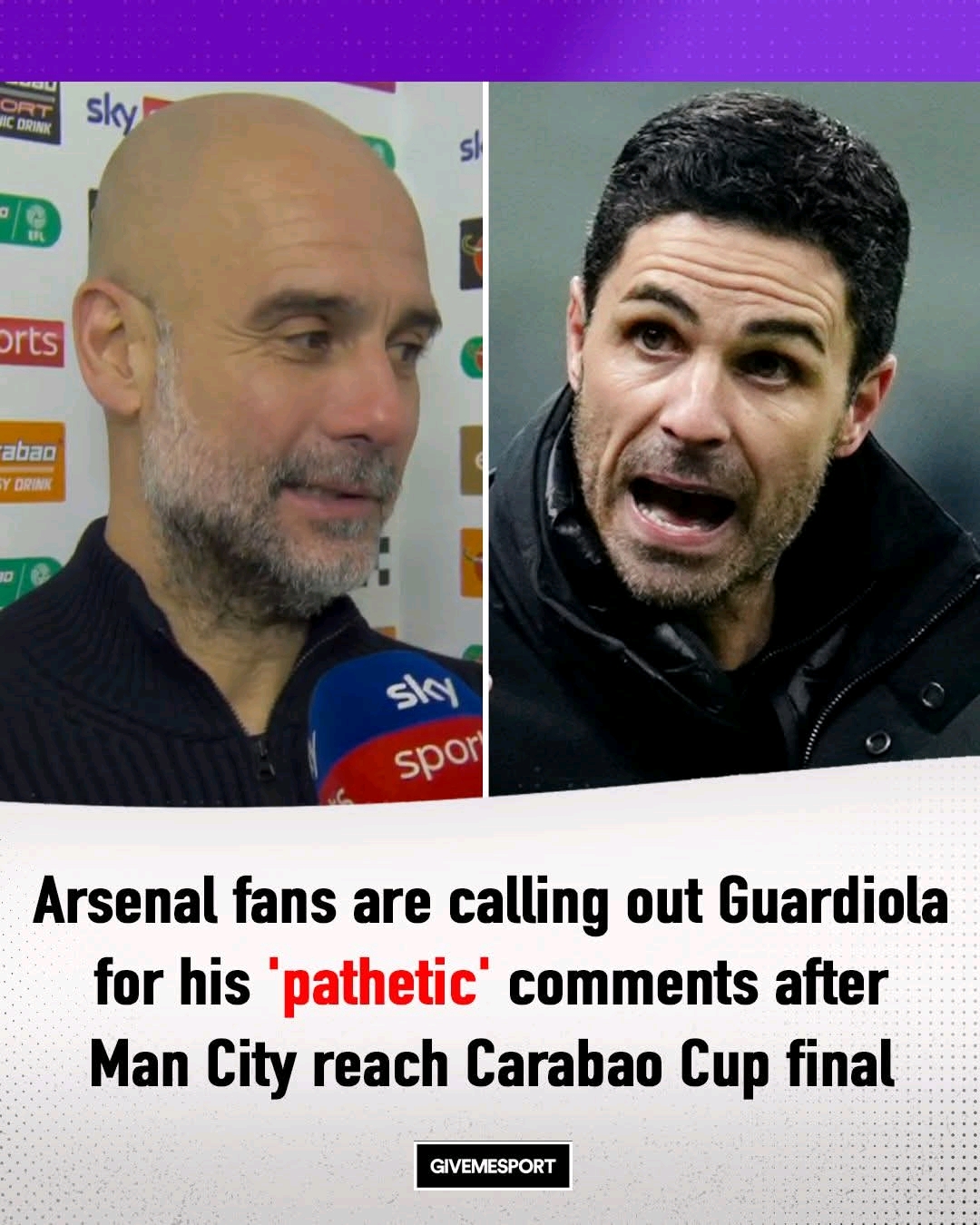
Despite this, his comments about travel sparked anger among Arsenal fans almost immediately. Social media filled with criticism. Some accused Guardiola of making excuses before the final had even been played. Others mocked him, suggesting he was afraid of Arteta. Words like pathetic, clown, and moaner were thrown around freely. For many Arsenal supporters, Guardiola’s complaints sounded like weakness.
But this reaction also misses something important about Guardiola. He has never been shy about pointing out what he sees as unfair or illogical. Whether people agree with him or not, he speaks honestly. He does not hide behind clichés. His comments are rarely random. They come from a place of deep thought about football structures.
And this brings the story to its most controversial element. Marc Guehi.
Marc Guehi joined Manchester City in January after months of speculation. The club saw him as a strong addition, a defender with Premier League experience, leadership qualities, and the ability to fit into Guardiola’s system. City invested significant money to bring him in, and Guardiola clearly values him. However, because of the timing of his transfer, Guehi is currently ineligible to play in the Carabao Cup final.
This is where Guardiola’s frustration really boils over.
Guehi was cup tied earlier in the competition, having played before joining City. Under current Carabao Cup rules, that makes him unavailable for the final. Guardiola does not understand this rule, and he has said so very clearly. From his point of view, the logic makes no sense.
Guardiola argued that City made a big investment in the player. Guehi now belongs to Manchester City. He trains with them, earns his salary from them, and is fully registered. Yet, because of a rule that Guardiola believes is outdated, Guehi cannot play in the final. Guardiola finds this difficult to accept, especially considering the final will take place in March, long after Guehi has settled into the club.
He revealed that Manchester City will do everything they can to challenge this rule. The club plans to write to the competition organisers in the hope that an exception can be made or that the rule can be reconsidered. Guardiola admitted that he does not fully expect success, but he believes it is important to ask the question.
In his eyes, if the transfer window is open and a club signs a player, that player should be eligible for competitions going forward. He pointed out that transfer windows are not controlled by managers, but by governing bodies. Once a player is signed legally, Guardiola believes it is logical for them to be allowed to play.
This is not the first time Guardiola has clashed with competition rules. He has often questioned regulations in domestic and European football, especially when he feels they fail to reflect the modern game. For him, football should be simple. If a player is registered, he should play. Anything else feels unnecessarily complicated.
The situation is even more painful for Guehi himself. He has already experienced Wembley glory in his career. He knows what it means to play there, to win finals, to lift trophies. Missing out on this opportunity, especially after just joining a new club, is a cruel twist. While his teammates prepare for the biggest domestic cup stage, he will likely be watching from the stands.
For Manchester City, this final carries extra weight. The club has not won a trophy in almost two years by their own high standards. That may sound strange to outsiders, but City measure success differently. A Carabao Cup win would not only end that wait, it would also send a message to Arsenal and the rest of the league.
The final is more than just a trophy. It is a psychological battle. Arsenal are pushing hard in the Premier League. City are chasing them closely. Meeting at Wembley offers a chance to strike a mental blow. Guardiola knows this. Arteta knows this. Every word spoken now is part of that build up.
Guardiola’s complaints, whether about travel or rules, are part of the pressure game. He is shifting attention, creating noise, and forcing discussions. Some see it as excuses. Others see it as clever management. The truth is probably somewhere in between.
What is certain is that Manchester City are once again where they expect to be. In a final. Under the spotlight. With Guardiola leading the way, questioning everything around him, demanding clarity, and refusing to accept things simply because they have always been that way.
As March approaches, the noise will only grow louder. Arsenal fans will remember his words. City fans will defend him. The debate about Wembley, fairness, and rules will continue. And Marc Guehi’s situation will remain a talking point until a final decision is made.
But when the whistle blows at Wembley, none of that will matter. What will matter is which team handles the pressure better, which players rise to the occasion, and which manager makes the right decisions. Guardiola has been here many times before. He knows the path. The complaints, the arguments, and the controversies are all part of the journey.
And once again, Manchester City are walking it, straight towards Wembley, with Pep Guardiola leading, questioning, challenging, and believing that his team belongs right at the centre of English football’s biggest stages.