Manchester City superstar Erling Haaland facing potential jail time in Switzerland over bizzare fine

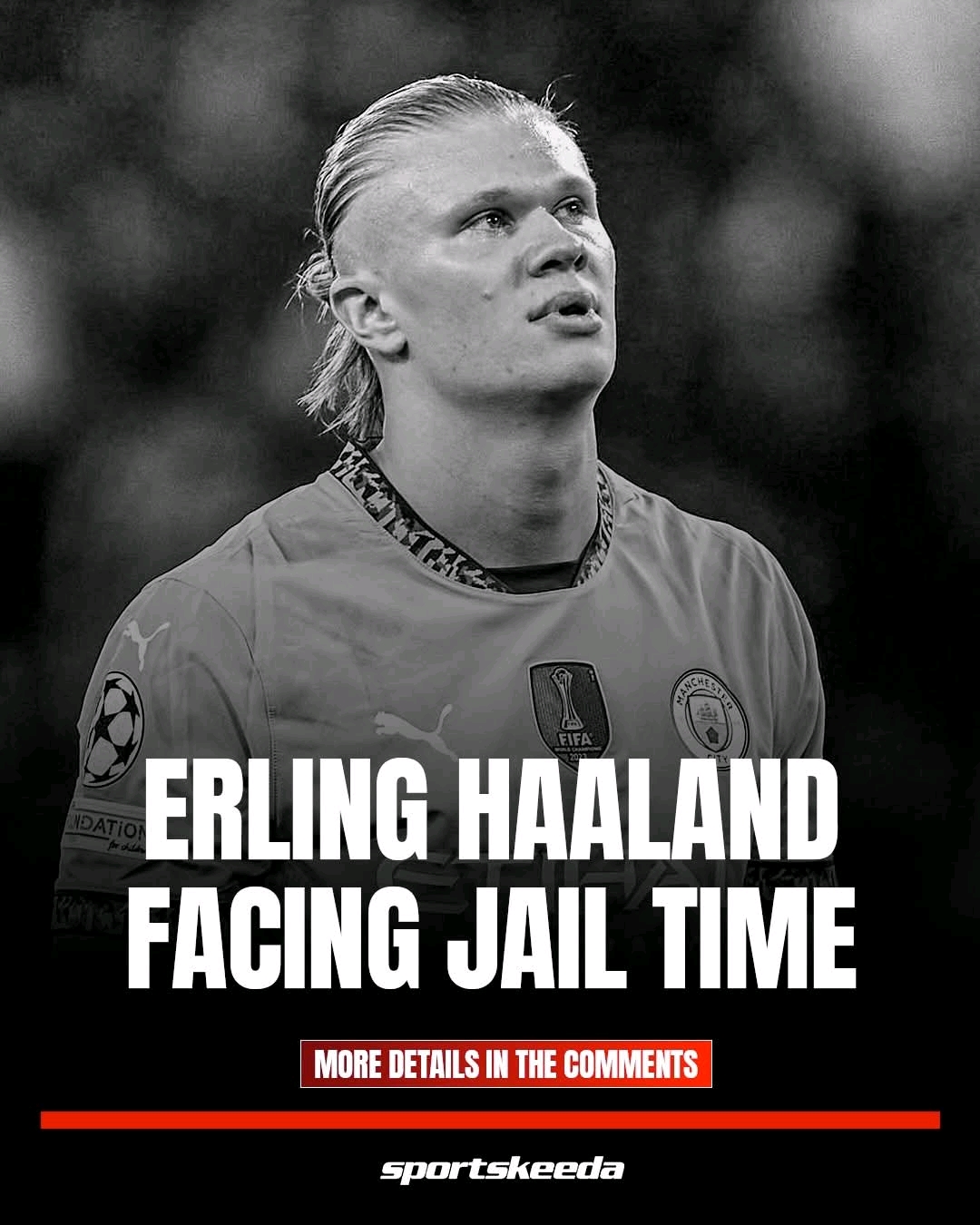
Erling Haaland is a name that currently needs no introduction in the world of football. At just 24 years old — still in the early peak years for most strikers — he has risen to the highest echelons of the sport with astonishing ease. He is already one of the most feared goal-scorers in the world, having shattered records wherever he has played. Since joining Manchester City, Haaland has become a defining figure of modern attacking football, blending power, athleticism, precision finishing and a cold, clinical instinct in front of goal that few, if any, players in history have matched.
Yet even the biggest stars in the world aren’t exempt from life’s strange twists — and in Haaland’s case, one of these twists has now taken him far from the usual headlines about goals and trophies and placed him into something almost absurd: the possibility of a day in jail in Switzerland over an unpaid €65 fine
For most professional footballers, being talked about in the media involves match-winning goals, transfer rumours, contract renewals or even off-field endorsements. But global headlines recently took an odd detour when Swiss reporting outlets suggested that Haaland faces potential imprisonment if he sets foot again in Switzerland — all because of a small unpaid fine of just **60 Swiss francs
The story began nearly a year ago when Haaland’s name appeared on the official notification list in the Swiss canton of Vaud, according to reporting from the Swiss newspaper Blick. The list contained names of individuals who had failed to pay fines related to various minor offences. In Haaland’s case, Swiss authorities noted that he had not paid a fine roughly equivalent to the cost of a moderate meal out, and because of this omission, the legal system there stated that the fine could escalate to a brief custodial sentence — essentially a day in jail— if he returns to
Yes — you read that right. One of world football’s most eminent athletes, the biggest household name in one of Europe’s most beloved sports, could — in theory — be punished with a brief incarceration for failing to pay a fine that most people would overlook in a heartbeat. The surreal nature of the situation has captivated sports fans and casual observers alike, spawning everything from disbelief and humour to genuine concern among those who support him.
According to the available reports, the exact reason for the original fine has not been fully disclosed to the public. What is clear is this: in 2023, Haaland was in Switzerland — presumably travelling either for football reasons or personal business — and received a **traffic or minor municipal fine** issued by authorities in the canton of Vaud. This fine, set at 60 Swiss francs (approximately €65), would be considered a small administrative penalty in many countries. ([Star][3])
Related Posts:






However, Swiss law operates under a system where fines are sometimes enforced with far greater severity if left unpaid. In some jurisdictions, these fines — even when minor — can be converted into a brief custodial sentence if an individual fails to settle them within a certain timeframe. In ordinary cases, this conversion is seen as a procedural step to ensure compliance. But in Haaland’s situation, the disparity between his world-class income and the tiny amount of the fine makes the potential punishment seem almost comical — or at the very least, strange.
Swiss media reported that since the fine was not paid following its issuance, the next time Haaland enters Switzerland, he could be required to serve up to one day in prison That is not a lengthy sentence by most standards — but the symbolic weight of such an event for an international superstar is huge. Imagine the world’s footballing news networks waking up to a headline that a Premier League icon was detained in a Swiss jail cell for a fine worth less than a designer pair of football boots.
And yet, that is exactly the scenario outlined by local reporting.
To understand the situation more fully, one has to look at the way Swiss administrative law** functions. In Switzerland, traffic offences and similar misdemeanours often result in fines rather than court appearances in the first instance. These fines are generally modest amounts — designed to act as penalties rather than punitive measures. However, if an individual fails to pay a fine, especially after repeated reminders or legal notices, Swiss authorities may proceed with other enforcement measures.
In many countries, minor fines are rarely enforced to the extreme of detention: people often pay them late, or they escalate to additional fees or civil enforcement before any form of custodial action. But Switzerland’s legal framework allows for **a conversion where fines can be substituted with a short period of imprisonment** if they remain unsettled. This might be intended to cover situations where individuals deliberately ignore penalties, but when applied to someone like Haaland — who has no financial barrier to settling the charge — it looks almost like a bureaucratic joke.
The official notice sheet from Vaud, which listed Haaland’s name alongside others, did not specify what the original fine was for, only that it remained unpaid. The lack of public detail on the actual offence has led to heavy speculation and humour online, with fans and pundits alike wondering whether someone had to explain the situation through translators or whether Swiss officials even grasped whose name was on the list. After all, Haaland earns tens of millions of euros per year — hardly someone who cannot afford to clear a 60-euro fine.
Once the story broke, reactions ranged from disbelief to pure amusement. On social media platforms, fans shared memes that juxtaposed Haaland’s world-class status with the petty offence that could see him briefly incarcerated. The contrast struck many as absurd — a reminder that even the highest paid athletes are sometimes subject to the same legal mechanisms that ordinary citizens face.
In football forums and comment sections, supporters discussed possible scenarios, including whether Haaland might simply pay the fine before ever stepping foot in Switzerland again. After all, if the penalty is genuinely unpaid because of oversight or miscommunication, it could theoretically be paid at any time to settle the matter once and for all.
Indeed, most legal experts and commentators believe that it is highly unlikely Haaland will ever spend a day in a Swiss prison. The cost of dealing with his legal team and resolving the fine would likely be settled quickly if the matter progressed. Moreover, given Haaland’s status, Swiss authorities may also have pragmatic ways to settle the issue without forcing a public spectacle. Yet, the mere possibility — however remote — has made headlines because it is so unusual.
It is difficult to find many precedents where a globally recognized athlete — someone whose image alone can generate millions in commercial endorsements — faces jail time for a regulatory fine that is nearly trivial in both financial and legal weight. This juxtaposition is what has made the story so compelling, drawing attention not only from sports pages but also from general news outlets around the world.
While the legal issue in Switzerland has captured attention, it is essential to remember Erling Haaland’s standing in the football world at large. Since his breakout years in the German Bundesliga with Borussia Dortmund, Haaland has grown into one of the most prolific goal-scorers the sport has seen in recent memory. His move to Manchester City in the English Premier League was greeted with immense excitement and expectations — expectations that he has more than met. His training ethic, physical presence, ability to time runs, relentless finishing and sheer determination have made him a nightmare for defenders across England and Europe.
At Manchester City, under the stewardship of legendary coach Pep Guardiola, Haaland’s numbers have continued to rise. He has broken Premier League scoring records, led City to domestic and European success and become one of the defining stars of his generation. He earns a massive salary, and his contract places him among the highest-paid players in the league. His exploits on the pitch have solidified his reputation as one of the top forwards in world football — admired and feared in equal measure.
Within this context, the Swiss fine seems almost ridiculous: a tiny blip in an otherwise remarkably successful professional journey.
So what can actually happen if Haaland returns to Switzerland? Here are the main possibilities as laid out by Swiss reporting:
1. He pays the outstanding fine before travelling there again: This is the simplest and most straightforward solution. If Haaland or his representatives settle the 60 Swiss franc fine, even today, there would likely be no further issue when he enters Switzerland. The legal system would close the file, and no additional penalties would apply.
2. The fine remains unpaid but is resolved quietly: It is possible that Swiss authorities could communicate with Haaland’s representatives to resolve the matter behind the scenes, particularly because of his high-profile status. This could involve official notice and payment arrangements without any appearance on a public notice list.
3. He enters Switzerland with the matter unresolved: Only in this scenario — and only if Swiss officials strictly enforce their legal framework — could there be an order for him to serve a very short custodial sentence. Most analysts believe this is highly unlikely, precisely because the effort required would far outweigh any practical benefit to the Swiss legal system, and because Haaland’s legal team is expected to handle the case before it reaches that stage.
In any case, legal experts say the matter is almost certainly procedural rather than punitive in nature — and given the small amount involved, a real prison sentence is unlikely to happen in practice.
The Haaland situation raises interesting questions about how rigidly legal systems operate across jurisdictions:
Could this happen to anyone? In theory, yes. People who fail to pay fines in foreign countries sometimes face worse penalties if they re-enter those countries. But for the average person, this rarely results in jail time — especially for such small fines.
Why does Switzerland do it? Swiss legal practice — including in the canton of Vaud — is simply more strict about converting unpaid fines into custodial sentences if they remain unsettled. It’s meant to ensure compliance, but it hasn’t evolved with the modern realities of global travel and famous individuals.
Why did his name appear publicly? Official notice lists are sometimes published as part of transparency in legal enforcement. But when a superstar’s name appears, it becomes a worldwide talking point — something Swiss authorities can hardly ignore in hindsight.
The sheer oddity of the situation — a superstar facing jail for a tiny unpaid fine — captures the imagination because it breaks the mold of what we expect from celebrity news
This isn’t the first time footballers have found themselves in legal trouble abroad. World football history is filled with incidents where players have faced fines, arrest warrants, travel bans and other legal issues in foreign countries — often for traffic violations, public disturbances or other misdemeanours. But very few of those cases involve someone of Haaland’s calibre or have attracted this level of global attention. In the modern era of social media, where every statement, tweet and headline travels within seconds, anything involving a major sporting figure becomes amplified.
Yet even in the face of these circumstances, Haaland’s situation remains fundamentally small in scale. There is no indication of widespread corruption, criminal behaviour or anything of that magnitude. At its core, this is simply about a bureaucratic process and something as ordinary as paying a minor fine — albeit combined with the punch of Haaland’s fame to make it seem outsized
At the time of writing, Haaland himself has not publicly spoken in depth about the issue. The reports that exist come from Swiss media outlets and secondary sources rather than official statements from the player or Manchester City. However, considering Haaland’s general approach to handling controversy — which has typically been to focus on football and let his performance on the pitch speak for him — it would not be surprising if he chose not to make a prolonged public commentary on what many people are treating as a strange non-story.
In the past, when facing other off-field challenges — such as media speculation about transfers or contract issues — Haaland has often stuck to focusing on his profession. His attitude has generally been one of bold confidence: let results and performances define him, not distractions. As such, it is likely that his camp will handle this quietly, pay the fine if required, and move on without allowing it to escalate into something bigger than it needs to be.
The Haaland tale also highlights a broader point about how systems built for ordinary citizens intersect with global celebrity. When a regular person gets a traffic ticket in a foreign country, they might pay it and forget about it — or not think much about it at all. But when a globally famous figure is involved, especially one with enormous income, wealth and public persona, the situation suddenly becomes newsworthy, even if the underlying matters are trivial.
This reflects a curious blend of celebrity culture and civic accountability. On one hand, stars like Haaland are held to the same legal standards as everyone else, which is fair in principle. On the other hand, the real-world implications of those standards — especially when applied literally — can produce scenarios that seem almost surreal.
For most ordinary citizens, jail time for a 65-euro fine would be unheard of. Yet in Switzerland’s legal framework, the statute exists and can, technically, be enforced. The lesson here — whether amusing or sobering — is that the law sometimes operates in ways that defy our expectations, regardless of who is involved.
Erling Haaland’s brush with Swiss legal enforcement over a tiny unpaid fine is one of the most bizarre footnotes in recent footballing news. It underscores how even the world’s elite athletes can find themselves on the wrong side of regulations if they aren’t careful — and how systems built for everyday life can affect even the most unusual lifestyles.
At its essence, this story is not about criminal behaviour or a dramatic fall from grace. It is about a minor administrative oversight that snowballed into a global headline purely because of the fame attached to the individual involved. Whether it results in anything more than a paid fine and a good laugh, only time will tell. But for now, the idea that one of the greatest goal-scorers of his generation might have to settle a €65 bill to avoid jail makes for one of the most unexpected legal stories of the year.
And that — in a world where footballers are often defined by their goals, trophies and contracts — is a reminder that sometimes, reality can be stranger than fiction.