José Mourinho has never been one to stay silent when football, fairness, or his own principles are at stake. Over the past few weeks, the Portuguese manager has found himself at the center of a fresh storm in European football, sparked not by his team’s performance or a controversial transfer, but by comments about one of the most successful clubs in modern English football – Manchester City. The situation, which began with Pep Guardiola’s tongue-in-cheek remarks and escalated into a media frenzy, has reignited an old rivalry between two of the game’s most famous tacticians. For Mourinho, the story is not about jealousy, competition, or petty rivalry; it is about justice, and his fight for fairness in a football world increasingly dominated by financial power.
The latest controversy traces back to Manchester City’s ongoing legal battle with the Premier League over a staggering 115 charges, allegations that the club broke financial rules and mismanaged its spending in ways that could have serious consequences. It is an issue that has attracted global attention because it touches the very heart of football’s integrity. The Premier League, like other leagues across Europe, has established financial fair play rules to prevent clubs from spending beyond their means, to ensure a level playing field, and to protect smaller teams who cannot compete with the financial giants of the sport. And yet, the question remains: are these rules enforced equally? This is precisely where Mourinho’s comments struck a nerve.
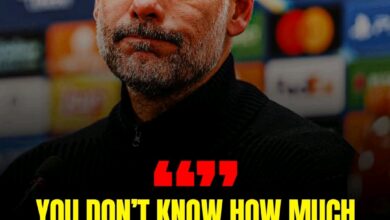
Speaking ahead of Fenerbahce’s Europa League clash against Athletic Bilbao, Mourinho addressed the media with his characteristic directness. He was asked about Guardiola’s recent claim that he wants to see Manchester City relegated to League One. Mourinho, known for his colorful but often cutting words, took a different approach. “It’s not true that I want Man City to be relegated,” Mourinho said calmly, yet with conviction. “It’s true that I like justice, and many times small clubs are punished by going €5, €10 over budget and the rules for Financial Fair Play. For example, I suffered in Roma three years with great limitations about it. I don’t think it’s fair that the big sharks – when I say sharks, I say financial sharks – they always find a way to escape the rules. I’m just a football man, a man that loves football, more than being a professional football man I am very passionate, I just like justice in football. But apart from that, no bad feelings.”
Mourinho’s words are layered with history, both personal and professional. For those who followed football over the past fifteen years, the rivalry between Mourinho and Guardiola is legendary. Their clashes date back to Mourinho’s time at Real Madrid and Guardiola’s reign at Barcelona. Those matches were more than just contests of skill; they were battles of philosophy, strategy, and personality. Mourinho’s Real Madrid sought to break the dominance of Guardiola’s Barcelona, a team that dazzled the world with its tiki-taka style and collection of trophies. The tension between them spilled over into the media, into press conferences, and into fan culture, creating one of the most fascinating managerial rivalries of the modern era. So when Guardiola raised six fingers during a response to Liverpool fans’ taunts about Manchester City’s titles at the Etihad, it was not just a playful gesture. It was a subtle reminder of his success, a quiet prod aimed at Mourinho’s history of outspoken commentary.
Yet Mourinho’s response, rather than escalating the drama, was grounded in principle. By saying he wants “justice,” he was framing the conversation in terms of ethics and fairness, not revenge. In the past, Mourinho has not been shy about calling out perceived injustices. At Roma, he experienced firsthand the limitations imposed by financial rules, observing how smaller clubs were constrained by strict budgetary limits while larger clubs seemed to maneuver around similar regulations. His point is simple but profound: football should be fair. Talent, hard work, and strategy should determine outcomes on the pitch, not the ability of a club to bend or bypass rules because of its financial muscle.
Guardiola’s own perspective, however, shows a different side of the story. The City manager, who has led his team to multiple Premier League titles and redefined the tactical landscape in England, addressed the issue with a mix of humor and nonchalance. During his pre-match press conferences, Guardiola described Mourinho’s comments as “a joke” and implied that the media often overstates these exchanges. Yet beneath the humor lies a tension that cannot be ignored. City’s 115 charges are serious; they carry potential penalties that could include fines, points deductions, or even relegation in the most extreme scenario. For a club of Manchester City’s stature, the financial and reputational stakes are immense, and Guardiola’s public statements reveal a man trying to balance confidence with caution.
Mourinho’s remarks, while centered on fairness, also carry an implicit critique of the modern football landscape. In an era where mega-rich owners can inject billions into clubs, financial prowess often overshadows sporting merit. Smaller teams struggle to compete, not because of talent or tactical skill, but because the rules are applied unevenly. Mourinho’s career, which has spanned Portugal, England, Italy, Spain, and Turkey, has given him a unique vantage point. He has managed clubs of varying sizes, budgets, and ambitions, and he understands the challenges of competing on a level playing field. When he talks about “sharks” and financial giants, he is warning about the dangerous trend where wealth can distort competition, allowing some clubs to dominate not just on talent, but on their ability to manipulate or sidestep regulations.
The tension between Mourinho and Guardiola is thus more than personal; it is emblematic of a broader debate in football. Should clubs be allowed to spend without limits if they can find legal loopholes? Should financial fair play rules be strictly enforced across all teams, regardless of size or influence? Mourinho’s insistence on justice positions him as a defender of the principle that football should reward effort, skill, and fairness rather than wealth. It is a stance that resonates with fans who feel disenfranchised by the growing financial divide in modern football.
Yet despite the heat generated by these comments, Mourinho has been careful to downplay any suggestion of personal animosity. “In relation to Pep, let me say something – we were together for three years [at Barcelona],” he explained. “I was an assistant and he was a player. I like him a lot and he knows that. He likes me and I know that, there are no problems between us. One thing are words and another thing is deep feelings.” This acknowledgment of mutual respect highlights Mourinho’s ability to separate professional debate from personal feelings. It is a reminder that even in the world of high-stakes football, where media narratives often amplify conflict, seasoned professionals like Mourinho and Guardiola can maintain a level of decorum and mutual regard.
Meanwhile, Guardiola has offered insights into his own long-term plans, shedding light on his commitment to Manchester City. Having recently signed a contract extension until 2027, Guardiola confirmed that he does not intend to manage another club side after leaving City. “I won’t coach another team,” he told Dani Garcia on the Desmontadito YouTube show. “I’m not talking about the long-term future, but what I won’t do is leave Manchester City to go to another country and do the same thing I’m doing now. I won’t have the energy. Maybe with a national team, but that’s different, it’s not every day, every three days. But right now, no. I’m right here.” His statement underscores the level of dedication required to lead a top club in modern football, and it highlights the personal sacrifices managers make when they commit to such high-pressure roles.
As the debate rages on, the football world watches closely. Fans, pundits, and journalists dissect every comment, gesture, and interview, often framing it as another chapter in the Mourinho-Guardiola saga. But behind the headlines and the soundbites lies a more fundamental issue: the role of fairness and integrity in the sport. Mourinho’s stance is clear – he is not against Manchester City as a club, nor is he motivated by personal vendetta. His comments are a call to uphold the principles that make football not just a game, but a fair competition where talent and strategy determine success, not merely financial power or influence.
Moreover, Mourinho’s remarks are a reminder that football, despite its global commercialization and celebrity culture, is still a passion-driven sport. His love for the game, evident in every press conference and tactical decision, is rooted in the desire to see the sport thrive in a just and equitable environment. For him, justice in football is not an abstract concept; it is a guiding principle that shapes his approach to management, his treatment of players, and his engagement with the broader football community.
In practical terms, the ongoing investigation into Manchester City will have consequences that extend beyond the club itself. The Premier League’s handling of the 115 charges will set precedents for financial governance in football. Clubs across Europe will be watching closely, assessing how rules are enforced and whether fairness truly prevails. In this context, Mourinho’s voice is significant. As someone who has managed at the highest levels in multiple countries, his insights carry weight, and his advocacy for fairness adds pressure on football authorities to ensure that financial regulations are applied consistently and transparently.
Ultimately, the Mourinho-Guardiola narrative illustrates the complex interplay between personal rivalry, professional respect, and systemic issues in modern football. It is a story that transcends a single club or league, touching on themes that are relevant to fans, players, and administrators alike. Mourinho’s insistence on justice, Guardiola’s confident yet cautious responses, and the Premier League’s ongoing investigations together form a multi-layered drama that captures the imagination of anyone who follows the sport.
For fans, these developments are more than just news items; they are a reminder of the stakes involved in football today. Success on the pitch is intertwined with financial management, ethical compliance, and strategic planning. Managers like Mourinho and Guardiola are not just tacticians; they are guardians of values, advocates for fairness, and representatives of the sport’s highest ideals. Their interactions, even when heated, reflect the passion, commitment, and complexity that make football the world’s most beloved game.
As Fenerbahce prepared to face Athletic Bilbao, Mourinho’s words echoed beyond the Europa League stadium. They served as a statement of principle, a call for justice, and a reaffirmation of his commitment to fairness in football. He was not seeking headlines, personal attacks, or sensationalist drama. He was articulating a vision of football where rules apply equally to all, where clubs compete on merit, and where passion and integrity define the game. In this sense, Mourinho’s comments are not just about Manchester City; they are about the future of football itself.
In conclusion, the story of José Mourinho and the 115 Manchester City charges is more than a managerial spat; it is a reflection of the tensions, challenges, and ideals that define modern football. Mourinho’s focus on justice reminds us that the sport is more than money, more than trophies, and more than prestige. It is a competition that thrives when fairness is maintained, when rules are applied consistently, and when managers, players, and fans hold the game to its highest standards. Whether Manchester City faces penalties, whether Guardiola continues to dominate in England, and whether the Premier League enforces its regulations rigorously, one thing remains clear: Mourinho’s voice will continue to champion fairness, integrity, and the love of football above all else