After a rough night against Real Madrid, striker Erling Haaland faced heavy criticism – but Manchester City legend Carlos Tevez spoke up

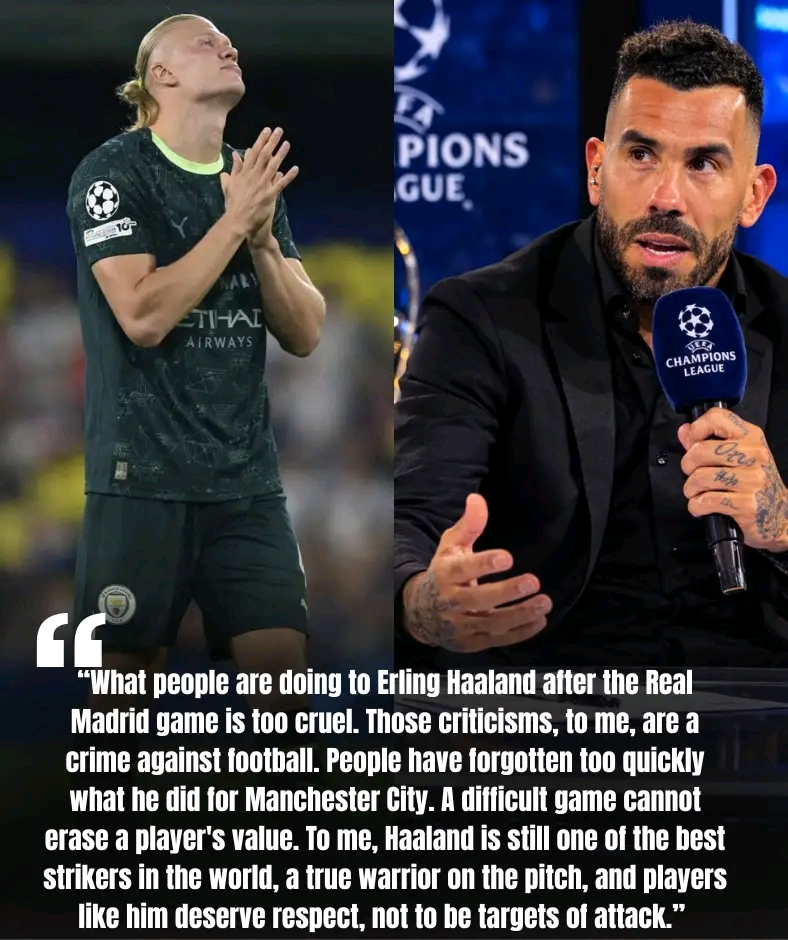
After one of the most intense UEFA Champions League nights in recent memory, the football world was buzzing—not just because of the result, but because of one name: Erling Haaland. Manchester City’s towering striker had faced Real Madrid at the Santiago Bernabéu, and the headlines the next day were filled with criticism. Analysts dissected every touch, every missed opportunity, and every failed attempt to break through Madrid’s defensive lines. Social media was relentless, fans debated, and even casual observers had something to say. The pressure on Haaland was immense.
But amid all the noise, an unexpected voice rose in his defense. A voice that carried weight, experience, and understanding. That voice belonged to Manchester City legend, Carlos Tevez.
Tevez, who himself had once felt the crushing weight of expectation at City, did not hesitate to defend the striker who was now in the hot seat. His words were measured but firm. “The criticism directed at Haaland is too harsh,” Tevez said. “People are forgetting that he is still one of the best strikers in the world. A difficult game against Real Madrid cannot define his value.”
These were not just empty words. Tevez spoke from experience. He knew what it was like to be a hero one day and a scapegoat the next. At City, the highs are euphoric, but the lows are unforgiving. When you score, you are celebrated; when you do not, the spotlight turns into a harsh glare, and all eyes are on you.
“I used to play for Manchester City, and I understand how much pressure there is at that club,” Tevez continued. “When you score, you are a hero. But when the team loses, all eyes immediately turn to the striker. Haaland is not the problem. He is a goal-scoring machine, a warrior on the pitch. And players like that deserve respect, not to be the target of criticism.”
These words resonated deeply with many fans. Suddenly, people started to reconsider their views. Perhaps the striker who had faltered on a single night was not a failure, but rather a human being under extraordinary pressure. Football, after all, is as much about emotion as it is about skill. And in those moments when the world is quick to judge, perspective can be the difference between tearing a player down and lifting them up.
The reality is that Erling Haaland is not just a player; he is a phenomenon. From the early days of his career, he has been a goal-scoring machine, breaking records and turning heads wherever he plays. But even the greatest stars face nights when the ball refuses to cooperate, when defenders seem insurmountable, and when every pass, shot, or movement is scrutinized under the magnifying glass of global attention.
On that night against Real Madrid, Haaland experienced one of those rare, difficult evenings. The Spanish giants defended with discipline, tactical awareness, and the kind of intensity that leaves even the best strikers searching for solutions. Haaland tried, he fought, he moved tirelessly, but the goals did not come. And immediately, criticism followed. Pundits questioned his form, fans debated his value, and headlines questioned whether he could perform on the biggest stages.
But this is where Tevez’s perspective became crucial. He reminded everyone that greatness is not measured by single games but by consistency, resilience, and the ability to rise after adversity. Tevez himself had been in those situations, and he understood how damaging harsh criticism could be. His message was clear: big stars are human too, and they deserve understanding, respect, and protection.
Tevez’s defense of Haaland went beyond mere words. He painted a picture of what it truly means to be a striker at Manchester City. “The pressure is enormous,” Tevez explained. “Every touch you make is analyzed. Every missed chance is magnified. But that is part of what makes football so beautiful. It’s not just the goals; it’s the courage to step onto the pitch night after night, knowing the world is watching, knowing mistakes will be remembered, but still choosing to give everything for the team.”
For many fans, this was a wake-up call. It was a reminder that the game they love so much can sometimes blind them to the humanity of the players. Haaland may have had a tough night, but he had spent the previous months scoring, creating chances, and lifting Manchester City in countless matches. One difficult evening should not erase the brilliance of what he has accomplished.
And then there’s the psychological aspect. Football is not just physical; it is mental. Haaland, like all top players, operates under intense mental pressure. The Champions League stage is unlike any other. The expectations are sky-high, the scrutiny is relentless, and one misstep can dominate headlines for days. A voice like Tevez’s, coming from someone who knows exactly what that pressure feels like, offers more than comfort—it offers validation, perspective, and encouragement.
Tevez’s words reminded fans that football is not black and white. Stars are not defined by flawless performances. They are defined by their ability to endure criticism, to learn from difficult nights, and to come back stronger. Every missed opportunity, every lost ball, and every failed attack is part of the journey. For Haaland, the journey is far from over; in fact, nights like the one against Real Madrid are the ones that shape legends.
Fans began to reflect. They realized that their quick judgment after the match was perhaps unfair. They remembered the goals he had scored, the matches he had won, and the records he had broken. They thought of the energy, determination, and sacrifice it takes to play at this level. And slowly, the narrative began to shift. Instead of questioning Haaland’s ability, people started discussing how he would respond, how he would learn, and how he would return to dominate the pitch again.
This is where the story takes a deeper turn. Because what happened next was nothing short of remarkable. After the match, Haaland did not retreat. He did not sulk. Instead, he returned to training with renewed focus, determination, and hunger. His work ethic, his dedication, and his mental toughness became apparent to teammates and coaches alike. In those hours after the defeat, while criticism still echoed in the media, Haaland’s response spoke louder than words.
It was a reminder of why Tevez had defended him. The striker’s resilience was evident. He took the lessons from the defeat, analyzed his performance, and prepared himself for the next challenge. This is what separates good players from great ones. The ability to face adversity, to accept criticism without letting it break you, and to channel every setback into motivation.
Carlos Tevez, watching from the sidelines—both literally and figuratively—could not help but be moved. The striker he had defended was proving that the faith placed in him was not misplaced. Haaland’s next moves, his next matches, would demonstrate that true stars are not defined by a single game, but by their response to challenges.
And the fans, too, began to understand this. They saw Haaland’s commitment, his focus, and his drive. They remembered that football is not just about perfection but about passion, effort, and resilience. In a world where instant judgment is the norm, Tevez’s words reminded everyone to slow down, to consider context, and to respect the human element of the game.
The narrative surrounding Haaland shifted. Headlines no longer focused solely on missed opportunities but on his determination to bounce back. Analysts began discussing his potential impact in the rest of the Champions League, highlighting the skills and attributes that make him one of the most feared strikers in the world. Social media posts started emphasizing his achievements, his goals, and his relentless work ethic.
It is in moments like these that football transcends sport. It becomes a lesson in resilience, perspective, and empathy. Tevez’s defense of Haaland was more than a statement—it was a reminder of the principles that define greatness. Respect, understanding, and the recognition that even the best players are human.
For Manchester City, the message was clear. Their striker, Erling Haaland, was not just a player—they were witnessing a warrior, a professional who would continue to give everything for the club. Tevez’s words helped restore belief, not only among fans but within the squad. Confidence is contagious in football, and when a legend like Tevez speaks, it resonates deeply.
The story also illustrates an important truth about criticism in football. The game is emotional, opinions are strong, and judgments are often rushed. One bad night should never define a player’s career. History is full of examples where players faced temporary setbacks only to come back stronger, more determined, and more brilliant than before. Haaland, with Tevez’s backing and his own mental fortitude, was clearly on a path to do the same.
And then, there was the human side. Tevez, who had once experienced the highs and lows of City’s merciless environment, saw something in Haaland that reminded him of his younger self. He saw courage, resilience, and dedication. In defending Haaland, Tevez was not creating drama or sparking debate—he was protecting a fellow professional, reminding everyone that even football’s biggest stars deserve understanding and compassion.
Fans began to embrace this perspective. They began to celebrate Haaland’s achievements, to empathize with the challenges he faces, and to anticipate his next performances with excitement rather than judgment. The narrative transformed from one of criticism to one of admiration, hope, and anticipation.
And then, in a gesture that would touch the hearts of many, Haaland himself responded in a way that spoke volumes. His determination on the training ground, his focus during tactical sessions, and his interactions with teammates showed that he was taking Tevez’s advice to heart. The striker’s humility, discipline, and drive were evident. It was a reminder that legends are built not just from talent, but from character, resilience, and the ability to rise after setbacks.
Tevez’s defense of Haaland, combined with the striker’s response, became a story that transcended football. It was about humanity, respect, and the understanding that greatness is not about perfection but about effort, courage, and the will to overcome adversity.
In the end, this episode highlighted why Manchester City remains one of the world’s elite clubs. It is not just the talent on the pitch, but the culture, the leadership, and the values that guide the players. A legend like Carlos Tevez defending a current star like Haaland illustrates the continuity of excellence, the importance of mentorship, and the recognition that every player, no matter how great, deserves support.
Fans, pundits, and fellow professionals began to see Haaland in a new light. They remembered that the striker who had once torn apart defenses across Europe was still the same player who could change games, score incredible goals, and inspire those around him. The difficult night against Real Madrid was just one chapter in a much larger story—a story that promised triumphs, records, and unforgettable moments.
And as for Tevez, his words had done exactly what he intended. They had reminded everyone that football is human, that criticism should be balanced with empathy, and that stars like Haaland are not just athletes—they are people, warriors, and inspirations.
💙 The tale of that night, Haaland’s struggle, Tevez’s defense, and the striker’s remarkable response is now part of Manchester City folklore. It is a story that will be told and retold, a reminder that even in the face of criticism, perseverance, respect, and human understanding prevail.
Erling Haaland may have had a challenging night at the Bernabéu, but with legends like Tevez defending him and fans beginning to see the bigger picture, one thing is certain: the striker’s journey is far from over. And when he bounces back, as all great players do, the world will witness not just his talent, but his character, resilience, and the indomitable spirit that defines a true footballing star.
Because in football, as in life, great stars are human too—and they deserve protection, respect, and admiration. And sometimes, a single voice—like that of Carlos Tevez—can remind the world of exactly that.