Liverpool’s 2-1 win over Tottenham should have been remembered mainly for the result, the fight, and another small step forward under Arne Slot. Instead, the evening ended with a cloud of worry hanging over the club after Alexander Isak was forced off injured, only minutes after making a decisive impact. The Swedish striker scored a crucial goal, showed his quality in one sharp moment, and then disappeared down the tunnel, leaving his manager uneasy and his teammates concerned.
The match itself was tense and awkward from the start. Both Liverpool and Tottenham looked cautious, almost nervous, in the opening stages. There was little rhythm, little flow, and very few risks taken. It felt like one of those games where both sides were more focused on not losing than on winning. Tottenham tried to control space, Liverpool tried to stay organised, and the ball moved slowly between players as the atmosphere inside the stadium remained tight and edgy.
Everything changed with one reckless challenge. Xavi Simons, in a moment of complete loss of control, flew into Virgil van Dijk and caught him high on the back of the leg. It was dangerous, unnecessary, and immediately alarming. The referee initially played on, but VAR quickly stepped in. John Brooks was sent to the screen, and after reviewing the incident, he showed a straight red card. Tottenham were reduced to ten men, and the entire game shifted in Liverpool’s favour.
From that moment, Liverpool had a clear advantage. An extra man, more space, and more time on the ball. This should have been the signal for them to take control, move the ball quicker, and break Tottenham down. But football is rarely that simple. Instead of stepping up immediately, Liverpool continued to play at the same slow tempo. Tottenham, even with ten men, stayed compact and disciplined. They sat deep, closed spaces, and dared Liverpool to find a way through.
The first half drifted by without a goal. Liverpool had possession, but possession without purpose. Tottenham were relieved to go into the break level, while Arne Slot knew his team needed more urgency and sharper attacking movement. At half-time, he made a big decision. Conor Bradley was taken off, and Alexander Isak was sent on. It was a clear attacking change, a sign that Slot wanted to use the extra man properly.
Isak’s introduction immediately changed the feel of the game. He offered movement, speed, and a direct threat that Liverpool had been missing. Tottenham’s defenders suddenly had something to worry about. The spaces that were previously easy to defend now became dangerous. Liverpool pushed higher, played with more confidence, and began to test Tottenham’s resistance.
Related Posts:





The breakthrough came in the 56th minute. Florian Wirtz picked up the ball and played a perfectly weighted pass into Isak’s path. The timing was perfect, the movement intelligent. Isak did the rest with calm precision, finishing past Guglielmo Vicario to give Liverpool the lead. It was a quality goal, the kind that showed exactly why Liverpool invested in him. In one moment, he justified his presence on the pitch.
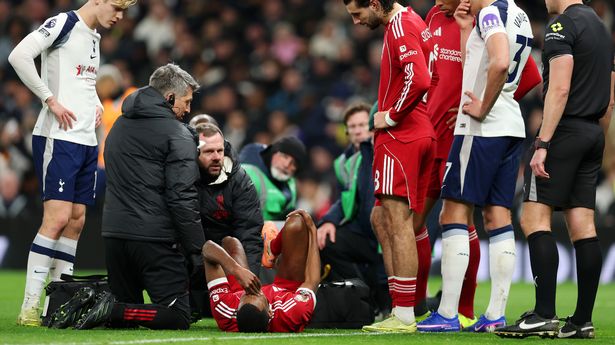
But that same moment brought disaster. As Isak struck the ball, Micky van de Ven launched into a desperate sliding tackle. The challenge was heavy and late. Isak went down immediately, clutching himself in pain. The stadium fell quiet as medical staff rushed onto the pitch. The goal stood, but the celebration was muted. Everyone could see that this was serious.
Isak received treatment on the field, but it quickly became clear he was in trouble. Unlike some injuries where players try to shake it off, this one looked different. After a brief assessment, he was replaced by Jeremie Frimpong. Isak walked off slowly, his body language worrying, his face showing frustration and concern. He had come on, scored, and left injured within minutes.
Liverpool continued to push and soon doubled their lead through Hugo Ekitike, who rose highest to head home Jeremie Frimpong’s cross. At 2-0, Liverpool looked comfortable. Tottenham were tiring, struggling with nine men after Cristian Romero later lost his discipline and was sent off for a second yellow card. The match seemed decided.
Richarlison’s late goal made the final minutes slightly nervous, but Liverpool held on. The final whistle brought relief and satisfaction. Another away win. Another step forward. But as players shook hands and fans celebrated, Arne Slot’s thoughts were elsewhere. His focus was on Alexander Isak.
After the match, Slot spoke honestly, and his words revealed real concern. He admitted he had a bad “gut feeling” about Isak’s injury. He made it clear that there was no medical update yet, but his instincts as a manager worried him. He explained that when a player scores and then gets injured and does not even attempt to return to the pitch, it is usually not a good sign.
Slot compared the situation to Conor Bradley, who also picked up a knock but tried to continue before being taken off. Isak, by contrast, did not try to return. That difference mattered to Slot. It told him that the pain was serious enough for the player to know something was wrong. Still, Slot was careful not to jump to conclusions. He stressed that his feeling was not based on medical information, only instinct.
He also revealed that he had not yet spoken to Isak about how the player felt. Everything was still too fresh. Medical checks would follow. Scans would be done. Only then would Liverpool know the true extent of the problem. Until that moment, all they had was uncertainty.
Slot did try to find positives. He praised Isak for scoring a good goal and highlighted Florian Wirtz’s assist. He repeated his belief that the players are improving and that the team is developing in the way he wants to see. He admitted the performance was not perfect, especially in the final ten minutes, but emphasised that picking up points while growing is important.
Even so, the concern around Isak overshadowed much of that optimism. Liverpool have already dealt with injuries this season, and losing a key attacking option would be a serious blow. Isak was signed to add quality, movement, and goals. His ability to change games, as he showed against Tottenham, is exactly what Liverpool need in tight matches.
The timing also makes the situation worse. The fixture list is crowded. Important league games are coming quickly. Rotation becomes harder when key players are unavailable. Slot is still shaping his squad, still finding the right balance. Losing Isak now could slow that process.
For Isak himself, the frustration will be intense. He waited for his moment, came on, delivered instantly, and then was forced off. Strikers live for goals, and this should have been a confidence boost. Instead, it ended with uncertainty and fear. Injuries are cruel, especially when they arrive just as momentum is building.
Liverpool supporters will now wait anxiously for updates. Every word from the club medical team will be analysed. Social media will speculate. Rumours will spread. Until official confirmation arrives, nobody will truly relax.
This match will be remembered for many reasons. Tottenham’s red cards. Liverpool’s resilience. The importance of the three points. But above all, it will be remembered as the night Alexander Isak gave Liverpool hope with one goal and then left them worried with one injury.
Arne Slot’s “gut feeling” may turn out to be wrong. The injury could be minor. Isak could return quickly. Football has a way of surprising people. But until that good news comes, Liverpool move forward carefully, aware that success often comes with a price. For now, Liverpool celebrate the win, but they do so quietly. Because in football, joy and concern often walk side by side.