Bernardo Silva is sent off after a VAR review for handling Vinícius Júnior’s shot inside the box! Big moment for Manchester City Did the referee get it right?

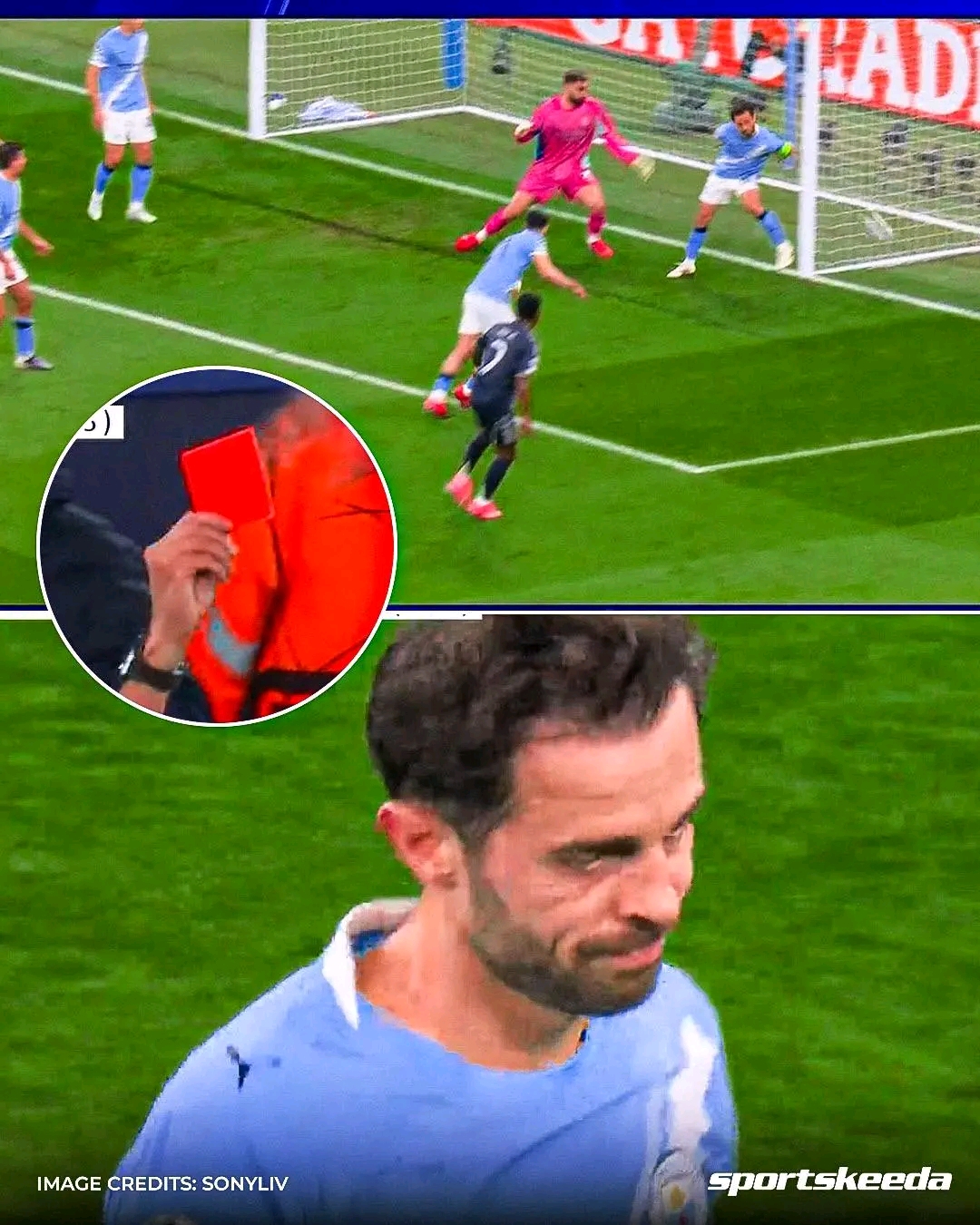
The moment it happened, everything stopped. The noise inside the stadium, the rhythm of the game, the confidence of the players, all of it froze in one shocking instant that nobody saw coming. A simple attack, a quick move, a dangerous shot, and then suddenly chaos. The ball struck inside the box, players shouted, arms went up, and within seconds the attention of the entire world shifted to one man. Bernardo Silva, the captain of Manchester City, found himself at the center of a storm that would change the entire match.
At first, it did not look like something major. In real time, it was one of those moments that happen many times in football. A shot from Vinícius Júnior, a quick reaction from a defender, the ball bouncing in a crowded penalty area. Players appealed, but appeals are common. Referees wave them away all the time. The game seemed ready to continue. But this was not just any moment. This was a Champions League clash, the kind of game where every detail matters, where every decision can decide everything.
Then came the pause. That silence that only VAR can create. The referee did not restart play immediately. Instead, he put his finger to his ear. The signal everyone now understands. Something was being checked. Something serious. And in that moment, the tension began to rise. Fans inside the stadium started reacting, some shouting in hope, others in fear. On the pitch, players gathered, some arguing, some defending, all waiting.
The replay began to circulate. The angle changed everything. From one view, it looked accidental. From another, it looked suspicious. And then from the final angle, the one that matters most, it became clear why VAR had intervened. The ball had struck the arm of Bernardo Silva inside the box. But even that was not simple. Was the arm in a natural position? Was it deliberate? Did it block a clear goal-scoring opportunity? These are the questions that make football so complicated in the modern era.
The referee walked over to the monitor. That long walk always feels longer than it is. Every step increases the tension. Every second feels like a minute. Players surrounded him, trying to influence the decision, but deep down they knew the final call was coming. Fans watched the big screen, holding their breath. And then, after what felt like forever, the referee made his decision.
Red card.
The reaction was instant and explosive. Shock. Anger. Confusion. Disbelief. Bernardo Silva could not believe it. He protested, he questioned, he tried to explain. But it did not matter. The decision was made. The captain of Manchester City was sent off in one of the biggest games of the season.
For City, it was a nightmare. Playing against Real Madrid is already one of the toughest challenges in football. Doing it with ten men is something else entirely. The balance of the game changed instantly. What was once a controlled performance suddenly became a fight for survival.
Players had to adjust quickly. Positions changed. Tactics shifted. The plan that Pep Guardiola had carefully prepared was thrown out of the window in seconds. Now it was about damage control. Now it was about staying in the game, staying alive, and hoping for a miracle.
But beyond the tactical impact, there was the emotional side. Losing your captain is not just about numbers. It is about leadership, about calmness, about experience. Bernardo Silva is not just any player. He is one of the most trusted figures in the squad, someone who understands the system, someone who fights for every ball, someone who leads by example. Seeing him walk off the pitch was a huge blow.
At the same time, for Real Madrid, it was a moment of opportunity. A turning point. They sensed weakness, and teams like Madrid do not forgive weakness. With players like Vinícius Júnior leading the attack, they began to push harder, faster, with more belief. The crowd could feel it. The momentum had shifted.
But the biggest question remained the same. Did the referee get it right?
This is where football becomes a debate, a never-ending argument that splits fans, players, and even experts. Some believe the decision was correct. They argue that the hand stopped a dangerous shot, that the arm was not in a natural position, and that by the rules, it had to be punished. In modern football, handball inside the box, especially when it denies a clear chance, is often punished harshly.
Others completely disagree. They see it as too harsh, too strict, too unforgiving. They argue that Bernardo Silva did not intentionally handle the ball, that his arm was in a natural position as he tried to react, and that a red card in such a big moment destroys the spirit of the game. For them, VAR is taking away the human side of football, turning every moment into a technical decision rather than a natural one.
And this is the reality of football today. VAR has brought accuracy, but it has also brought controversy. Every decision is analyzed, replayed, debated from every angle. There is no hiding. There is no escape. And sometimes, even with all the technology, there is still no agreement.
Back on the pitch, the game continued, but it was no longer the same. Manchester City had to dig deep. Every player had to run more, fight harder, think faster. The pressure from Real Madrid increased with every minute. The ball came into the box again and again. Defenders threw themselves into challenges. Midfielders dropped deeper. It became a test of character.
For Guardiola, it was one of those moments that define managers. How do you react when everything goes wrong? Do you panic, or do you stay calm? Do you attack, or do you defend? These decisions can shape careers. And while the cameras focused on the pitch, there was another battle happening on the touchline, a battle of minds between Guardiola and his opposite number.
The fans, meanwhile, were living every second. For City supporters, it was painful, frustrating, almost unbearable. For Madrid fans, it was exciting, a chance to take control, a moment to push their team forward. Football is always emotional, but moments like this take it to another level.
As the match went on, the red card continued to dominate the story. Every pass, every tackle, every chance was influenced by that decision. It was no longer just a game. It was a narrative. A story that would be talked about long after the final whistle.
And when the game finally ended, the debate did not stop. It only grew louder. Pundits discussed it. Fans argued online. Clips were shared everywhere. Some slowed it down, some zoomed in, some added lines and angles to prove their point. Everyone had an opinion, and no one wanted to be wrong.
For Bernardo Silva, it was a moment he will not forget. Being sent off in such a big game is something that stays with a player. The frustration, the disappointment, the feeling of letting the team down, even if the decision is debatable. These are the emotions that come with football at the highest level.
For Manchester City, it was a reminder of how quickly things can change. One moment you are in control, the next you are fighting to survive. One decision can change everything. That is the beauty and the cruelty of the game.
And for football as a whole, it was another chapter in the ongoing story of VAR. A tool designed to bring fairness, but one that continues to create questions. Is it making the game better? Or is it taking something away? There is no simple answer.
In the end, the red card was given. The moment happened. And nothing can change that. What remains is the memory, the debate, and the lesson. In football, nothing is certain. Not even for the biggest teams, not even for the best players.
And as the dust settles, one thing is clear. This was not just a red card. It was a moment that defined a match, a moment that sparked a global debate, and a moment that reminded everyone why football is the most unpredictable, emotional, and talked-about sport in the world.