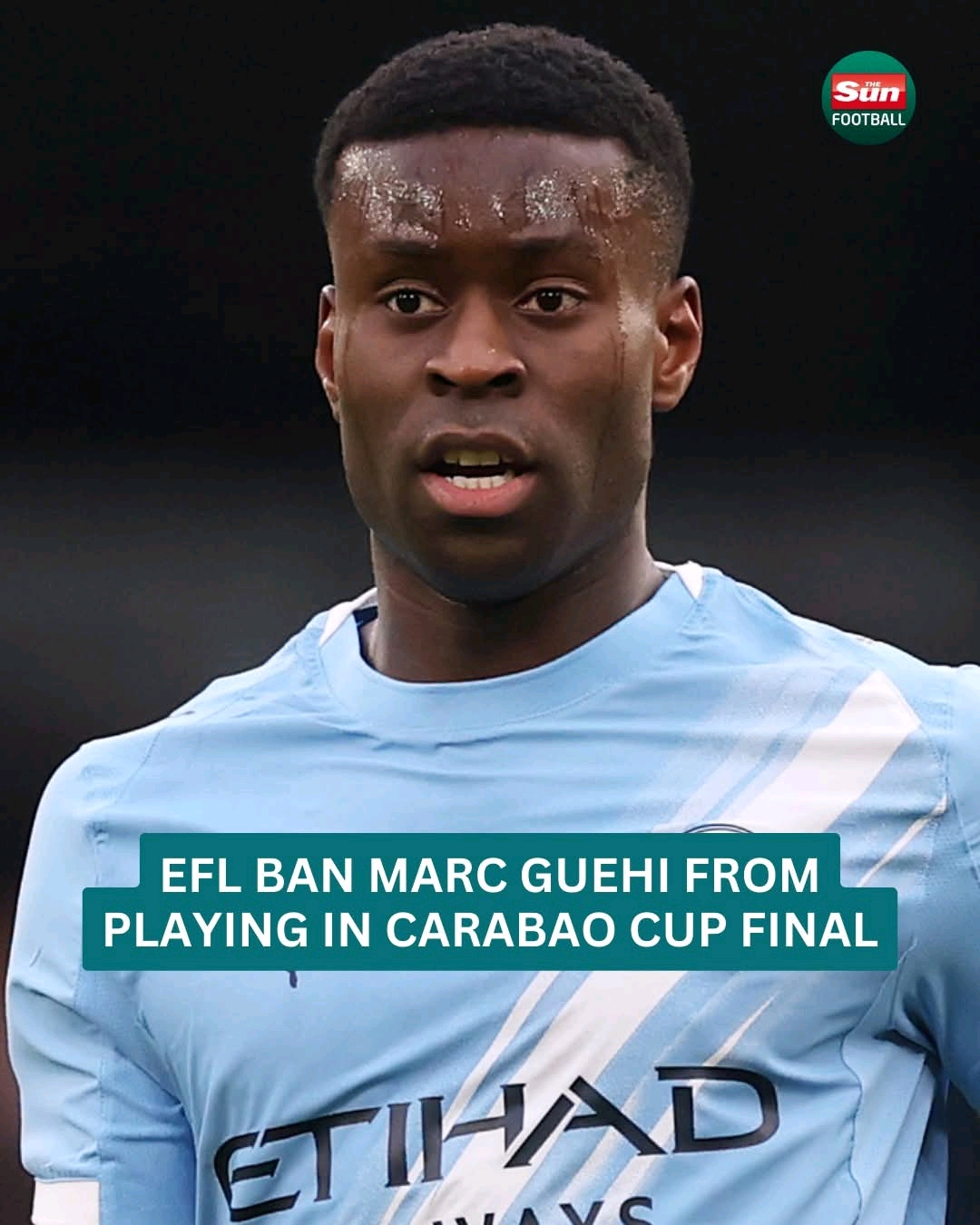
Marc Guehi’s dream of walking out at Wembley in the Carabao Cup final wearing Manchester City colours has been cruelly taken away, not by injury, not by suspension for a red card, but by a little-known rule buried deep inside the EFL regulations. What should have been a proud moment in the England defender’s career has instead turned into a painful lesson about football bureaucracy, timing, and how unforgiving the rulebook can be, even for the biggest clubs in the country.
When Manchester City completed the £20 million January signing of Guehi from Crystal Palace, the expectation inside the club was simple. They believed they had added an experienced, calm, ball-playing defender at exactly the right moment in the season. City were chasing trophies, competing on multiple fronts, and the Carabao Cup final was already on the horizon. To Guardiola and his staff, it felt logical that a player who now belonged fully to City, who trained every day at the Etihad Campus, and who was fit and ready, should be available for the final. In Guardiola’s mind, it was common sense.
But football does not always reward common sense.
Instead, the cold reality of the EFL rulebook has delivered a brutal verdict. Marc Guehi will not be allowed to play in the Carabao Cup final against Arsenal on Sunday March 22. No appeal. No exception. No late reprieve. He will watch from the stands as his teammates fight for silverware, knowing that even if City lift the trophy, his contribution will go unrecognised on the pitch.
The frustration for Guardiola is clear, and it has been written all over his face in recent press conferences. After City sealed their place in the final with a dominant 5-1 aggregate win over Newcastle United, the City manager could not hide his disbelief. He spoke openly, emotionally, and with visible confusion about why his new defender was being punished by a rule that felt outdated and illogical.
In Guardiola’s eyes, City had done everything right. They paid good money for the player. They followed the transfer rules. They registered him properly. He belonged to Manchester City in every legal and sporting sense. Yet, because of a technical detail linked to timing, he was suddenly considered ineligible for the biggest domestic cup final of the season.
Pep described it as “pure logic” that Guehi should be allowed to play. He questioned why a club that invests heavily in a player should then be blocked from using him in a final that could define their season. He even went as far as asking the club to write formally to the EFL, hoping that common sense might prevail.
But even as he spoke, Guardiola knew the reality. He admitted openly that he did not expect the rules to be changed. And by Thursday morning, those fears were confirmed. EFL sources made it clear there would be no adjustment, no special decision, and no bending of regulations ahead of the final. The rules, they said, are the rules.
To understand why Guehi has been blocked, you have to go back to the early rounds of this season’s Carabao Cup. Before his move to Manchester City, Guehi played three matches in the competition for Crystal Palace. At the time, there was nothing unusual about that. Palace were competing, Guehi was their captain, and he was simply doing his job.
The complication came later, when City entered the latter stages of the tournament and decided to strengthen their squad in January. Guehi’s transfer was finalised on January 19. By that date, Manchester City had already played the first leg of their semi-final away at St James’ Park, a match they won 2-0 against Newcastle. That date, as it turns out, is everything.
Earlier this season, the EFL had quietly adjusted its regulations to allow more flexibility for players who move clubs. This is why City’s other January signing, Antoine Semenyo, has been able to play in the competition despite already featuring for Bournemouth earlier in the tournament. Semenyo arrived before the crucial cut-off point, and under the updated rules, he was cleared to play for City in both semi-final legs. He even played an important role in City’s success over Newcastle, which only added to Guardiola’s confusion.
In Guardiola’s mind, if Semenyo could play, why not Guehi?
The answer lies in a small but decisive detail. The regulation allows a player to represent two clubs in the same Carabao Cup season only if the transfer is completed before either the closure of the winter transfer window or the first leg of the semi-final, whichever comes sooner. For Semenyo, that condition was met. For Guehi, it was not.
By the time Guehi officially became a Manchester City player, the first semi-final leg had already been played. That single date turned out to be the line between eligibility and exclusion. No matter how important the player, no matter how logical the argument, the rule leaves no room for interpretation.
The relevant section of the EFL regulations spells it out in dry, legal language. A registered player can play for up to two clubs in the competition in one season only under specific circumstances. One of those circumstances involves transfers completed before the semi-final first leg. Guehi missed that deadline by days, and that was enough to shut the door completely.
From the EFL’s point of view, the situation is simple. The rules were agreed at the start of the season. Clubs were informed. The regulations apply equally to everyone. Making an exception for Manchester City, even in a high-profile final, would open the door to accusations of unfair treatment and favoritism.
From City’s point of view, and especially Guardiola’s, the situation feels deeply unfair. They see a player being punished not for breaking rules, but for arriving slightly too late in a transfer window that is already packed with deadlines and complications. They see a final that could showcase one of their best defenders, reduced instead to a lesson in red tape.
For Marc Guehi himself, the disappointment is personal and painful. At 25, he has already built a strong reputation in English football. He has captained Crystal Palace, earned England caps, and now secured a move to one of the biggest clubs in the world. The Carabao Cup final would have been a perfect moment to announce himself fully as a Manchester City player, to lift his first trophy with the club, and to play on the grandest domestic stage Wembley can offer.
Instead, he will sit in the stands, watching teammates live the moment he had imagined for himself. He will train, prepare, and support the squad, but he will not feel the grass under his boots when the final whistle blows.
There is also a wider sense of irony in the situation. The very rule that blocks Guehi was introduced to give clubs more flexibility and to prevent unfair disadvantages caused by player movement. Yet in this case, it has produced the opposite effect. City strengthened in January, as many top clubs do, only to discover that one of their biggest signings is unavailable for a major final.
The debate now extends beyond Manchester City. Many fans, pundits, and even rival supporters have questioned whether the rule truly serves the game. Some argue that once a player is registered with a club and eligible for league matches, it feels strange to block them from a cup final based purely on timing technicalities. Others insist that without strict cut-off points, competitions would become chaotic and unfair.
Guardiola himself summed up the dilemma perfectly. He said he wanted the club to ask the Carabao Cup organisers to reconsider. He said he did not understand why a player who belongs fully to City could not play the final. And yet, in the same breath, he admitted that he expected nothing to change.
That sense of resignation tells its own story. Even one of the most influential managers in world football knows that once the rulebook is closed, it rarely reopens for anyone.
As the final approaches, attention will naturally turn to the match itself. Arsenal, City’s opponents at Wembley, will prepare with full focus, unaffected by City’s internal frustration. For them, the absence of Guehi may even be seen as a small advantage, though nobody inside Arsenal will openly celebrate another player’s misfortune.
For City fans, the situation leaves a bitter taste. They will cheer their team, hope for victory, and dream of lifting another trophy, but they will also know that one of their best defenders was denied the chance to play by a rule few people had even heard of before this week.
In the end, Marc Guehi’s Carabao Cup story this season will be remembered not for tackles, headers, or clean sheets, but for paperwork, deadlines, and a regulation number buried deep in the EFL handbook. It is a reminder that in modern football, success is not decided only on the pitch. Sometimes, it is decided in meeting rooms, legal documents, and lines of text that most fans never read.
For Guehi, the hope now is that this disappointment becomes motivation rather than frustration. There will be other finals, other trophies, and other moments to shine in a Manchester City shirt. But that does not make this one hurt any less.
When Wembley lights up on March 22 and the Carabao Cup final kicks off, Marc Guehi will be there. He will hear the roar. He will feel the tension. He will watch every pass and every challenge. But he will do so from the sidelines, a silent reminder that in football, timing can be everything, and sometimes, even logic is not enough.