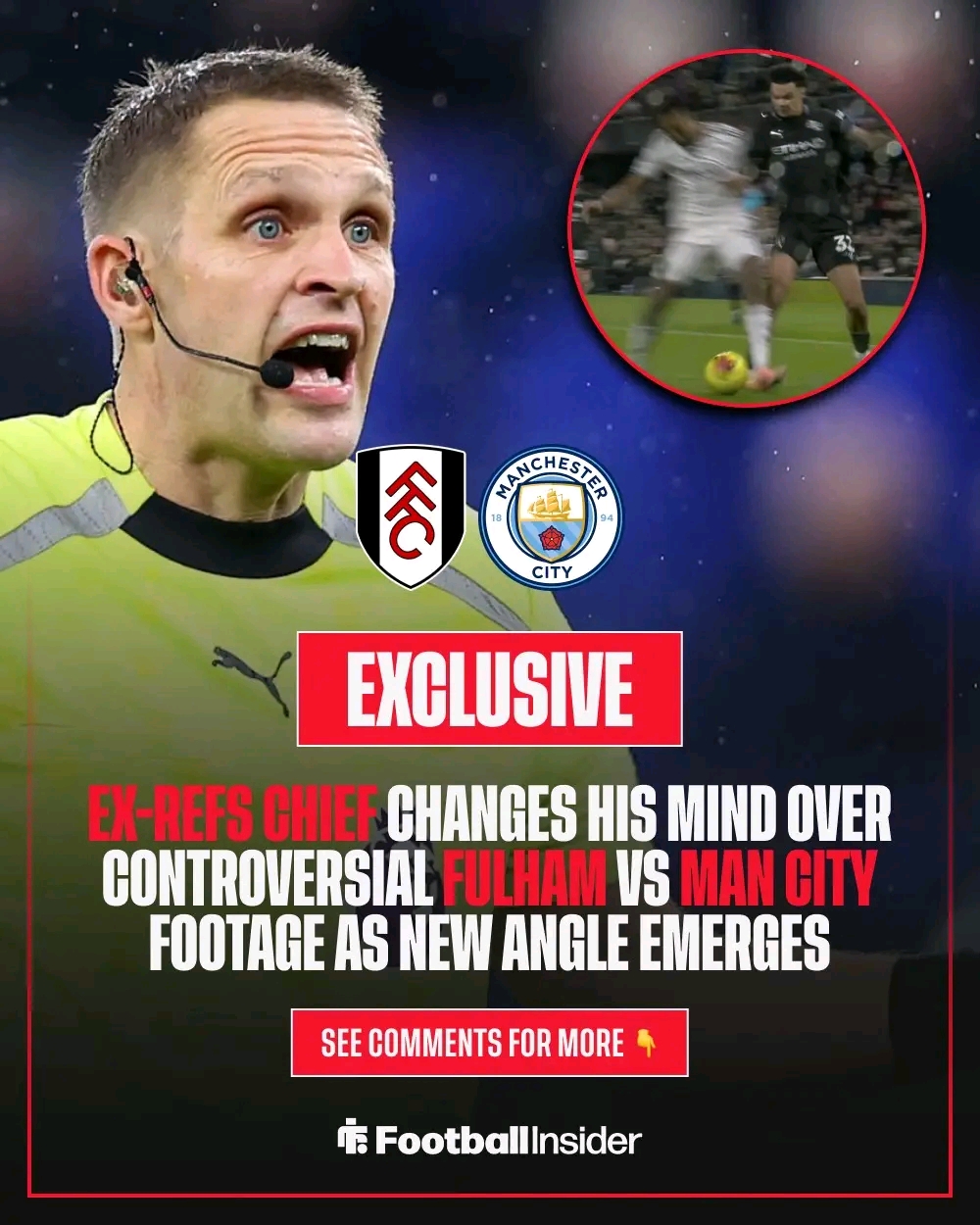
Craig Pawson had a major decision to make as Fulham tried to complete a stunning comeback against Man City and now, our PGMOL expert has delivered his verdict having changed his mind after new footage emerged.
The night football lovers witnessed at Craven Cottage will remain in the memory of fans for a very long time because it was the type of match that forces you to sit at the edge of your seat from beginning to end, the type of match that shows the real madness of Premier League football, the type of match that makes managers age ten years within ninety minutes. Marco Silva was pacing up and down his technical area like a man who had forgotten what calmness felt like, while Pep Guardiola stood with his arms folded, the rain dripping from his jacket, trying to convince himself that the chaos unfolding in front of him was still under control. But even he, the master of calculated football, could not hide his shock as the goals kept coming, mistake after mistake, drama after drama, and the final minutes left everyone screaming at the top of their lungs. It was supposed to be a normal league game, but it turned into a nine-goal roller coaster that shook every soul inside Craven Cottage.
The headline before kickoff was simple: Erling Haaland chasing another record, Manchester City looking to continue their dominance, Fulham hoping to cause an upset in front of their home fans. But nobody expected what they saw. Haaland, the man who treats records like snacks, started things off in the most Haaland way possible. A sharp run, a brilliant finish, and just like that he broke another Premier League record. The Fulham defenders looked around as if asking each other how many records this man still had left to break. It was only the first goal of the night, and yet it set the tone for what was coming, the madness, the fear, the hope, and the heartbreak that would follow.
The second goal came from Tijjani Reijnders, smashing the ball in with confidence, and the third from Phil Foden, who played like a man who had swallowed electricity. City looked like they were ready to score ten, ready to embarrass Fulham in their own home, ready to send Marco Silva home in silence. But Fulham refused to bow. They refused to roll over. They refused to accept the script that everyone had already written in their head. Football is not mathematics, and Fulham came alive through Emile Smith Rowe, whose goal brought the entire stadium to its feet and injected belief into the Fulham players. His strike was clean, powerful, and full of emotion, a reminder that the Premier League never sleeps, never stays predictable, never gives you comfort for too long.
Sander Berge added another for Fulham and suddenly the match that looked finished was breathing again. Fulham fans were roaring, singing, screaming for their players to push harder, and the players responded. Alex Iwobi came alive like a man possessed, running the midfield, driving the ball forward, forcing City players to backpedal. Samuel Chukwueze was dancing down the wings, taking on defenders like they were training cones, trying everything he could to break City apart. Fulham smelled blood, and City smelled danger, and that is when football becomes a battlefield. Even Pep Guardiola’s calmness began to fade, and Marco Silva was shouting instructions so loudly that even the fans at the back could feel his desperation.
But the moment that shook the stadium came in the dying minutes of the game, when Fulham pushed every man forward in search of the equalising goal that would have made the night legendary for them. Josko Gvardiol, who had been one of the most criticised City players after his mistake against Leeds United, suddenly turned into a hero. Fulham thought they had scored, the ball rolling toward the goal line, the fans already lifting their arms to celebrate, but Gvardiol slid in at the very last second to clear the ball off the line, saving City from humiliation. The noise that escaped the stadium at that moment was unbelievable. The Fulham fans screamed in despair, the City fans clutched their heads, and Gvardiol himself looked like he had just saved the club’s entire season. It was drama you cannot write in a script, the kind of moment that football gods create to remind humans that anything can happen.
And then came the controversy that took over the entire game, the moment that had the whole crowd shouting at the referee, the moment that sparked arguments from the pitch to the stands to social media. Substitute Jonah Kusi-Asare ran into the Manchester City penalty area, and Nico O’Reilly went into a challenge. There was a tangle of legs, Kusi-Asare went down, and Fulham immediately screamed for a penalty. The fans behind the goal started jumping, shouting at the referee Craig Pawson, begging him, ordering him, demanding him to point to the penalty spot. O’Reilly himself looked panicked, like a man whose future depended on the whistle. He had been in impressive form for City, showing courage, showing maturity, but this moment threatened to turn him into the villain of the night. Every camera inside Craven Cottage turned toward the incident, replay after replay showing the legs touching, showing the fall, showing the desperation of Fulham players pleading for justice.
But Craig Pawson did not even hesitate. He waved his hands, signalling no penalty. The City bench exhaled, Fulham’s bench exploded, the stadium erupted in anger. Marco Silva jumped toward the fourth official, shouting and pointing at the screen, convinced that they had been robbed, convinced that this was the moment VAR was created for, convinced that Manchester City had escaped again. It was pure fire, pure emotion, pure Premier League energy. Calls for a penalty were everywhere. Fans online were debating, pundits were arguing, even neutral supporters were confused.
At first, former PGMOL chief and ex-FIFA referee Keith Hackett believed the referee had made a mistake. He studied the first footage, the first angle, and his conclusion was simple: Fulham should have had a penalty. His first reaction was strong and direct. He said Fulham had every right to feel angry, that the challenge from O’Reilly looked careless, that the referee should have pointed to the penalty spot, that VAR should have stepped in. According to him, the decision was a clear and obvious error, something VAR should have corrected. Fulham fans used his words like fuel, posting them everywhere, saying this was proof they were robbed, that City were saved by luck once again.
But football is a game of angles, a game where one new camera view can change the entire story of an incident. Hours later, a new angle emerged, a reverse angle that showed something completely different, something that flipped the entire incident on its head. Keith Hackett watched it again and again, analysed it like a detective studying evidence in a big case, and his conclusion changed completely. He realised that the foul was actually from the Fulham player himself. The new footage showed Kusi-Asare stepping across O’Reilly carelessly, initiating the contact, causing the collision. It was the Fulham man who committed the offence, not the City defender. Suddenly, everything changed. Fulham fans who had been shouting for justice were now forced to confront a truth that stung. City fans who had been nervous were now celebrating. The referee Craig Pawson was praised for getting it right in real time, without needing VAR to save him.
Hackett himself came out publicly and admitted that his first reaction was wrong. He said the new footage clearly showed the Fulham player was the guilty one, not O’Reilly. He explained that what initially looked like a bad challenge from the City defender was actually a situation where the Fulham substitute made the careless move. The story flipped just like that. One moment Fulham believed they were robbed, the next moment they realised the penalty they were begging for was never theirs. It was the type of VAR twist that defines modern football, the type of incident that can break a fanbase in two, the type of moment that analysts replay for days.
Meanwhile, Pep Guardiola stood quietly after the match, probably thanking every star in the sky that his team escaped with the win. City had nearly thrown away a four-goal lead, nearly dropped points, nearly added another chapter to a season filled with emotional rollercoasters. Marco Silva’s Fulham fought with heart, passion, and fire, but in the end it was not enough. They came close, painfully close, but football does not reward effort alone. Sometimes one clearance, one challenge, one angle, one decision is all that stands between glory and regret.
This match will be remembered not just for the nine goals, not just for the drama, not just for the comeback attempt. It will be remembered for the penalty shout that divided everyone, for the moment when Nico O’Reilly’s entire season flashed before his eyes, for the moment when a former referee admitted he changed his mind, for the moment when VAR proved once again that football lives on details.
Fulham walked away heartbroken, City walked away relieved, and the Premier League walked away with another story that will live forever. The type of story that shows why this league is the most dramatic, most unpredictable, most emotional football competition in the world. It was chaos, it was fire, it was beauty, it was pain, and it was football in its purest form. And even as the night ended, people kept talking, replaying, arguing, analysing, because matches like this do not die easily. They echo for days, weeks, maybe months. Craven Cottage witnessed madness, and the world watched with open mouths, because the Premier League never disappoints.