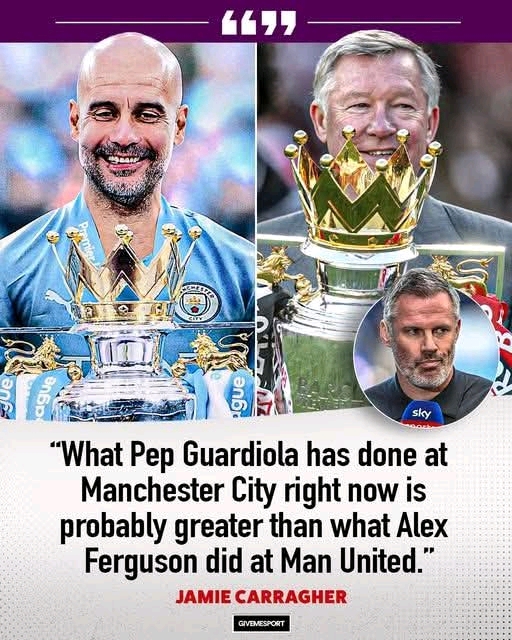
Jamie Carragher has never been afraid to speak his mind, and when he talks about football history, people listen closely. So when Carragher compared Pep Guardiola and Sir Alex Ferguson, it quickly became one of the most talked about debates in football. Two managers. Two eras. Two very different styles. Yet both have changed the game in ways that will never be forgotten. Carragher’s comparison was not just about trophies or numbers. It was about impact, personality, control, pressure, and how each man shaped football in England and beyond.
Sir Alex Ferguson is often described as the greatest manager English football has ever seen. He ruled the Premier League for more than two decades. Year after year, Manchester United stayed at the top or very close to it. Managers came and went. Players arrived and left. Tactics changed. But Ferguson stayed. He adapted again and again. Carragher often points out that Ferguson did not just build one great team. He built many. From the early days with Mark Hughes and Bryan Robson, to the Class of 92, to the later teams with Cristiano Ronaldo, Wayne Rooney, and Robin van Persie, Ferguson always found a way to win.
Pep Guardiola, on the other hand, represents something different. Carragher describes Pep as a football architect. Someone who does not just want to win, but wants to dominate every part of the game. Pep’s teams control the ball, control space, and control the opponent’s mind. When Guardiola arrived at Manchester City, English football changed. Full backs moved into midfield. Goalkeepers became playmakers. Centre backs were asked to pass like midfielders. Carragher believes Pep has influenced how almost every top team now tries to play.
One of the key points Carragher makes is about longevity versus intensity. Ferguson stayed at the top for a very long time. He survived challenges from Arsenal, Chelsea, Liverpool, and later Manchester City. He dealt with new owners, new money, and new rules. Pep’s time at City, while incredibly successful, is more focused on peak performance. Carragher says Pep builds machines. Perfect systems that work best when every piece is in place. Ferguson, by contrast, could win even when things were not perfect.
Carragher often brings up man management when comparing the two. Sir Alex Ferguson was famous for controlling the dressing room. Players feared him, respected him, and loved him at the same time. The famous hairdryer treatment became part of football legend. Ferguson knew when to shout and when to put an arm around a player. Carragher believes this was one of Ferguson’s greatest strengths. He could deal with big egos, young talents, and experienced leaders all at once.
Pep Guardiola manages players differently. Carragher says Pep demands total belief in his ideas. If a player does not fully buy into the system, they struggle. Pep is intense. He studies details endlessly. Training sessions are sharp and demanding. Carragher notes that many players say Pep makes them better footballers, but also admits that Pep’s style is not for everyone. Some players thrive. Others fade away.
Trophies are always part of the discussion. Sir Alex Ferguson won 13 Premier League titles, two Champions Leagues, and countless domestic cups. His success came in different eras, against different rivals, with different squads. Carragher highlights that Ferguson won titles without always having the biggest budget. Especially in the early years, United were smart, not just rich.
Pep Guardiola’s trophy list is also stunning. League titles in Spain, Germany, and England. Multiple domestic cups. Champions League success. Carragher points out that Pep often takes over strong squads. Barcelona had Messi. Bayern dominated Germany. Manchester City already had money and talent. Critics use this against Pep. Carragher does not ignore this point, but he also says money alone does not guarantee success. Many clubs spend big and fail. Pep turns spending into dominance.
Another area Carragher focuses on is adaptability. Ferguson was a master of change. When his teams stopped winning, he rebuilt. He changed tactics, formations, and playing styles. From direct football to wide wingers to counter attacks, Ferguson adjusted to what the league demanded. Carragher believes this ability to evolve kept Ferguson at the top for so long.
Pep Guardiola adapts too, but in a different way. He does not change his philosophy. He changes the details. Carragher explains that Pep tweaks positions, roles, and movements, but the core idea remains the same. Control the ball. Press high. Suffocate the opponent. This consistency is part of Pep’s genius, but Carragher wonders if it also limits him sometimes, especially in big Champions League moments.
Carragher also talks about pressure. Managing Manchester United under Ferguson meant dealing with massive expectations every season. United were expected to win. Anything else was failure. Ferguson handled this pressure year after year. Pep faces pressure too, especially with Manchester City and the Champions League. Carragher notes that Pep is judged harshly in Europe, even when his teams dominate domestically.
One interesting point Carragher makes is about legacy. Sir Alex Ferguson’s legacy is clear. After he left, Manchester United struggled. This showed how much control and influence he had. The club lost its direction. Managers came in and failed to match his standards. Carragher sees this as proof of Ferguson’s greatness.
Pep Guardiola’s legacy is more tactical. Even when he leaves, his ideas stay. Coaches copy his style. Young managers study his teams. Carragher believes Pep has changed football education. How players are trained. How coaches think. His influence goes beyond one club.
Carragher does not say one is clearly better than the other. Instead, he says they represent different types of greatness. Ferguson was a builder, a ruler, a survivor. Pep is an innovator, a perfectionist, a thinker. Ferguson won through personality and control. Pep wins through structure and detail.
The debate also touches emotions. Carragher, as a former Liverpool player, grew up watching Ferguson dominate. He knows how painful that was for rivals. Pep’s City dominance creates similar feelings today. Carragher understands what it means to face a team that seems unstoppable.
In the end, Carragher believes football is lucky to have seen both. Comparing them is part of the fun, but also part of understanding how the game has grown. Ferguson showed how to win over time. Pep shows how to win through ideas. Both raised standards. Both pushed others to be better.
Carragher’s comparison is not meant to end arguments. It is meant to start them. Fans will always choose sides. Some will value trophies and longevity. Others will value style and influence. But one thing is clear. Pep Guardiola and Sir Alex Ferguson are giants of football. And thanks to voices like Jamie Carragher, their stories will keep being told, debated, and celebrated for many years to come.