The cold December air inside the Etihad Stadium felt like electricity waiting to burst. Manchester City fans arrived with a strange mixture of confidence and tension sitting in their chests. They had seen the news earlier in the day, the kind of news that changes the mood of an entire football city in a single moment. Arsenal, the league leaders, had been beaten 2-1 by Aston Villa. It was a result that opened a door for Manchester City, a door that Guardiola and his players could not afford to ignore. If City won against Sunderland, they would move within just two points of the top of the Premier League table. The title race was no longer a distant thought. It was breathing right in front of them. And everyone knew that this match against Sunderland could become one of those moments that people talk about months later. A simple win on paper, but a match that could shift the momentum of an entire season.
Inside the dressing room before kickoff, Pep Guardiola stood quietly for a long moment, his hands together, eyes fixed on the floor as if he was trying to see the future hiding behind the grass. The players were moving around with headphones, stretching bands, and fast boots, but the manager remained silent. He had seen Arsenal’s game. He had seen the league table. And he knew exactly what this match represented. When he finally spoke, his voice was sharp but calm. He reminded the players that these are the days that test champions. Not the big games under bright lights. Not the nights against Real Madrid or Liverpool. But these afternoons when the pressure sneaks from behind and whispers that the season can change with one wrong pass, one moment of weakness, one slip in concentration.
Manchester City stepped onto the pitch like a team that understood the assignment. From the first whistle, their passes were crisp, the movement was sharp, and Sunderland were immediately pushed back into their own defensive line. Sunderland arrived with energy and effort, but they were a team fighting to survive, a team that depended on grit more than brilliance. City were a team built on structure, ideas, control, and talent scattered everywhere like stars in the night. And on this afternoon, they looked like a team that refused to let the opportunity slip away.
Ruben Dias, the warrior who defended with both pride and fire, had been criticised recently for a few mistakes. But in this match, he looked hungry to prove something. He stepped high, won duels, shouted instructions, and demanded full intensity from everyone wearing blue. Sunderland tried to test Manchester City with long balls and quick transitions, but Guardiola’s men handled them without panic. Phil Foden was drifting everywhere, receiving the ball in small pockets, turning in tight spaces, and playing as if he had fire inside his boots. Bernardo Silva moved with that calm elegance he always carries, like a man who sees football two seconds earlier than everybody else. And then there was Rayan Cherki, the young magician, the player City signed to bring creativity, chaos, and unpredictability to their attack. A player still trying to find his place in a team full of stars, but a player who carried the type of talent that lights up games.
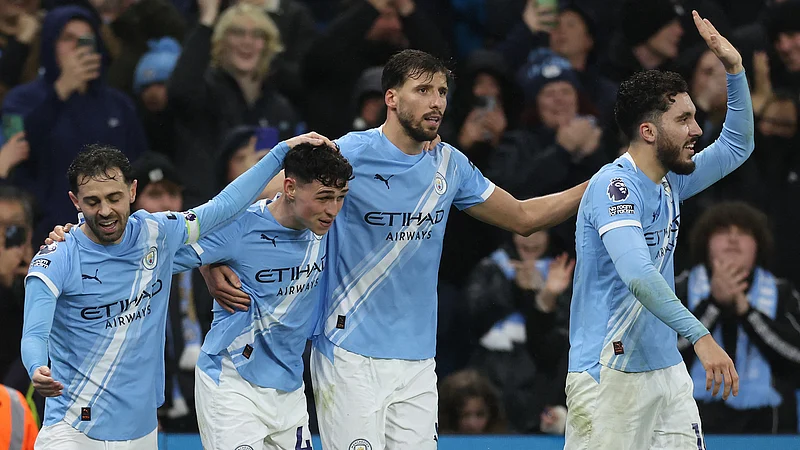
City continued their dominance and finally, in the 31st minute, the breakthrough arrived. But it wasn’t Haaland. It wasn’t Foden. It wasn’t one of the attackers. It was Ruben Dias, the defender who was tired of seeing others decide games. When the ball rolled towards him outside the box, he struck it with everything he had. It was a thunderous shot, the kind of shot defenders dream about but rarely attempt. The ball took a deflection off Dan Ballard, wrongfooting the Sunderland goalkeeper, and flew into the net. The Etihad erupted, the players rushed to Dias, and you could see the fire in his eyes. This was a goal of relief, a goal of frustration released, and a goal that announced that Manchester City were here to chase Arsenal properly.
Sunderland tried to settle, but City smelled blood. Four minutes later, before they even had time to reorganize, Josko Gvardiol found himself in the right place at the right moment. Foden curled in an in-swinging corner, a dangerous ball that bent toward the near post with speed. Gvardiol moved like a basketball player timing a rebound perfectly. He ghosted behind the Sunderland defense, jumped, and hit a powerful downward header that bounced past the goalkeeper and into the net. It was 2-0, and the job looked almost done. The Etihad became louder. Guardiola smiled slightly, and you could almost see the weight dropping from his shoulders.
By halftime, Manchester City walked into the tunnel with control, confidence, and the feeling that everything was going according to plan. But football never stays comfortable for long. Sunderland came out for the second half like a team that remembered why they were fighting in the Premier League. They pressed higher, they ran harder, and they created chances. And suddenly, the calm City had enjoyed turned into a few moments of panic.
The most worrying moment came when Ruben Dias made an uncharacteristic mistake. A sloppy touch, a heavy step, and suddenly Wilson Isidor was through on goal with only Gianluigi Donnarumma to beat. The Etihad gasped. Guardiola grabbed his head. Dias shouted in frustration. Isidor sprinted forward, trying to keep the ball close as he approached the giant Italian goalkeeper. But Donnarumma stood tall, waited for the perfect moment, and spread his arms wide to make a crucial one-on-one save. The ball bounced away, and Dias breathed a sigh of relief, thanking the goalkeeper with a tap on the chest.
Not long after, Granit Xhaka took a half-volley from the edge of the box that smashed against the upright. For a moment, Sunderland believed they were inches away from shifting the entire match. But football is cruel. The ball bounced out, not in, and the attack faded. City had been warned, but they survived the danger.
And then came the moment that froze time. The moment that people will replay for years. The moment that proved why Manchester City signed Rayan Cherki. It happened in the 65th minute, but it felt like something from a different dimension. Cherki received the ball on the right side of the box. Omar Alderete stepped forward, ready to block him, ready to contain him, ready to stop him. But Cherki moved with a kind of confidence that young players only show when they feel something special inside. He shifted the ball, faked one direction, then dragged it with skill and calm, making Alderete fall backward onto the grass. The stadium gasped. Fans stood up. Even Guardiola opened his eyes wider.
And then Cherki did something nobody expected. Instead of crossing traditionally, he swung his leg behind his standing leg and produced a perfect rabona cross. The technique was beautiful, the timing was flawless, and the idea was something that only football artists see. The cross curled toward Phil Foden, who attacked the ball with hunger. He jumped and headed it with power. The ball hit the crossbar, bounced down, and crossed the line. The goal was given. The stadium exploded. Cherki ran to celebrate, teammates jumped on him, and Foden pointed at the young Frenchman with admiration. It was the kind of assist that makes headlines. The kind of assist that makes coaches smile even when they pretend to be serious. The kind of assist that makes fans fall in love with a player instantly.
With the score at 3-0, Sunderland’s hope died slowly. Their players tried to keep fighting, but they were now facing a Manchester City team full of energy, full of joy, and full of belief. Every pass made Sunderland chase shadows. Every run pulled their defense apart. Every combination was a reminder of the gap in quality between the two sides. Haaland wanted a goal desperately, but Sunderland held him tight. Still, his movement created space for everyone else, and City looked comfortable even without their striker scoring.
As the match entered its final minutes, frustration finally boiled over for Sunderland. Luke O’Nien, who had only been on the pitch for a few minutes after coming in as a late substitute, flew into a reckless challenge on Matheus Nunes. It was high, dangerous, and unnecessary. The referee had no hesitation. Red card. O’Nien walked off the pitch, and his teammates watched with disappointment. Not only had Sunderland lost the game. They had now lost a player for the next match, the first Tyne-Wear derby against Newcastle United since 2016. A huge match for their fans, and now one of their players was suspended because he let his frustration win.
The final whistle blew, and Manchester City walked off with a 3-0 victory, a performance filled with confidence, control, and moments of magic. Guardiola shook hands, hugged his staff, and walked into the tunnel knowing that his team had done exactly what they were supposed to do. They had taken advantage of Arsenal’s slip. They had closed the gap. They had brought themselves back into the title conversation in the most convincing way.
But beyond the scoreline, beyond the goals, beyond the points, the match was also a story of belief returning to the Etihad. Fans walked out of the stadium talking about Cherki’s rabona, Dias’ strike, Gvardiol’s header, and Donnarumma’s save. They talked about the title race. They talked about the pressure Arsenal would now feel. They talked about the momentum shifting in Manchester City’s favor. They talked about the noise, the energy, the feeling that something big was beginning to brew.
Inside the dressing room afterward, players were smiling, joking, and relaxing. Cherki received pats on the back and words of praise from teammates who knew they had witnessed something special. Foden teased him about trying impossible skills, and Cherki laughed, knowing he had delivered a moment that would replay on screens around the world. Guardiola approached him later, not with loud excitement, but with that quiet look he gives when he sees a player growing into something important. A look of approval, of trust, of expectation. He told him to enjoy the moment but remember that the season is long, that many more battles are coming, that this was only the beginning of what he can become.
The analysis after the match showed how complete Manchester City had been. They controlled possession, created chances, defended strongly, and moved the ball with rhythm. Sunderland had moments, but City responded each time. Dias’ goal changed the energy. Gvardiol’s header killed the fear. Cherki’s assist ended the match. Donnarumma’s save protected the scoreline. Foden’s movement kept the defense confused. Bernardo’s intelligence glued the midfield together. And the defense held strong even when minor mistakes tried to create problems.
But the most important thing was the league table. Manchester City were now two points behind Arsenal. Two points. A gap that can disappear in one weekend. A gap that can flip with one good run. Arsenal had been leading proudly, but their defeat reminded everyone that the Premier League does not forgive weakness. And Manchester City, the champions, smelled opportunity like lions hunting at night.
The fans felt the shift as well. Walking out of the stadium, they talked like believers again. They talked like people who had seen their team wake up. They talked like people who had witnessed a spark. And sometimes, in football, all you need is a spark to light a fire that burns until May.
Guardiola knows that this season will demand everything. The injuries, the fixture congestion, the pressure, the mistakes, the moments of brilliance, the tactical battles, the mental strength, and the hunger to keep winning. But he also knows that his team still has that fire. The fire that won trebles. The fire that dominates big matches. The fire that makes moments like Cherki’s rabona feel normal inside this club of high standards and endless expectations.
The Sunderland match will not be remembered as a title decider. But it will be remembered as a match where Manchester City looked like Manchester City again. A match where young talent shined. A match where the big players stepped up. A match where the team responded to pressure with confidence instead of fear. And a match where a single assist captured the imagination of football fans everywhere.
As the night fell over Manchester, the Etihad lights slowly dimmed, the noise faded, and the celebrations moved into quiet conversations inside the training ground. But the feeling remained. The feeling that the season was alive. The feeling that the chase had begun. The feeling that City were coming.
And somewhere inside the city, supporters replayed the rabona again and again, smiling because they knew that football sometimes gives you moments that stay forever. And on this December day, Manchester City had one of those moments, delivered by a young talent who might one day become a superstar in sky blue. For now, though, the only thing that mattered was the victory, the points, and the message sent to Arsenal.
Manchester City were not going anywhere. They were alive. They were close. They were coming for the top. And the league, once again, was warned.