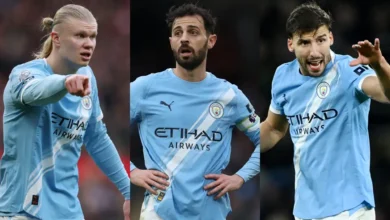
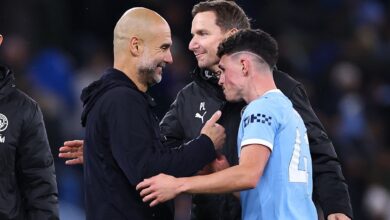
The night felt like it carried the weight of an entire season on its shoulders, a night where Manchester City arrived in Madrid not just to play football but to prove a point about who they truly were becoming in this strange new era of transition. Pep Guardiola and his young squad walked into the Santiago Bernabeu with many doubts floating around them, whispers that this team was too inexperienced, too different, too raw to survive the pressure Real Madrid always brings. But football never follows the script people predict, and on this particular evening in Spain, Manchester City wrote their own chapter full of fight, stubbornness, and belief. Yet even as the drama unfolded beautifully on the pitch, the night ended with a twist that left fans talking about something else entirely: the suspension of their captain Bernardo Silva after receiving yet another yellow card.
The game itself started with intensity, the kind of intensity that makes the Champions League feel like a completely different sport compared to weekend football. Real Madrid drew first blood through Rodrygo, and the goal sent waves of noise around the stadium. The home fans started bouncing, the commentators started sharpening their lines, and every critic waiting to question City’s mentality suddenly leaned forward as if they believed they were about to be proved right. A young Manchester City side conceding early at the Bernabeu has historically been a recipe for disaster, and everybody knew what Madrid does when they find momentum. They push, they squeeze, they surround you with fear and atmosphere until you break. But not this time.
One of the proudest moments in Manchester City’s season arrived when Nico O’Reilly, one of the youngest faces in the squad, stepped up when nobody expected him to. He scored his first ever Champions League goal, a moment that felt like a piece of football history being written in slow motion. The young midfielder sprinted away in celebration, arms wide, eyes shining, as if in disbelief of what he had just done. And in that moment, all the doubts that surrounded this team felt like they disappeared into thin air. Manchester City did not travel to Madrid to hide. They came to fight. They came to show that transition does not always mean weakness. Sometimes it means rebirth.
Then came Erling Haaland, icy as ever, stepping up to take a penalty that carried huge emotional weight. The Norwegian did not blink. He sent the goalkeeper the wrong way, converting with the calmness of a man who has built his entire reputation on delivering when it matters most. The away end exploded. City players celebrated with passion. Guardiola punched the air like he was trying to release all the pressure he had been carrying in his chest. And when the final whistle blew, Manchester City walked off the pitch with three points, and not just any three points—three points at the Bernabeu, three points that could redefine their Champions League journey, three points that injected belief into a squad that many people believed was not ready.
This result lifted them to fourth place in the new Champions League group-phase standings, firmly placing them in a strong position to qualify for the Round of 16. Considering everything—their form earlier in the competition, the injuries, the criticism, the pressure—it felt like one of the most significant achievements of their season. It also arrived at the perfect time. City had lost 2-0 to Bayer Leverkusen at the Etihad not long ago, and that defeat created a cloud of fear over their European campaign. But beating Real Madrid away, especially after conceding first, changed the mindset of the entire squad.
The dressing room under Hugo Viana has been evolving—young, hungry, energetic, full of players trying to write their own stories. Manchester City’s journey this season is not the polished, experienced story people have seen in past years. It is rougher, newer, and full of players trying to prove they belong on the big stage. And nights like this one at the Bernabeu accelerate their growth more than anything else could.
Pep Guardiola and his team returned to Manchester from Madrid early Thursday morning, tired but filled with pride. They had Crystal Palace waiting for them next, another difficult challenge, but the momentum was beginning to build. Guardiola could feel it. The players could feel it. The fans could sense that something special was developing even if everything was not perfect.
Their recent Premier League form has been impressive. They closed the gap on Arsenal—who were leading the league—after a strong 3-0 victory over Sunderland at the Etihad. Ruben Dias, Josko Gvardiol, and Phil Foden got on the scoresheet that day, each goal carrying its own sense of authority. Arsenal then slipped against Aston Villa, losing 2-1 thanks to an injury-time strike from Emiliano Buendia. Suddenly Manchester City were just two points behind Mikel Arteta’s side. Suddenly the title race felt alive again.
Arsenal had also been flying in the Champions League, winning 3-0 against Club Brugge to keep a perfect record in Europe. They were scheduled to welcome Wolves to the Emirates Stadium next, but the pressure was beginning to shift. The narrative had changed. Manchester City were no longer the team stumbling through a transitional season. They were the dangerous hunters closing in again.
But even with all this good news, the night in Madrid came with one major downside—Bernardo Silva picked up a yellow card that triggered a suspension. This means he will miss City’s next Champions League match against Bodo/Glimt in Norway. It came as a huge talking point among supporters, because Bernardo is not just any player. He is the captain. He is the emotional leader of the team. And losing him, even for one match, feels like losing a heartbeat in midfield.
UEFA’s rules are very clear. From the first match of the league phase, if a player accumulates three yellow cards without receiving a red, they must serve a one-match suspension. After that, suspensions also occur on every odd-numbered caution—five, seven, nine, and so on. These yellow cards do not disappear when the knockout stage begins. They only reset after the quarter-finals, which means clubs must manage their discipline carefully.
Bernardo’s suspension highlights the fine margins in this new Champions League format. Every match carries weight, every booking has consequences, and every decision by a referee could shape how a team progresses. Guardiola will not be happy about losing his captain at this stage, especially considering the importance of squad stability during a group phase that features many more matches than before.
But Bernardo is not the only concern. Nico O’Reilly and Savinho, both of whom have picked up two yellow cards this season, are now walking a tightrope of their own. If either of them receives another booking against Bodo/Glimt, they will be suspended for the home match against Galatasaray on matchday eight. With the group standings still tight and qualification not yet guaranteed, Guardiola must now manage his young players with extra care.
The Champions League has always been demanding. It tests not only ability but mentality, discipline, and consistency. Manchester City have often suffered from suspensions at the worst possible times, and the fear among supporters is that missing key players in critical matches could affect the momentum they are trying so hard to build.
Beyond the suspension drama, the club continues to attract headlines. The media has been flooded with stories ranging from Guardiola insisting that Manchester City are not yet ready to win the Champions League this season, to questions about his future, to transfer rumours involving players like Claudio Echeverri. The noise never stops around this club. But Guardiola has always said the same thing: focus on the next game, the next step, the next challenge. Nothing more.
And the next challenge, at this moment, is Bodo/Glimt—away in Norway, in cold conditions, against a team that may not have the glamour of Real Madrid but absolutely has the ability to frustrate bigger clubs. Without Bernardo Silva’s leadership, the responsibility will fall on younger shoulders. Players like O’Reilly, Savinho, Foden, and Gvardiol will need to carry more weight. Haaland, always the focal point, must continue delivering goals. Rodri, who has been the backbone of the squad, must guide his teammates with his calm presence.
Yet this is exactly what Guardiola wants. Growth. Maturity. Responsibility. Nights like Madrid, setbacks like suspensions, circumstances like pressure—these moments are what transform promising talents into genuine leaders. Manchester City’s evolution is being shaped not just by victories but by challenges, and losing Bernardo for a match is another piece of the story they are writing this season.
But the fans, passionate as ever, will expect the team to deal with this hurdle just like they dealt with Madrid—by stepping up, by refusing to collapse, by believing that youth and transition do not mean weakness. The hunger in this squad is clear. The ambition is visible. And the belief is growing each week.
The Champions League journey continues, and the road ahead is long. But Manchester City’s fight in Madrid, their progress in the Premier League, their rising young stars, and their determination to prove their critics wrong all point to a team that is not scared of the challenges ahead. They know what they want. They know what they are chasing. And even without Bernardo Silva for one match, they remain focused on qualifying, competing, and building something that can last.
A suspension may slow them down for a moment, but it will not stop them. Not this season. Not with the spirit they showed at the Bernabeu. Manchester City walk forward—young, hungry, bruised, but unstoppable