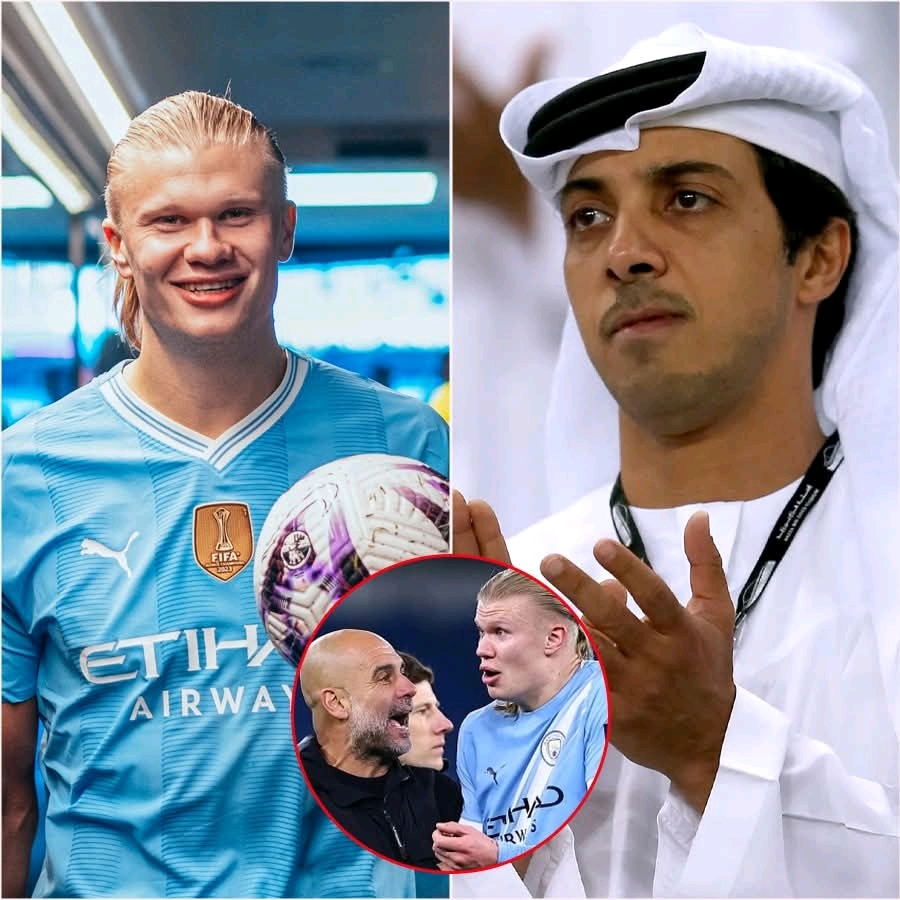
Manchester City’s board to double his salary, even wanting to receive the highest salary in the team. “I have contributed a lot to this team, but have never received the reward I deserve…” Haaland shared. Immediately, chairman Sheikh Mansour personally responded to Haaland’s request with a nine-word message
The football world was suddenly thrown into chaos when reports emerged claiming that Erling Haaland had made a stunning and very public demand to Manchester City’s board. According to the story, the Norwegian striker, one of the most feared goal scorers in world football, had asked the club to double his salary immediately and make him the highest-paid player in the squad. The claim spread like wildfire across social media and football websites, triggering shock, debate, anger, and disbelief in equal measure.
Haaland, who has become the face of Manchester City’s attacking power since arriving at the Etihad, was said to be unhappy with his current financial package. Despite scoring goals at an incredible rate and playing a central role in the club’s success, he reportedly felt that his contributions had not been rewarded in the way he believed they should be. What truly stunned observers was not just the demand itself, but the way it was allegedly made. Instead of handling it privately behind closed doors, the story claimed Haaland went public, putting direct pressure on the club’s leadership.
The report suggested that Haaland believed the timing was right. His goal numbers were impossible to ignore. His influence on City’s performances was obvious. Week after week, he carried the team’s attack, punished defenders, and decided matches on his own. From his point of view, the argument seemed simple. He was delivering at the highest level, breaking records, and justifying elite status. In his mind, elite status deserved elite pay.
In a widely circulated interview, Haaland was quoted as saying that he had contributed a lot to the team but had never received the reward he felt he deserved. The words were blunt, direct, and impossible to misunderstand. There was no attempt to soften the message or hide behind vague language. If true, it was one of the boldest public contract statements ever made by a Manchester City player.
The reaction was immediate. Fans were split down the middle. Some agreed with Haaland, arguing that he was the most important player in the squad and should be paid accordingly. Others felt uncomfortable with the idea of a player publicly challenging the club, warning that such behaviour could damage unity and destabilise the dressing room. Pundits debated whether Haaland was right to push so hard or whether he had crossed an invisible line.
Inside Manchester City, the situation was described as tense. The board was reportedly caught off guard by the public nature of the demand. Manchester City are known for handling contracts quietly, efficiently, and without drama. Players negotiate through agents, discussions remain private, and the club maintains strict control over its wage structure. A public challenge, especially from a star player, threatened that carefully maintained balance.
For several hours, there was silence from the club. No official statement. No clarification. No denial. That silence only added fuel to the fire. Rumours of emergency meetings began to circulate. Some claimed the club was furious. Others suggested they were considering a compromise. Speculation ran wild, with some even suggesting that Haaland’s long-term future at the Etihad could be in doubt if the situation escalated.
Then, everything changed with a single intervention. Sheikh Mansour bin Zayed Al Nahyan, the owner and chairman of Manchester City, reportedly decided to step in personally. Instead of allowing the issue to drag on or filtering a response through club officials, he chose direct communication. According to the story, he sent Haaland a message that was short, precise, and impossible to misinterpret.
The response was just nine words, but they carried enormous weight. “Your contract is already signed. Your value is understood.” That message was quickly leaked and spread across the football world within minutes. It was seen as a firm but calm rejection of Haaland’s demand. There was no anger in the words, no insult, no attack. But there was authority, and there was finality.
The meaning was clear. Haaland’s importance was not in doubt. His value to the team was recognised. But his contract had already been agreed, and Manchester City would not be pressured into rewriting it through public statements. The club was reminding him, and everyone else, that agreements matter and that negotiations are handled on the club’s terms, not through media campaigns.
The impact of that nine-word message was immediate. Reports claimed that Haaland, who had appeared confident and defiant before, suddenly fell silent. Journalists noticed a change in his tone. The bold public stance vanished. He stopped speaking about the issue. Sources close to the situation described him as embarrassed and speechless, caught off guard by the directness of the response.
What was supposed to be a power move had backfired. Instead of forcing the club’s hand, Haaland had run straight into the strongest wall at Manchester City. Sheikh Mansour’s involvement elevated the situation beyond normal contract talks. It became a reminder of who ultimately controls the club’s direction.
Inside the dressing room, the atmosphere was said to be delicate. While no public comments came from teammates, it was impossible for players not to notice what had happened. A public salary demand from the biggest star can create uncomfortable questions. Who earns what? Who deserves more? Where does loyalty fit into ambition?
Pep Guardiola now found himself in a difficult position. His job was to keep the squad focused, united, and motivated. Guardiola values harmony above almost everything else. He demands discipline, humility, and commitment to the collective. A situation like this, even if resolved quickly, risks leaving emotional scars.
Guardiola’s challenge was to bring Haaland back into the fold fully, not just physically but mentally. The striker would need to refocus on football, forget about money, and deliver performances that justify his reputation. The manager would also need to reassure other players that the club’s values had not changed and that no individual stands above the group
From the club’s perspective, the message sent by Sheikh Mansour was deliberate. Manchester City wanted to protect their wage structure. They have built success on control, planning, and fairness within defined limits. Granting a sudden, public pay rise could open the door for similar demands from other stars, creating a chain reaction that would be difficult to stop.
That does not mean Haaland’s future earnings are settled forever. Everyone understands that a new contract will eventually be discussed. Haaland is young, ambitious, and one of the most valuable players in the world. A pay rise at some point is almost inevitable. But the timing, tone, and process of that discussion have now been firmly reset.
The incident serves as a clear warning, not just to Haaland but to every player at the club. Manchester City are willing to reward excellence, but they will not be forced. Public pressure is not the way. Loyalty to the contract and respect for internal processes come first.
For Haaland, the situation now demands a response on the pitch rather than off it. The only way to strengthen his position is through goals, performances, and trophies. If he continues to deliver at an extraordinary level, the club will eventually come to the table on its own terms. If not, his bargaining power weakens
As the dust settles, Manchester City are eager to move on. The season is long. Challenges are coming. Titles are at stake. The club wants focus on football, not finances. The public saga, brief but intense, appears to be over.
Sheikh Mansour’s nine words have closed the conversation for now. They have reasserted authority, restored order, and reminded everyone where the power truly lies. Haaland, humbled by the response, must now channel his energy back into what he does best, scoring goals and winning matches.
In the end, the episode may be remembered less for the demand itself and more for the response. In a football world often dominated by noise, drama, and endless speculation, a calm, concise message proved more powerful than any headline. Manchester City have drawn a line, and for now, Erling Haaland must play within it.