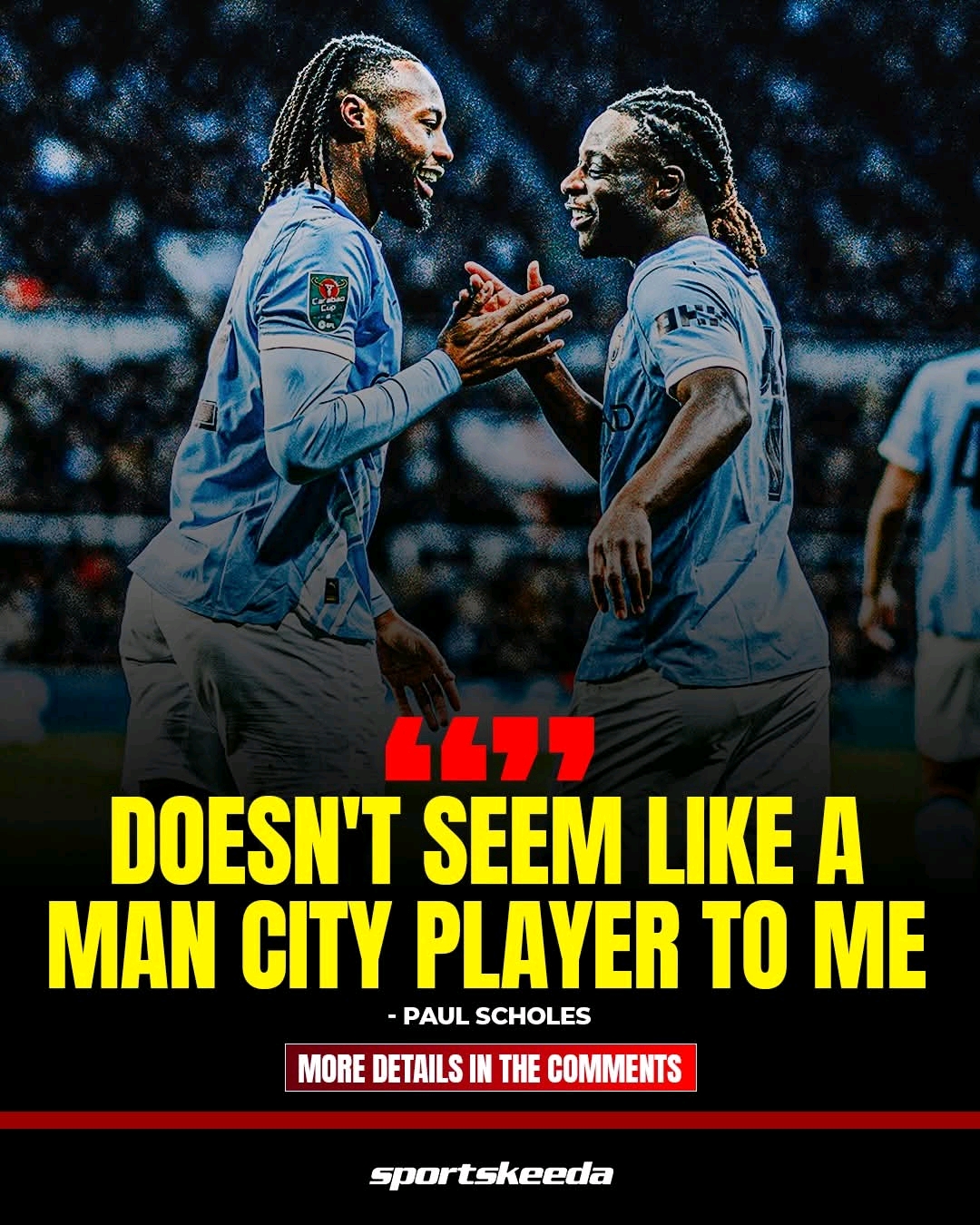
Paul Scholes has never been a man who hides his feelings, and when the Manchester United legend speaks about football, especially when it involves Manchester City, people listen. This time, his words have caused serious debate across England after he questioned whether Antoine Semenyo truly fits the Manchester City identity. In a statement that quickly went viral, Scholes openly suggested that Semenyo does not look like a Manchester City player and would have been far more suitable at Manchester United instead.
The comment came just days after Manchester City completed the shock signing of Antoine Semenyo from Bournemouth in a deal worth around sixty-four million pounds. It was one of the most talked-about transfers of the January window. City moved fast, triggered the release clause, and tied the Ghanaian international down to a five-and-a-half-year contract that will keep him at the Etihad Stadium until 2031. The speed and decisiveness of the move caught many clubs by surprise, especially Manchester United, Chelsea, and Liverpool, who had all been monitoring Semenyo closely.
Over the last twelve months, Semenyo had quietly turned himself into one of the most dangerous attackers in the Premier League. At Bournemouth, he was not just another winger. He was the main man. Everything went through him. He carried the ball, bullied defenders with his strength, scared full-backs with his pace, and finished chances with confidence. By the time City made their move, he was already sitting third on the Premier League scoring chart this season, a remarkable achievement for a player from a club fighting to stay competitive in the league.
Yet for Paul Scholes, goals and numbers alone do not define whether a player belongs at Manchester City. Speaking on The Good, The Bad & The Football podcast, the former United midfielder made it clear that while Semenyo is a very good player, he does not see him as a natural fit for Pep Guardiola’s system. According to Scholes, City simply did not need him.
Scholes explained that Manchester City players are usually known for their intelligence, close control, and ability to play in tight spaces. He spoke about players like David Silva and Phil Foden, footballers who can unlock defenses with one touch, quick thinking, and technical creativity. In his eyes, Semenyo is built differently. He is about power, speed, and direct running. He is a player who likes space, who likes to drive forward, and who uses physical strength to dominate opponents.
Scholes did not say Semenyo is a bad player. In fact, he admitted that he would have loved to see him at Manchester United. That, for him, was the real issue. He believes Semenyo’s qualities match United’s needs far more than City’s. United have been crying out for power, pace, and aggression in wide areas. They have struggled to stretch teams, to attack with intensity, and to hurt opponents on the counter. Semenyo, in Scholes’ view, would have solved many of those problems.
The former midfielder also compared Semenyo’s situation to what happened with Jack Grealish. At Aston Villa, Grealish was everything. He was the leader, the star, the player who decided games almost on his own. At Manchester City, he had to adapt. He became one part of a bigger system. While Grealish eventually found success and won trophies, the transition was not easy. Scholes believes Semenyo may face the same challenge.
At Bournemouth, Semenyo was a big fish in a small pond. Every defender feared him. Every attack depended on him. At Manchester City, he is just one of many stars. Erling Haaland, Kevin De Bruyne, Bernardo Silva, Phil Foden, and Julian Alvarez already dominate attention. Semenyo now has to fight for space, minutes, and influence in a squad full of world-class talent.
Scholes also questioned City’s priorities in the transfer market. He argued that the club needed defensive reinforcements more urgently than another attacker. According to him, a centre-back and a right-back should have been higher on City’s shopping list. To him, Semenyo felt more like a statement signing than a necessary one.
However, football has a funny way of responding to criticism, and Semenyo wasted no time answering his doubters on the pitch. From the moment he pulled on the sky-blue shirt, he made an impact. On his debut against Exeter City in the FA Cup, he scored a goal and provided an assist, instantly winning over many City fans. It was the perfect start, full of confidence and purpose.
He followed that performance by scoring again against Newcastle United in the Carabao Cup semi-final first leg. With that goal, Semenyo wrote his name into the history books. He became the first player since Emmanuel Adebayor in August 2009 to score in his first two games for Manchester City across all competitions. That statistic alone sent a strong message to critics.
Pep Guardiola, though calm as always, was clearly pleased. While he did not directly respond to Scholes’ comments, his trust in Semenyo was obvious. Guardiola does not sign players without a plan. He rarely makes emotional or unnecessary purchases. If City activated Semenyo’s release clause so quickly, it suggests they see something deeper in his game than just pace and power.
Inside the City camp, there is belief that Semenyo can be molded. Guardiola has a long history of transforming players. Wingers become midfielders. Full-backs become playmakers. Powerful runners learn patience and positional discipline. Semenyo is expected to learn how to combine his natural athleticism with the technical demands of City’s possession-based system.
Meanwhile, the debate intensified when another Manchester United legend, Nicky Butt, came out with similar comments. Butt openly agreed with Scholes, stating that Semenyo looked more like a luxury signing than a necessary one for City. He questioned whether City were ever desperate for that kind of player, especially considering the attacking options they already possess.
Butt’s words added fuel to the fire, especially among Manchester United fans who already feel frustrated by their club’s struggles. United spent heavily in the summer, bringing in players like Bryan Mbuemo, Benjamin Sesko, and Matheus Cunha. On paper, it looked like a strong transfer window. In reality, results have been inconsistent, performances unstable, and confidence fragile.
For United supporters, watching City sign Semenyo and seeing him deliver immediately only deepened the pain. Here was a player many believed United needed, now thriving at their biggest rival. The contrast between City’s efficiency and United’s uncertainty could not be clearer.
Still, not everyone agrees with Scholes and Butt. Many analysts argue that modern football requires different types of attackers. City may dominate possession, but they also face teams that sit deep and defend with numbers. In those moments, pace and power can be decisive. A playerke Semenyo offers a different threat, someone who can break lines, attack space, and change the rhythm of a game.
There is also the argument that City are thinking ahead. With Kevin De Bruyne entering the later stages of his career and squad rotation becoming more important, adding versatile attackers makes sense. Semenyo can play across the front line, press aggressively, and provide depth during a long season filled with domestic and European commitments.
For Semenyo himself, the challenge is clear. He must prove that he is more than just a powerful winger. He must show intelligence, adaptability, and patience. Every touch will be judged. Every missed chance will be analysed. Playing for Manchester City comes with pressure unlike anything he experienced at Bournemouth.
Yet his early performances suggest he is ready for the fight. He looks hungry, fearless, and eager to learn. He presses defenders, makes clever runs, and does not shy away from responsibility. These are qualities Guardiola values deeply.
As for Paul Scholes, his comments reflect a wider debate about football identity. What does it truly mean to be a Manchester City player? Is it about technical elegance alone, or is there room for raw power and directness? Guardiola himself has evolved over the years, adding different profiles to his squads to stay ahead of the competition.
Time will ultimately decide who is right. If Semenyo continues to score, assist, and influence games, the noise will fade. If he struggles to adapt, the criticism will grow louder. Football, after all, is unforgiving.
For now, one thing is certain. Antoine Semenyo’s move to Manchester City has done more than strengthen a squad. It has sparked conversation, rivalry, and emotion. It has reopened old wounds between Manchester United and Manchester City. It has reminded fans how fine the margins are in modern football.
Scholes may believe Semenyo should have worn red instead of blue, but destiny chose otherwise. Now, under the bright lights of the Etihad, Semenyo has the chance to write his own story. And whether he proves his critics wrong or confirms their doubts, the journey promises drama, tension, and unforgettable moments in the Premier League season ahead.Football rarely gives simple answers. It only gives time. And for Antoine Semenyo, time has just begun.