The tension inside the Etihad Stadium on that Saturday evening was something nobody could ignore because Manchester City were not just playing for three points, they were playing to protect their pride, to silence the critics who were shouting after the shocking Champions League defeat against Bayer Leverkusen. This was a match they could not afford to drop, and every player on the pitch knew it. The fans were loud but nervous, the manager was restless, and the players were trying to look confident even though something inside them was shaking. Everyone wanted a smooth victory, something easy, something that would calm the storm, but football decided to write a different script.
When Phil Foden scored after just 59 seconds, the entire stadium exploded with relief. It felt like a message: the pain of midweek was gone, the anger was washed away, City were back. And when Josko Gvardiol rose high and scored the second from a corner, it felt like the game was already finished before it even began. People in the stands were smiling again, the crowd started singing louder, and even Pep Guardiola seemed calmer for a moment. Leeds looked lost and frustrated, and City looked like a team that wanted to punish anyone who crossed their path.
But football is cruel, ffootball always waits for the moment when you relax, when you think everything is safe, and then it flips the script. The visitors changed their tactics in the second half and started playing direct football, long balls, physical pressure, fast counterattacks. Suddenly the comfortable 2-0 lead didn’t feel so safe anymore. Then the first Leeds goal came out of nowhere, Dominic Calvert-Lewin getting in front of the defender and smashing the ball past Gianluigi Donnarumma. The moment the ball hit the net, panic entered the stadium. Every player in blue instantly felt fear because they remembered the collapse in Germany a few days earlier. The confidence that was there before suddenly disappeared.
Then Leeds scored again, Lukas Nmecha finishing a chance that felt like a dagger in the heart. From 2-0 to 2-2 the whole stadium turned silent, gasping in shock. City players looked at each other in confusion, wondering how this nightmare suddenly began, wondering why every mistake was punished, wondering why controlling the match suddenly felt impossible. The fans started biting their nails. The noise turned into anxiety. Pep Guardiola stood on the touchline looking like a man about to explode from frustration. Emotion was everywhere and nobody could hide it.
In moments like this, leaders are needed, and that was when Ruben Dias completely switched into warrior mode. Dias is not a quiet player when the team is under pressure. He is the type that screams, pushes, demands, and fights. Every tackle started to look like life or death for him. And then came one of the most dramatic moments of the match, the moment people are still talking about. Leeds were attacking again, City were losing control, the team were panicking, and Pep Guardiola desperately wanted to reorganize the squad, but there was no natural stoppage in play. Guardiola kept shouting instructions that players could not hear. The match was moving too fast, and City were sweating heavily.
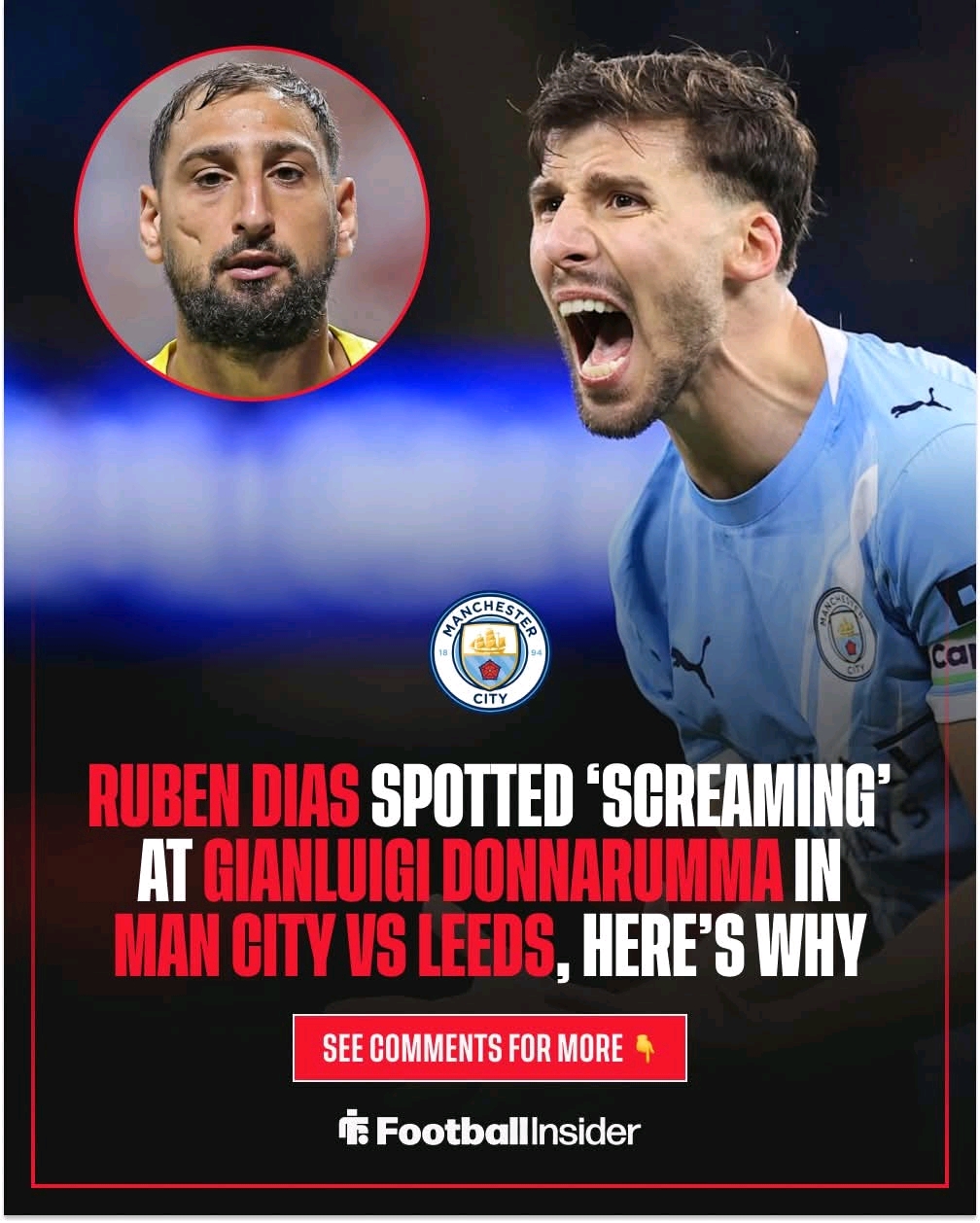
Then suddenly Ruben Dias turned toward the goalkeeper and started screaming, waving his arms like a man trying to save a city from an earthquake. For 10 or 15 seconds he was signalling loudly for Gianluigi Donnarumma to go down. People in the stands were confused. At first they thought Dias was telling Donnarumma to be alert or to switch positions, but then it became clear — Dias was asking Donnarumma to simulate an injury so the referee would stop the match and the team could go to Guardiola for an urgent tactical discussion.
A second later Donnarumma dropped to the ground holding his leg. The referee immediately stopped the match, the physios came running in, but everyone quickly realized what was happening. Manchester City players ran straight to Pep Guardiola. It was not about pain, it was about tactics. It was not about injury, it was about survival. Pep grabbed players one by one, giving instructions with full emotion, intensity written across his face. It was the type of strategic cheating that football fans know exists but never admit openly. Everyone does it, but nobody likes to talk about it.
The moment was so dramatic that journalists on social media reacted instantly. Jack Gaughan from the Daily Mail posted that Dias had screamed at Donnarumma to go down, Donnarumma fell to the ground, the City team used it as a tactical timeout, and then Donnarumma stood up perfectly fine. Fans across the country were arguing online, some calling it smart, some calling it embarrassing, some calling it football intelligence, others calling it against the spirit of the game. But the truth is simple — City were drowning, and they did anything they could to breathe again.
When the match restarted, City looked a little more organized, a little more confident, but they were still nervous because they knew this was not a normal match. All the pressure from midweek, all the fear of losing again, all the criticisms about not being mentally strong, all the doubts about the new signings — everything was sitting on their shoulders like a mountain. Leeds kept attacking and the fans were praying and suffering and begging for it to end. Every mistake felt like disaster. Every cross sent fear through the stadium.
Then the moment that saved the club happened — Phil Foden again, the hero of the night. It was stoppage time, nerves everywhere, hearts beating fast, and Foden received the ball, didn’t think twice, and fired a shot that flew into the net like destiny. The Etihad went wild. People were hugging strangers. The bench was full of bodies jumping everywhere. Pep Guardiola finally let out the frustration with a scream of relief. The nightmare was avoided. The collapse was prevented. The victory was stolen back from disaster.
Even though City won 3-2, the match left marks inside the squad. People saw the fear. People saw the panic. People saw the tactical timeout incident. People saw how easily City can lose control when under pressure. And a new talking point started instantly — the performance of Gianluigi Donnarumma.
It was not his best night. His handling was shaky, his decisions under pressure were uncertain, and his communication with defenders was not perfect. Many fans online started asking if the big signing was worth it, if the goalkeeper who came with such reputation could really fit in this system. Even more worrying is the fact that Donnarumma is now one yellow card away from suspension after collecting his fourth booking of the season. The rule says he must go six Premier League games without another card or he will miss a match, and that possibility has City supporters scared because the club is already under pressure and a goalkeeper change during this difficult period could be dangerous.
James Trafford, the academy graduate who started the season as number one, has now been pushed to the bench. He is waiting patiently, trying to stay professional, but that hunger to prove himself is burning inside him. Trafford knows that one more yellow card for Donnarumma means an automatic opportunity for him. And if he gets a chance and performs brilliantly, the goalkeeper debate inside the club will become even bigger. Guardiola doesn’t want that type of drama right now because the team is already fighting for stability and fighting to regain confidence.
The situation is now complicated. Donnarumma is the number one but under pressure from fans, from journalists, and from Trafford sitting right behind him. Every game he plays from now until the next six matches will feel like walking on glass because one mistake might lead to a booking and one booking might lead to a suspension. And if the suspension happens at the wrong time — maybe against a big team — the headlines will explode and the blame will be heavy.
Ruben Dias on the other hand has earned praise and criticism at the same time. Some fans loved his leadership, calling him the general of the defence, saying this is the type of warrior spirit the team needs when things get difficult. Others said his actions were embarrassing, claiming that asking a teammate to fake an injury shows weakness, not strength. But Dias is not the type to worry about opinions. He only cares about winning, and that night he was willing to do anything to protect the team from collapsing.
Inside the dressing room after the match, it was not full celebration. It was relief mixed with frustration. Guardiola congratulated the team for fighting, but he reminded them that this performance was not acceptable for champions. Players were silent because they knew he was right. They escaped, but they didn’t control the match. They won, but they didn’t convince anyone. The three points were in the bag but the world still saw the cracks.
Phil Foden was the golden boy of the night, the only one who looked fearless, the only one who looked confident, the only one who looked ready to lead. Without him, City would have drowned. With him, they survived. But football is not about one player. Football is about a system, a unit, a mentality. And Manchester City are now in a part of the season where any small weakness becomes a big weakness.
This match will be remembered not because of the scoreline, not because of the dramatic late winner, but because of that moment when Ruben Dias screamed at Donnarumma to go down, because it symbolised the pressure, the fear, the desperation, and the huge expectations that Manchester City live with every week. Being a champion is not easy. Staying a champion is even harder. When you win too much, the world expects you to win forever, and the moment you struggle, people start shouting louder than ever.
City escaped disaster this time. They grabbed the victory when everything seemed lost. But football never sleeps, and the next match is already coming. Everyone will be watching Donnarumma. Everyone will be waiting to see if City look stronger or weaker. Everyone will be ready to judge again.
And that is why the Premier League is a battlefield — there is no time to rest, no time to relax, no time to hide. You either rise or you fall. And after this dramatic win over Leeds, Manchester City are standing, but still shaking