THIS IS NOT A MEANINGLESS TROPHY!” — Agüero fires back at Henry after Carabao Cup final After Manchester City’s 2-0 win over Arsenal at Wembley, with Nico O’Reilly scoring twice, a fiery debate erupted between Sergio Agüero and Thierry Henry. Henry sparked controversy by calling the Carabao Cup “meaningless,” saying top clubs should focus on bigger

The sun had barely set over Wembley Stadium, but the lights blazed down like the bright intensity of the Carabao Cup final itself. Manchester City had just secured a 2-0 victory over Arsenal, a performance that was clinical, precise, and utterly dominant. Nico O’Reilly had scored both goals, his composure and finishing lighting up the pitch and giving the Cityzens another reason to celebrate. Fans roared in celebration, banners waved, flags flew, and chants filled every corner of the stadium. It was the sort of night that players, managers, and supporters alike would remember for years. Yet, amidst the celebration, a storm was quietly brewing in the world of football punditry, one that would spark fierce debate and divide opinions on the very value of trophies, glory, and ambition.
Thierry Henry, the legendary Arsenal forward whose name had long been associated with the art of attacking football and winning major honours, had voiced a statement that immediately caught fire. During a live broadcast following the match, Henry referred to the Carabao Cup as “meaningless.” According to him, top clubs—those chasing the Premier League, Champions League glory, and historic European dominance—should focus on titles that carry weight, titles that etch themselves into history books and into the minds of football fans worldwide. The Carabao Cup, in Henry’s view, was secondary, an achievement of minor importance compared to the drama and prestige of league campaigns and continental competitions. His words, though calm and measured, were enough to ignite a debate that would become explosive within hours.
Sergio Agüero, a man whose career had been defined by goals, hunger, and a relentless pursuit of victory, was not about to let such a statement pass without challenge. Agüero had witnessed firsthand the value of winning, the pride that comes with lifting a trophy, no matter its perceived importance. In his mind, every title mattered, every victory carried weight, and every cup had a story behind it. He believed that football was not just about the grandeur of the Champions League or the historic prestige of the Premier League—it was about passion, about moments of triumph, about building a winning culture. And the Carabao Cup, far from meaningless, represented all of that.
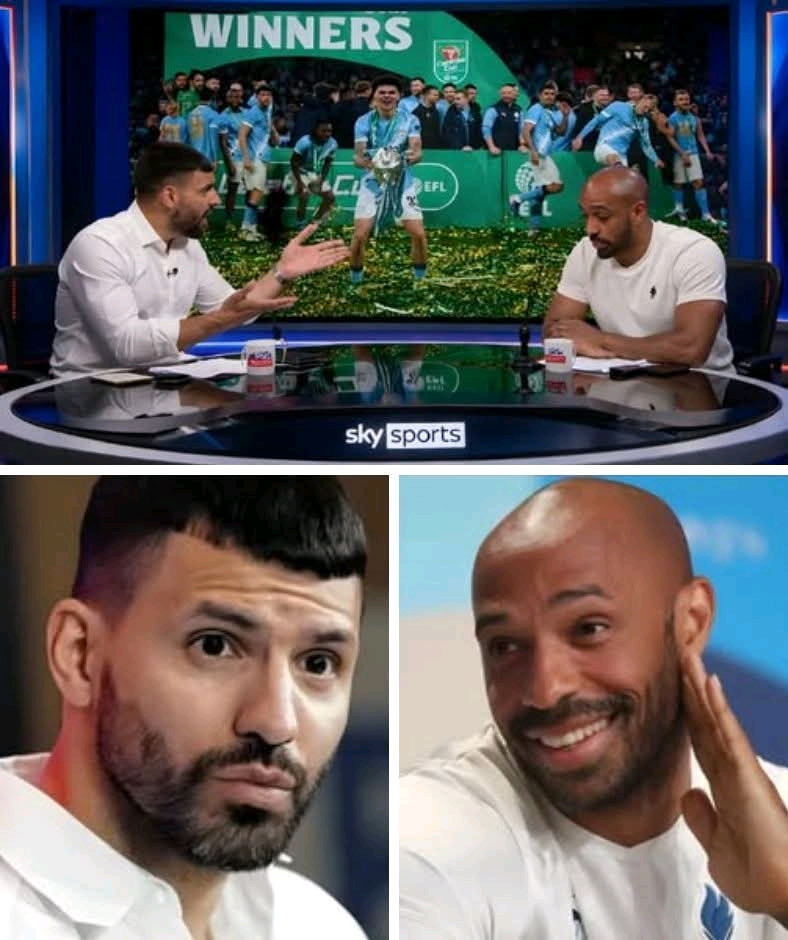
The exchange between Agüero and Henry did not happen in whispers. It happened live, on television screens across the country, as pundits, former players, and fans watched every expression, every gesture, every carefully chosen word. Agüero, sitting with a fire in his eyes that could ignite a stadium, leaned forward and began to articulate his point with precision and fervor. He reminded viewers that trophies, regardless of size or public perception, were proof of effort, evidence of skill, and testament to teamwork. Every final, every goal, every training session that contributed to a victory mattered, and each victory built momentum, confidence, and a culture of winning that could elevate a team to greatness in the future.
Henry, ever the measured voice of reason, maintained his stance calmly. He acknowledged the brilliance of Manchester City’s performance, the quality of Nico O’Reilly’s finishing, and the tactical mastery displayed by Pep Guardiola’s side. Yet he reiterated his central point: elite clubs needed to prioritize the trophies that shaped legacies, the competitions that tested every ounce of their strategy, endurance, and resilience. To Henry, the Carabao Cup was a stepping stone, a minor hurdle compared to the grandeur of the league or Europe’s toughest battles.
The debate intensified as cameras captured every reaction in the studio. Agüero’s gestures were animated, passionate. He spoke of the history created in every dressing room, of the celebrations in training grounds that followed a hard-fought win, of the motivation that victory infused into players, young and old alike. “Every trophy matters,” he declared, voice rising with emotion. “You cannot diminish the work, the effort, the dedication. Winning builds history, it builds fighting spirit, it builds belief. You do not look back on effort and say, ‘that does not matter.’ It always matters, and that is what football is about.”
Henry nodded, respecting Agüero’s intensity, but he countered with strategic reasoning. “I understand your point, Sergio,” he said calmly. “I know what it feels like to lift trophies, to celebrate with your teammates, to hear the fans chant your name. I have been there. But when you are at a club that competes for the highest honours, you have to make decisions about where to focus. Energy, attention, mental sharpness—these are limited resources. Sometimes, winning everything is impossible, and prioritizing is necessary. The league, the Champions League, they define careers. They are remembered decades later. Minor trophies do not carry the same weight, even though they are earned fairly and with effort.”
Agüero, however, was unyielding. He leaned back for a moment, letting Henry’s words settle, then struck again with precision and emotion. “You cannot separate effort from value,” he said. “Every game you play, every pass, every run, every save, every goal—these moments accumulate. If you do not value the smaller victories, you never truly respect the bigger ones. The Carabao Cup may not carry the same history as the Premier League or the Champions League, but it represents excellence. It represents the team’s ability to perform, to adapt, to overcome. It represents discipline. And above all, it represents joy, for players and fans alike. You win, and you create memories. That is priceless.”
For viewers and fans, the debate was electric. Social media exploded with reactions, with fans of all clubs weighing in. Some agreed with Henry, citing the long history of elite footballers who focused on league dominance and European glory. Others aligned with Agüero, praising the Argentine’s defense of every victory, his respect for the work ethic required to succeed, and his belief that no triumph should be dismissed. Articles were written, forums lit up, and hashtags began trending worldwide, all inspired by this clash of footballing philosophies.
Inside the studio, the tension was palpable. Colleagues and fellow pundits attempted to mediate, to highlight both perspectives, yet the energy between Henry and Agüero was electric and unshakable. They represented two approaches to football culture: one emphasizing selective ambition, the other valuing relentless achievement. Yet beneath the surface, both agreed on the essence of the sport: passion, dedication, and the pursuit of excellence. The difference lay only in what counted most.
Agüero also emphasized the role of younger players in such victories. He spoke about the impact of a trophy on a young footballer’s confidence, on their belief in themselves, and on their understanding of professional football. “When a young player lifts a trophy, even a minor one, they understand what it takes to succeed. They understand commitment, teamwork, and resilience. They learn that victory is possible, that dreams can be realized. You cannot underestimate the effect this has on the future of a team.”
Henry responded with his usual eloquence, highlighting the need to balance ambition with realism. “I am not against winning trophies,” he said. “I am against misaligned priorities. Winning is important, but you must focus where it counts most. Clubs that chase everything without strategy often falter in the competitions that define them. I have seen it, and history is full of examples. It is about preparation, planning, and legacy.”
Despite their differing viewpoints, a mutual respect underpinned the debate. Agüero’s words were fiery, but they were rooted in experience and passion. Henry’s logic was sharp, based on decades of elite-level competition and observation. The tension between emotional drive and strategic calculation highlighted a broader truth about football: it is as much about philosophy as it is about skill, as much about mindset as it is about goals.
The studio discussion went on for nearly an hour, with Agüero refusing to yield. He even recounted stories from his own career, victories that some may have seen as minor but that shaped him as a player and a teammate. He spoke of locker room celebrations, of fans’ joy, of the sense of achievement that could fuel a team to reach even higher goals. His voice carried the passion of someone who had lived football at the very highest level, someone who knew the value of every battle, every challenge, and every triumph.
By the end of the broadcast, the audience was left captivated, energized, and divided. The debate did not have a clear winner; rather, it highlighted the complexity of football culture. For some, Henry’s approach resonated—a reminder that focus, legacy, and careful prioritization were necessary in elite competition. For others, Agüero’s stance was inspiring, a celebration of effort, achievement, and the recognition that every success, no matter its scale, had meaning.
Even after the cameras were turned off and the lights in the studio dimmed, the discussion continued. On social media, fans dissected every quote, analyzed every gesture, and replayed the moments of fiery exchange. Memes were created, videos clipped, and pundits across the globe weighed in. Football forums became battlegrounds of opinion, and journalists wrote columns about the debate for days. It became a talking point that transcended a single match, sparking reflection about the essence of competition, ambition, and victory.
Meanwhile, back at Manchester City, the players continued to celebrate their victory. They understood that Agüero’s words reflected the ethos of the team: respect for every opponent, appreciation for every game, and pride in every trophy lifted. Guardiola and his staff recognized that maintaining motivation, focus, and belief in smaller victories could carry the squad through the grueling demands of the season. A Carabao Cup victory, far from being meaningless, became a foundation for confidence, cohesion, and future ambition.
Ultimately, the clash between Agüero and Henry was more than a debate about a single trophy. It was a philosophical battle, a conversation about how football is perceived, valued, and played. It was about ambition versus appreciation, strategy versus passion, and legacy versus journey. It reminded the footballing world that while history celebrates the great triumphs, the path to those triumphs is built on smaller, meaningful victories.
Agüero’s defense of the Carabao Cup, his passionate insistence that every trophy matters, and his unyielding belief in the value of victory became a rallying cry for players, coaches, and fans alike. And for Thierry Henry, the calm, measured argument about priorities, focus, and legacy served as a reminder that even in celebration, strategy must guide ambition.
In the end, both perspectives hold truth, both carry weight, and both offer lessons. And while the debate will continue, one thing remains certain: football, in all its glory, drama, and emotion, is never meaningless. Every goal, every win, every trophy, and every moment shapes the story of the game, inspires the next generation, and keeps the passion alive for players and fans around the world.
The Carabao Cup may not be the Premier League or the Champions League, but on that night at Wembley, it was a stage for brilliance, a canvas for victory, and a battleground for principles. Agüero’s words, fierce and heartfelt, echoed long after the celebrations ended: no trophy is meaningless. Every victory counts, every effort matters, and every player, every team, every fan has a stake in the story. Football is about winning, yes, but it is also about believing that every win, every moment, every memory is valuable, cherished, and part of something much bigger.
And so, as the Wembley lights dimmed and Manchester City’s celebrations carried on into the night, one debate remained unresolved but eternally relevant: what truly defines the value of a trophy? For Sergio Agüero, the answer was clear. For Thierry Henry, the challenge was strategic. For the rest of the football world, it was a reminder that passion, debate, and differing perspectives are what make the beautiful game endlessly fascinating.