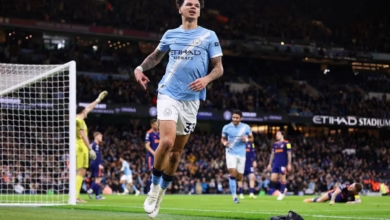
Manchester City walked onto the pitch knowing that every match now feels like a final. The title race is tight, the pressure is heavy, and every small decision can change everything. When they faced Newcastle United in what ended as a dramatic 2-1 victory, the spotlight did not shine only on the goals or the tactics. It shone brightly on VAR once again. In modern football, especially in the Premier League, Video Assistant Referee decisions are almost as important as the players themselves. Fans talk about them, managers complain about them, and players react to them. And in this game, two big moments caused heated debates — one about a disallowed goal and another about whether Bernardo Silva should have been sent off.
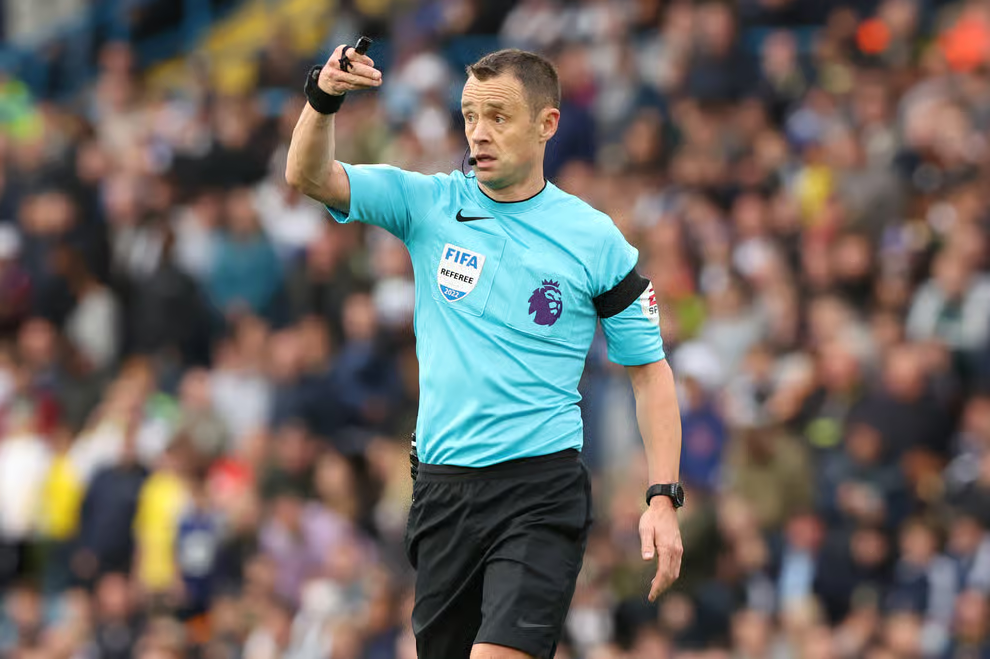
The match was played with intensity from the first whistle. Manchester City, led by Pep Guardiola, are used to controlling possession and dictating the tempo. Newcastle United, on the other hand, are a physical and aggressive side, not afraid to challenge City’s rhythm. It was a game full of energy, tackles, and strong aerial battles. The referee on the day was Tom Bramall, with James Bell operating as the VAR. Both officials knew they were handling a high-stakes encounter.
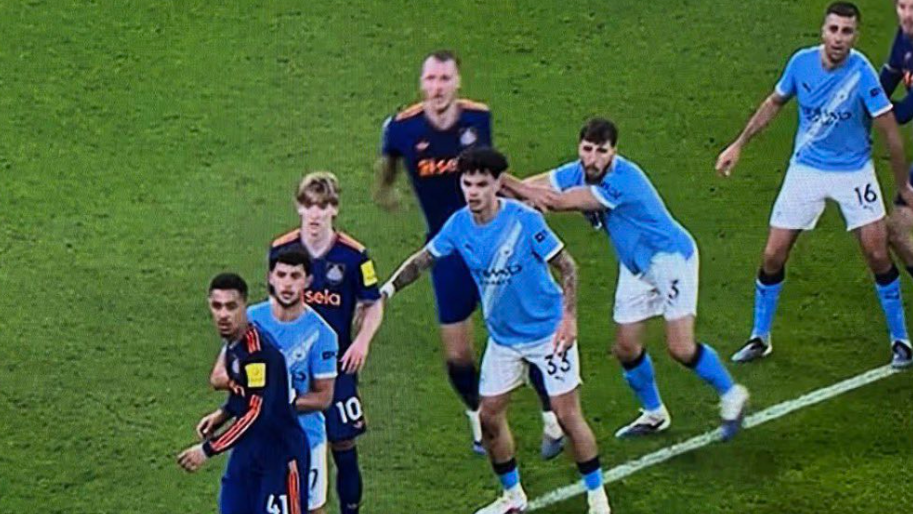
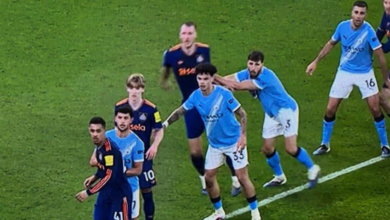
The first major controversy happened in the 42nd minute. Newcastle were pushing hard and won a free kick. Sandro Tonali stepped up and delivered a dangerous ball into the box. Dan Burn rose high above the defenders and nodded the ball into the net. Newcastle players celebrated. Their fans erupted in joy. For a moment, it looked like they had taken the lead in a crucial match.
But the assistant referee had his flag raised.
Offside.
The stadium’s energy changed instantly. Manchester City players felt relief. Newcastle players were confused and angry. Replays started to roll. And that is when the debate truly began.
The footage showed something important. Dan Burn was indeed standing in an offside position when he made contact with the ball. But there was another key detail. Before the ball was actually delivered into the area, Rúben Dias appeared to push Burn. That push moved Burn slightly forward. And that movement may have been the reason he was standing in an offside position when he scored.
This is where football becomes complicated.
According to the Laws of the Game, a foul can only be given when the ball is in play. If a player commits an offence before the ball is active, technically it is not punishable in the same way as a normal foul during open play. In this case, Tonali had not yet played the ball when Dias made contact with Burn. The push was clear. It was deliberate. But it happened before the free kick was taken.
VAR looked at everything. They reviewed the timing. They reviewed the contact. They checked the offside line. But under the laws, their hands were tied. Since the push occurred before the ball was in play, it could not be considered a foul leading to a penalty or any other decision. The only active moment that mattered was when Burn headed the ball — and at that exact moment, he was in an offside position.
So the on-field decision stood.
No goal.
For Newcastle fans, this felt unfair. From their point of view, their player was pushed into an illegal position. They believed that without the push, Burn would have been onside. They saw it as clever but cynical defending by Dias. They argued that justice was not served.
But from a purely legal standpoint, Manchester City’s defenders understood the rule. Timing is everything in football. Dias pushed before the ball was kicked. Once the ball was struck, Burn was already ahead. The law does not allow VAR to punish an action that occurs when the ball is not in play, unless it is violent conduct. This was not violent conduct. It was a calculated move.
In modern football, players are extremely aware of the rules. They study them. Coaches analyze them. Teams plan around them. It is possible that City’s defensive line knew exactly what they were doing. Push early. Hold the line. Force the offside. It was risky, but it worked.
The second controversial moment happened in the 51st minute, just after halftime. Bernardo Silva, already on a yellow card, challenged Dan Burn in what looked like an unnecessary collision. Silva jumped into Burn without making a clear attempt to play the ball. Newcastle players immediately appealed. They wanted a second yellow card. They wanted City reduced to ten men.
If Silva had been shown a second yellow, he would have been sent off. That could have completely changed the match.
The referee, Tom Bramall, chose not to book him again.
VAR did not intervene. Under current rules, VAR cannot review second yellow card offences. They can only step in if they believe a straight red card offence has occurred. This challenge, while clumsy, did not reach the threshold of serious foul play or violent conduct. Therefore, the VAR had no authority to recommend a red card review.
This is one of the most misunderstood parts of VAR. Many fans believe VAR can review everything. That is not true. VAR has strict limits. They can review goals, penalties, direct red cards, and cases of mistaken identity. They cannot review normal yellow cards or second yellow card situations.
So the responsibility was entirely on the referee’s shoulders.
For a referee to give a second yellow card, the foul must clearly deserve a caution. It must immediately feel like misconduct. In real time, in a fast and physical game, decisions are made in seconds. Watching slow-motion replays later can make incidents look worse. But referees do not have that luxury during play.
In isolation, Silva was lucky. That is the honest truth. He made no serious attempt to play the ball. He risked everything with that jump. In a different match, with a different referee, he might have walked off the pitch.
But context matters.
The game was physical. Challenges were flying in from both teams. There had been several strong duels. It was not a calm match. It was aggressive and competitive. In that environment, Bramall likely judged the challenge as part of the flow of the game rather than something deserving dismissal.
Game management is an important skill for referees. Sending a player off can dramatically affect the match. Referees are trained not to look for excuses to show cards but to manage the contest fairly. If a challenge is borderline, they may choose to warn rather than punish severely.
City eventually went on to win 2-1. The result boosted their confidence in the title race. Pep Guardiola praised his team’s resilience. Newcastle felt frustrated but proud of their effort.
Yet once again, the main talking point was VAR.
This has become a weekly pattern in the Premier League. Every round produces at least one controversial decision. Fans debate online. Pundits analyze clips repeatedly. Former referees give their opinions. Social media explodes with arguments.
The truth is that VAR was introduced to reduce clear and obvious errors. It was not designed to remove all controversy. Football is subjective. Some decisions will always divide opinion.
In the offside incident, the law was applied correctly. But many will argue that the spirit of the game was not satisfied. Should a player be allowed to push someone before a set piece to gain advantage? Should that be addressed differently in future rule updates?
In the Bernardo Silva case, the referee made a judgment call. It was not a clear mistake. But it was also not a perfect moment. It was one of those grey areas that define football.
As the title race continues, every decision feels bigger. Manchester City are chasing another championship. Newcastle are fighting for European qualification. Margins are small. Points are precious.
This match will be remembered not just for the scoreline but for the debates it created.
VAR remains a powerful tool, but it is not a magic solution. It works within the Laws of the Game. And those laws are sometimes rigid. When situations fall into technical gaps — like a push before the ball is in play — frustration grows.
Football is emotional. It always has been. Technology has not changed that. If anything, it has increased scrutiny. Every angle is shown. Every contact is replayed in slow motion. Every referee decision is examined from ten different perspectives.
But in the end, decisions must follow the rules.
Manchester City will not apologize for understanding those rules. Newcastle will feel hard done by. Neutral fans will continue to argue.
And next week, another VAR controversy will arrive.
That is the reality of modern Premier League football.
The game between Manchester City and Newcastle United was intense, dramatic, and full of passion. It reminded everyone why football is so loved — and why it can also be so frustrating.
As long as VAR exists, debates will continue. As long as football remains a game of small margins, emotions will run high.
But one thing is certain: in big matches, big moments define everything. And sometimes, those moments happen not with a goal, but with a whistle, a flag, or a silent review in a control room miles away from the stadium.