Yaya Touré Reopens His Rift with Pep Guardiola, Calling Him a “Snake” and Claiming He Was Treated “Like Dirt

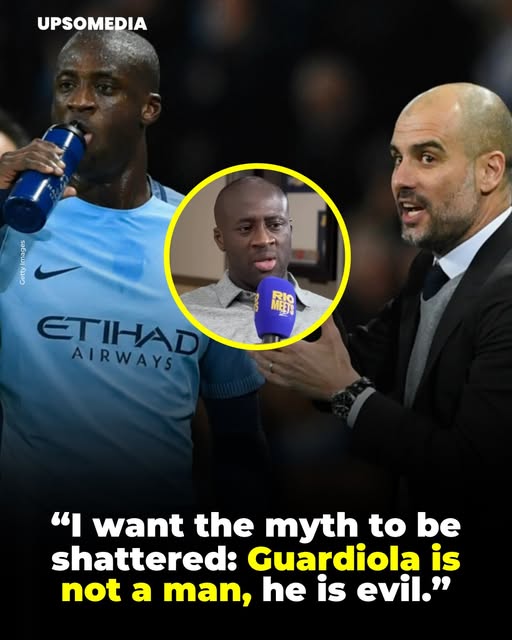
More than a decade after their first major conflict erupted in the dressing rooms of FC Barcelona, the long-simmering feud between Yaya Touré and Pep Guardiola has once again burst into public view. In a dramatic and emotionally charged new interview, the Ivorian midfield legend has launched fresh accusations at his former manager, claiming Guardiola treated him “like dirt” and insisting he still has not forgiven what he views as years of disrespect and humiliation. The renewed tension has sparked discussion throughout the football world, resurrecting one of the sport’s most notorious and enduring personal disputes.
Touré’s latest comments, delivered during an appearance on the ZACK YouTube channel, peel back old wounds and bring to light the complicated personal history between two towering figures of the modern game. What began as a tactical disagreement at Barcelona in 2008 evolved into one of the most widely debated manager-player conflicts of the era—one that followed them from Catalonia to Manchester and ultimately came to shape the later years of Touré’s career.
In this newly expanded retelling of events, we trace the origins of the feud, examine how their relationship deteriorated at two different clubs, explore the personal dimensions Touré has now added to the narrative, and consider the broader implications within the modern football landscape.A Legacy of Tension: How the Touré–Guardiola Rift First Began
To understand the intensity of Touré’s recent remarks, it is necessary to return to the summer of 2008, when Pep Guardiola—newly promoted from Barcelona B—took charge of a senior Barcelona squad that contained some of the most talented players in the world. Among them was Yaya Touré, already regarded as one of the most complete midfielders in European football.
But Guardiola walked into the dressing room with a radical tactical blueprint. Central to his philosophy was the idea of total positional control, quick and precise passing, and a dedicated pivot who could dictate rhythm from deep positions. In Guardiola’s view, a young Sergio Busquets—then only 20 years old—embodied the ideal qualities for that role.
Touré, powerful, athletic, dynamic and capable of playing multiple positions, had thrived at Barcelona under Frank Rijkaard. But under Guardiola, his responsibilities shifted dramatically. He was asked to play deeper, more rigidly, and eventually found himself sidelined altogether as Busquets rose to prominence.
Related Posts:



This decision marked the beginning of a fissure that would never fully close.
Touré later admitted that he struggled to understand the sudden loss of trust. While he continued to perform well when used—famously filling in as a centre-back during Barcelona’s 2009 Champions League final—he could not shake the feeling that Guardiola was phasing him out. By the summer of 2010, the relationship had deteriorated enough that Barcelona agreed to sell him to Manchester City.
Touré would later reveal that the exit left him deeply hurt, believing he had been pushed aside not for performance reasons but due to Guardiola’s personal opinion of him.
That bitterness, as we now know, would resurface years later.
Manchester City Reunion: Old Problems, New Stage
When Pep Guardiola was appointed Manchester City manager in 2016, it initially appeared to be a fresh start. Touré, by then a Premier League icon and one of City’s most influential players of the modern era, welcomed the opportunity to work again under one of the world’s top managers.
But, almost immediately, familiar tensions returned.
Touré was excluded from City’s Champions League squad at the start of the season—a decision that surprised many, given his legendary status at the club. Guardiola argued that the team needed a faster, more flexible midfield, while Touré interpreted the exclusion as a personal slight. Matters escalated further when Touré’s agent, Dimitri Seluk, launched a public tirade against Guardiola, accusing him of humiliating a club legend.
Guardiola responded by insisting that Touré would not play until Seluk apologised. Though an apology eventually came, the relationship was once again damaged beyond repair. Touré was reintegrated into the squad but never regained the central role he once enjoyed. He departed Manchester City in 2018, his final season overshadowed by the cold dynamic between player and manager.
After leaving the club, Touré suggested deeper, more troubling motivations had guided Guardiola’s decisions. He hinted that Guardiola did not trust African players—a suggestion the manager firmly denied. The comments generated heated discussion across the global football community, and while Touré eventually backtracked on some of those remarks, the damage had already been done.
Touré’s Latest Outburst: “He Treated Me Like Dirt”
In his recent interview, Touré reignited the controversy with unmistakable intensity. His comments revealed not only professional frustration but also a personal dimension that had not been fully articulated before.
“When I look at him, I don’t see a man,” Touré declared. “I see a snake.”
This metaphor—a strikingly harsh criticism—reflects just how deeply Touré feels he was wronged. He then recounted a pivotal moment from 2010, shortly before he left Barcelona. Guardiola, he claimed, made a last-minute attempt to convince him to stay, despite giving him minimal playing time throughout the season.
“The Barcelona coach calls me and says, ‘You have to come back, it’s important,’” Touré said.
According to him, his wife played a decisive role in pushing him to leave.
“My wife said, ‘Are you going to listen to that nonsense? He treated you like dirt. Now he wants you to stay? Let’s go to Manchester.’”
Touré described how she viewed Guardiola as a harmful presence in his career.
“She told me, ‘He’s wicked, he’s not a good person.’ She saw him as negative energy.”
This revelation adds a new personal layer to the feud. Until now, the conflict had been seen largely through a footballing lens—tactics, squad composition, playing time, and public disputes. Touré has now made it clear that he felt not just sidelined but personally disrespected.
Why Touré Felt Betrayed: The Deeper Emotional Core
To many observers, Touré’s emotions stem from a sense of unfulfilled potential under Guardiola. At Barcelona, Touré was converted from a marauding midfielder into a deeper, more defensive player. At Manchester City, a manager arriving at the club effectively signalled that Touré’s time as a central figure was over.
Touré has always insisted that he responded professionally, performing whenever called upon. What he could not accept was what he perceives as a lack of honesty and transparency.
He believed that Guardiola promised one thing but delivered another. From Touré’s perspective, Guardiola did not simply bench him—he misled him, first about his role in Barcelona’s future, then about his place at City.
Whether this version of events is entirely accurate is impossible to confirm. Guardiola has never publicly criticised Touré, and he has consistently avoided escalating the feud. But Touré’s pain appears genuine, and his anger stems from a personal sense of betrayal, not just lost playing time.
A Feud That Defines Eras and Clubs
Few manager–player relationships have evolved as dramatically—or as publicly—as the one between Touré and Guardiola. It is no exaggeration to say it has marked key chapters in both of their careers.
At Barcelona
- Guardiola built one of the greatest teams in football history.
- Touré was pushed aside, despite performing well.
- The decision to elevate Busquets became foundational to Guardiola’s tactical identity.
At Manchester City
- Touré was a club legend with an unmatched record of decisive goals and leadership.
- He was quickly marginalised under the new regime.
- His agent’s comments and Guardiola’s stern response deepened the wedge.
- Touré’s exit marked the end of an era, symbolising the transition to Guardiola’s fully restructured squad.
In both cases, Touré felt he was discarded, undervalued, and misled. Guardiola, for his part, viewed the decisions as purely footballing and necessary for his tactical evolution. The two perspectives have never aligned, and likely never will.
Why Touré’s Comments Matter Now
Some may wonder why Touré has chosen to speak out again in 2025, years after retiring from professional football and long after Guardiola moved on from the Manchester City era in which Touré last played under him.
The answer lies in legacy.
Touré, unquestionably one of Africa’s greatest footballers and one of the Premier League’s most influential midfielders, is aware of how history remembers players. He knows that Guardiola’s Barcelona and Guardiola’s Manchester City are widely celebrated as two of the most iconic teams of modern football. Yet Touré feels his role in these eras has been diminished in the public narrative—and perhaps unfairly so.
His latest outburst is an attempt to reclaim ownership over his story.
Touré’s perspective is not solely about anger; it is about recognition, respect, and clarity. He wants the world to understand that behind the trophies and the triumphs lay emotional battles, painful experiences, and relationships that were far more strained than fans realised.Guardiola’s Expected Silence
As has been his pattern for years, Pep Guardiola is unlikely to respond publicly. Throughout his career, he has refused to engage in direct conflict with players in the media. Whether the criticism comes from Zlatan Ibrahimović, Samuel Eto’o, or Touré, Guardiola rarely retaliates.
His silence is, in some ways, a statement in itself: he will not dignify the feud with public participation.
At present, Guardiola is more concerned with the challenges of the current Premier League season. His Manchester City squad is facing one of its toughest campaigns yet, with Arsenal appearing to be the dominant force in the title race. Engaging in a dispute from years past would only distract him and his players from more pressing concerns.
The Feud’s Place in Football History
The Touré–Guardiola conflict is not merely a personal saga; it reflects broader themes within elite football:
1. Tactical evolution versus individual brilliance
Guardiola values system efficiency above all else. Touré values expressive, powerful, individual performance. Their philosophical clash is emblematic of a modern football debate.
2. Cultural and emotional disconnect
Touré’s remarks suggest he felt personally and culturally misunderstood. Guardiola’s highly analytical style often comes across as cold or detached to players who thrive on emotional connection.
3. The struggle for legacy
Both men seek to define their place in football history. Touré wants recognition for his contributions; Guardiola wants freedom from accusations of bias or mistreatment.
4. The power dynamics of the modern game
Managers now wield unprecedented control over clubs. Even elite players like Touré can be sidelined overnight if they do not fit a strategic vision.
Will the Rift Ever Heal?
Given the intensity of Touré’s recent comments, reconciliation appears unlikely. Their paths have diverged too much, and the wounds remain too deep. Touré has repeatedly sought closure through public commentary, while Guardiola has opted for passive silence.
Unless both individuals one day choose to openly discuss what happened—with honesty and vulnerability—the conflict will remain frozen in time, unresolved but unforgettable.
Conclusion: A Feud That Won’t Be Forgotten
Yaya Touré’s latest comments have once again thrust his long-running rift with Pep Guardiola back into the spotlight. By calling Guardiola a “snake” and accusing him of treating him “like dirt,” Touré has revived one of football’s most infamous personal conflicts.
The story is more than a feud; it is a study in contrasting personalities, football philosophies, and the complexities of elite athlete-manager relationships. From Barcelona to Manchester, from tactical disagreements to emotional scars, the Touré-Guardiola relationship has become etched into football history.
Whether one believes Touré’s grievances or aligns with Guardiola’s methods, there is no denying the profound impact their relationship has had on both of their careers—and on the narrative of modern football itself.