Anfield has long been one of English football’s most unforgiving arenas, a stadium where history, noise, and expectation collide to suffocate even the most accomplished opponents. On Sunday afternoon, however, Manchester City walked into Liverpool’s fortress with composure, clarity, and a sense of unfinished business. By full time, they walked out with a crucial 2–1 victory, a result that not only reignited their Premier League title charge but also delivered a symbolic moment as Erling Haaland scored his first-ever league goal at Anfield.
The contest was everything a heavyweight Premier League encounter promises: tactical tension, momentum swings, moments of individual brilliance, and decisive interventions at the highest level. For Liverpool, the defeat was bitter, shaped by a brief but costly lapse in the second half and compounded by a late red card. For City, it was a statement — proof that even in a season of setbacks, they remain relentless, ruthless, and capable of winning where it matters most.
### City Strike Early Intent
From the opening whistle, Manchester City made their intentions unmistakably clear. Pep Guardiola’s side did not arrive at Anfield to absorb pressure or play for margins; they came to control the ball, dictate tempo, and silence the crowd through precision and patience.
Barely a minute had passed before City carved open Liverpool’s defensive line. Bernardo Silva, operating in the half-spaces with his usual intelligence, slipped a perfectly weighted through ball behind the defense for Erling Haaland. The Norwegian striker surged forward with his trademark power, bearing down on goal. Only the sharp reflexes and bravery of Alisson Becker prevented an immediate breakthrough, as the Liverpool goalkeeper sprinted off his line and blocked Haaland’s attempt at close range.
It was an early warning shot — one that echoed through the stands and underlined City’s sharpness. The visitors continued to dominate possession in the opening exchanges, circulating the ball with confidence and drawing Liverpool’s midfield out of shape.
City’s control was reflected in their territorial advantage. Abdukodir Khusanov came close to opening the scoring midway through the first half, meeting a teasing delivery from Silva with a header that sailed narrowly over the bar. The chance was emblematic of City’s approach: patient buildup, clever movement, and constant probing of Liverpool’s defensive structure.
For Liverpool, the first half was a frustrating exercise in containment rather than expression. Jürgen Klopp’s side found it difficult to string together meaningful attacking sequences, often pressed into rushed passes or forced backwards by City’s aggressive counter-press.
The Reds’ first genuine opening did not arrive until around the 25th minute. Alexis Mac Allister, one of Liverpool’s brighter performers on the day, spotted Mohamed Salah’s run and threaded a precise through ball into the Egyptian’s path. Salah found himself in a promising position inside the box, but a heavy touch allowed City’s defenders to recover, and the opportunity fizzled out before it could trouble Gianluigi Donnarumma.
That moment proved to be Liverpool’s lone spark in an otherwise subdued first half. City continued to look the more threatening side, moving the ball with purpose and forcing Liverpool to defend deep for extended spells. Despite their dominance, however, Guardiola’s men were unable to find a breakthrough before the interval.
As the halftime whistle blew, the scoreboard read 0–0, but the underlying story was clear. Manchester City had dictated the rhythm and limited Liverpool to speculative moments, while the home side headed into the dressing room having failed to register a single shot on target.
The second half began with a noticeable shift in energy from Liverpool. Klopp’s message at halftime was evident almost immediately, as the Reds pressed higher, moved the ball quicker, and committed more numbers forward.
Dominic Szoboszlai embodied Liverpool’s renewed intent. The Hungarian midfielder tested Donnarumma early in the half with a powerful strike from distance, forcing the City goalkeeper into a solid save. Moments later, Hugo Ekitike tried his luck with a curling effort that drifted just wide of the post, drawing a collective gasp from the Anfield crowd.
City were briefly rattled, but not panicked. They responded with a chance of their own when Antoine Semenyo broke free on the counter and fired a low shot toward goal, only for Alisson to produce another assured save. The game had opened up, transforming from a controlled chess match into a high-tempo exchange.
Liverpool continued to push. Salah, increasingly influential on the right flank, delivered a dangerous cross into the penalty area that seemed destined to be converted. Ekitike rose to meet it, but his header lacked precision and drifted harmlessly wide. It was another reminder of Liverpool’s struggle for clinical execution
As the match entered its final quarter, the sense grew that a single moment could define the outcome. That moment arrived in the 74th minute — and it belonged to Dominic Szoboszlai.
Awarded a free-kick just outside the penalty area, the midfielder stepped up with confidence etched across his face. The wall was set, Donnarumma positioned himself, and Anfield held its breath. Szoboszlai struck the ball cleanly, curling it with pace and precision over the wall and into the corner of the net. Donnarumma remained rooted to the spot, helpless as the ball flew past him.
Anfield erupted. Liverpool had finally broken through, rewarded for their second-half intensity. At 1–0, the momentum was firmly with the home side, and belief surged through the stands
But champions respond to adversity with composure — and Manchester City did exactly that.
Just minutes after falling behind, City struck back. A long ball into the box was contested by Haaland, whose aerial presence caused immediate problems. The ball dropped invitingly for Bernardo Silva, who reacted quickest, guiding it beyond Alisson with a composed finish. The equalizer was swift, decisive, and devastating for Liverpool.
The goal shifted the psychological balance instantly. Where Liverpool had been surging with confidence moments earlier, City now sensed vulnerability. Their passing became sharper, their movement more purposeful, and their pressing more aggressive.
The decisive moment followed soon after. Haaland, a constant menace throughout the match, was brought down in the penalty area under pressure from Liverpool’s defense. The referee pointed to the spot without hesitation.
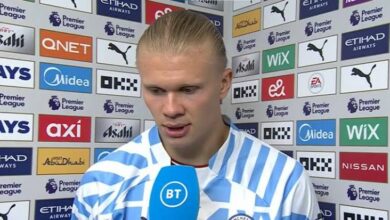
With the weight of history on his shoulders — and the chance to score his first Premier League goal at Anfield — Haaland stepped up. He remained ice-cold, sending Alisson the wrong way and calmly slotting the penalty home. The goal was not just significant; it was symbolic, a marker of City’s resilience and Haaland’s growing influence in the league’s biggest fixtures.
Liverpool’s afternoon went from difficult to disastrous in the closing stages. Pushing forward in search of an equalizer, they were caught on the break. Haaland surged through the center, once again threatening to escape clear on goal.
Szoboszlai, the hero just minutes earlier, was forced into a desperate challenge as the last defender. The referee had little choice but to produce a red card. Liverpool were reduced to ten men, and with time slipping away, any realistic hope of a comeback evaporated.
City expertly managed the final minutes, slowing the tempo, retaining possession, and closing down space with surgical efficiency. The final whistle confirmed a landmark result: a 2–1 victory at Anfield and a league double over Liverpool for the first time since the 1936/37 season
The victory was significant, but not definitive, in the context of the Premier League title race. Despite the three points, Manchester City remain six points behind leaders Arsenal, who had secured a win over Sunderland the previous day. However, the result sent a clear message: City are far from finished.
For Guardiola, the performance showcased his team’s maturity and adaptability. City weathered Liverpool’s second-half surge, responded immediately to conceding, and capitalized ruthlessly on key moments. Haaland’s contribution — both in general play and with the decisive penalty — underlined his growing importance in pressure matches.
For Liverpool, the defeat was painful but instructive. The second-half response demonstrated character and quality, yet the inability to sustain control after taking the lead proved costly. The red card compounded their frustrations, turning a competitive contest into a frustrating conclusion.
This was not just another Premier League fixture; it was a clash that captured the essence of modern English football. Tactical nuance, elite athleticism, and fine margins combined to produce a match that may yet be remembered as a turning point in the title race.
Erling Haaland’s goal at Anfield will stand as a personal milestone, but the broader story belongs to Manchester City’s refusal to fade quietly. In a season where consistency has been elusive, victories like this remind everyone why Guardiola’s side remain the benchmark.
For Liverpool, the challenge now is to respond — to turn disappointment into determination and ensure that moments of promise are not undone by brief lapses. The Premier League season is far from over, but on this afternoon at Anfield, it was Manchester City who left with belief intact and momentum restored.