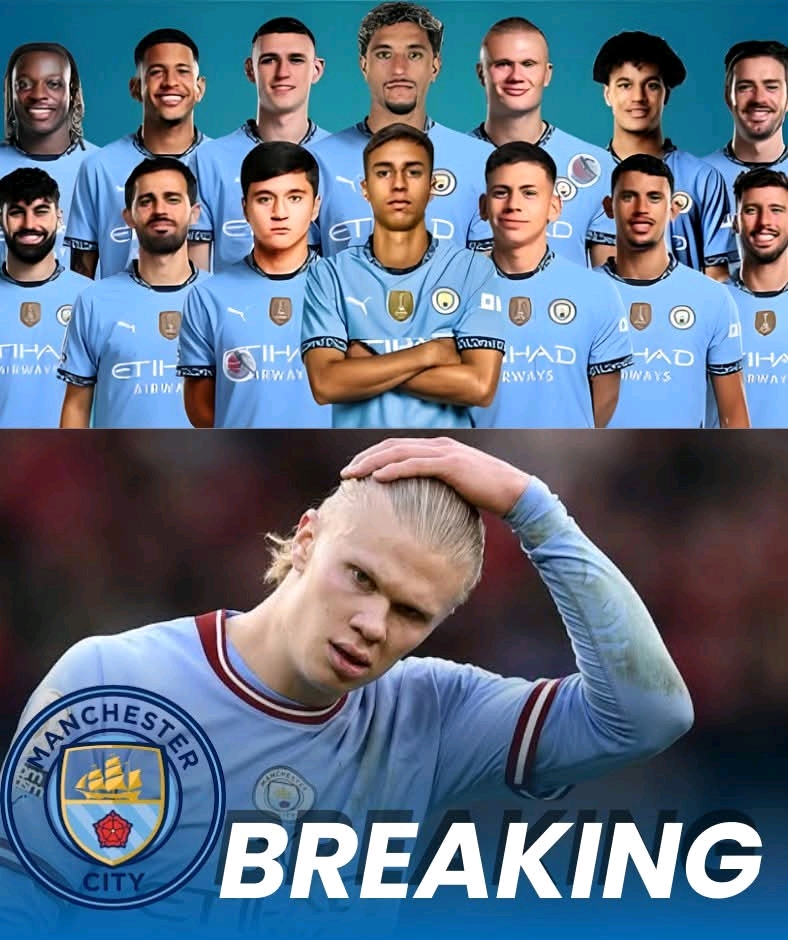
The tension did not arrive suddenly. It crept into Manchester City quietly, like a shadow stretching across the Etihad dressing room. At first, it was only whispers. A look held for a second too long. Conversations that stopped when certain players walked in. Smiles that felt forced. Inside one of the most successful teams in modern football, something was no longer right. And at the centre of it all stood Erling Haaland, furious, frustrated, and feeling betrayed.
For months, Manchester City had moved like a perfectly oiled machine. Trophies, dominance, control. Pep Guardiola’s system had once again proven unstoppable, and Haaland remained the ultimate weapon, the goal machine, the face of City’s ruthless efficiency. On the pitch, everything looked calm. Off it, however, a storm was gathering.
Sources close to the club say the problem exploded the moment news began to spread about the possible return of a former City star. A player whose past at the club was never fully settled. A name that still carried weight in the dressing room. A figure whose presence had once divided opinions, created tension, and left scars that never truly healed.
At first, it was treated as just another rumour. City are always linked with former players. But this time felt different. This time, the reaction was immediate and emotional. When Haaland became aware of the serious discussions happening behind the scenes, his response was said to be explosive. Shock turned into anger. Anger turned into disbelief. And disbelief quickly became something much more dangerous.
Those close to the Norwegian striker describe him as “furious beyond words.” Not the quiet frustration of a professional disappointed with club decisions, but raw anger. The kind that changes behaviour. The kind that makes teammates uncomfortable. The kind that forces coaches and executives to panic.
Haaland is not just another player. He is the centrepiece of Manchester City’s present and future. His goals define seasons. His presence shapes tactics. His personality, though often calm in public, carries enormous weight in the dressing room. When he is unhappy, everyone feels it.
Reports suggest Haaland made his feelings crystal clear during internal conversations. The message was not hidden. It was direct, emotional, and shocking. “If he comes back, I don’t know if I can stay.” Those words, or something very close to them, sent shockwaves through the club.
Suddenly, what had seemed like a routine squad discussion became a crisis.
The dressing room, once united, began to split. Some players welcomed the idea of the former star’s return, remembering his quality, his experience, and his past contributions. Others, including Haaland, saw only problems. Old tensions. Old power struggles. Old attitudes that no longer fit the group Guardiola had built.
This division quickly became visible. Training sessions grew tense. Small arguments broke out. Body language told a story that words could not hide. Even Guardiola, a master of control and psychology, was said to be deeply concerned.
Pep Guardiola values harmony above almost everything else. He believes a happy dressing room wins titles. He knows that one unhappy superstar can undo years of careful culture-building. And now, he was facing exactly that risk.
The identity of the ex-star has been kept tightly guarded, but inside the club, everyone knows who it is. A player whose exit from City was complicated. A player who did not leave quietly. A player who, according to some, clashed with teammates and staff before departing.
For Haaland, the issue is not just personal dislike. Sources say he believes the return would change the balance of the team. That it would create confusion about roles, leadership, and responsibility. That it would bring ego where humility is needed. That it would disrupt the chemistry that allows him to perform at his best.
Haaland is fiercely competitive. He wants to win everything, every season. He expects the club to support him fully, to protect the environment that allows him to dominate. From his point of view, bringing back someone associated with past tension feels like a step backwards.
City executives were not prepared for such a strong reaction. The idea of the return had been discussed quietly, viewed as an opportunity to add experience and depth. They did not expect it to threaten the very core of the project.
Now, they find themselves trapped between two dangerous options.
On one side, there is the possibility of abandoning the return entirely, risking embarrassment and backlash from those who supported the move. On the other, there is the unthinkable scenario of alienating Haaland, a player who could realistically leave any club in the world at any time.
The thought of Haaland even considering an exit has terrified City officials. He is under contract, yes, but modern football contracts mean little when a superstar truly wants out. Release clauses, private agreements, and massive offers from Europe’s giants are always waiting.
Real Madrid have never hidden their admiration. Paris Saint-Germain would move instantly. Even Bayern Munich continue to monitor his situation. If Haaland signals unhappiness, the sharks will circle.
Inside the dressing room, players are uneasy. Some feel caught in the middle. Others worry about choosing sides. Footballers talk, and when one of the biggest names in the squad is openly unhappy, it creates fear. Nobody wants to be part of a civil war.
Senior players have reportedly tried to calm Haaland down, urging patience and trust in the manager. Some have spoken to Guardiola directly, asking him to intervene before the situation becomes irreversible. Guardiola, for his part, is believed to be working tirelessly behind the scenes, holding private meetings, listening, negotiating, trying to restore balance.
But this is not an easy fire to put out.
Haaland is not known for empty threats. When he speaks, he means it. His career choices so far have been calculated, ambitious, and bold. He left Dortmund not for comfort, but for dominance. He chose City because of the project, the style, and the promise of a stable, winning environment.
Anything that threatens that environment is a direct threat to his commitment.
Fans, unaware of the full details, have begun to sense something is wrong. Social media is buzzing with speculation. Body language in recent matches is being analysed frame by frame. Every substitution, every touch, every reaction from Haaland is being interpreted as a clue.
City supporters are torn. Some trust the club completely and believe the drama is exaggerated. Others fear that history is repeating itself, that even the best-run clubs can lose control when egos collide.
The memory of past superstars leaving English clubs under similar clouds still lingers. No fan wants to imagine a future where Haaland wears another shirt, scoring goals elsewhere while City wonder what went wrong.
The former player at the centre of the storm has reportedly been made aware of the reaction. Whether this changes his desire to return remains unclear. Some say he is surprised by the hostility. Others say he expected it and believes he can win people over again.
But winning over Haaland will not be easy.
Trust, once broken or threatened, is difficult to repair. And for Haaland, this feels personal. He believes he has earned the right to be heard. He believes the club should prioritise the present harmony over nostalgia or sentiment.
City’s leadership now face one of the most delicate moments of the Guardiola era. Do they back their star striker fully, closing the door on the ex-player forever? Or do they push forward, hoping Haaland will calm down and accept the decision?
There are no easy answers.
What is clear is that the situation has already changed the atmosphere at the club. The idea that City are immune to drama has been shattered. Even the most successful teams can fracture under pressure.
As days pass, the silence becomes louder. Every press conference is watched closely. Every Guardiola answer is dissected. Haaland’s interviews, usually polite and short, are now scrutinised for hidden meaning.
This may still end quietly. A decision could be made behind closed doors. Apologies could be exchanged. Plans could change. Football has a way of resolving chaos without the public ever knowing the full truth.
But it could also explode.
If Haaland truly feels ignored or disrespected, the consequences could be enormous. Not just for this season, but for the entire future of Manchester City. Losing a player like him is not just about goals. It is about identity, fear, and power.
Right now, City stand at a crossroads. Harmony or heartbreak. Stability or storm. One decision could define an era.
And as the football world watches closely, one thing is certain. This is no ordinary dressing room disagreement. This is a battle that could reshape Manchester City forever.