It was painful, Thankfully, I wasn’t seriously injured. I only continued playing because of my life for the team….He could have ended my career,

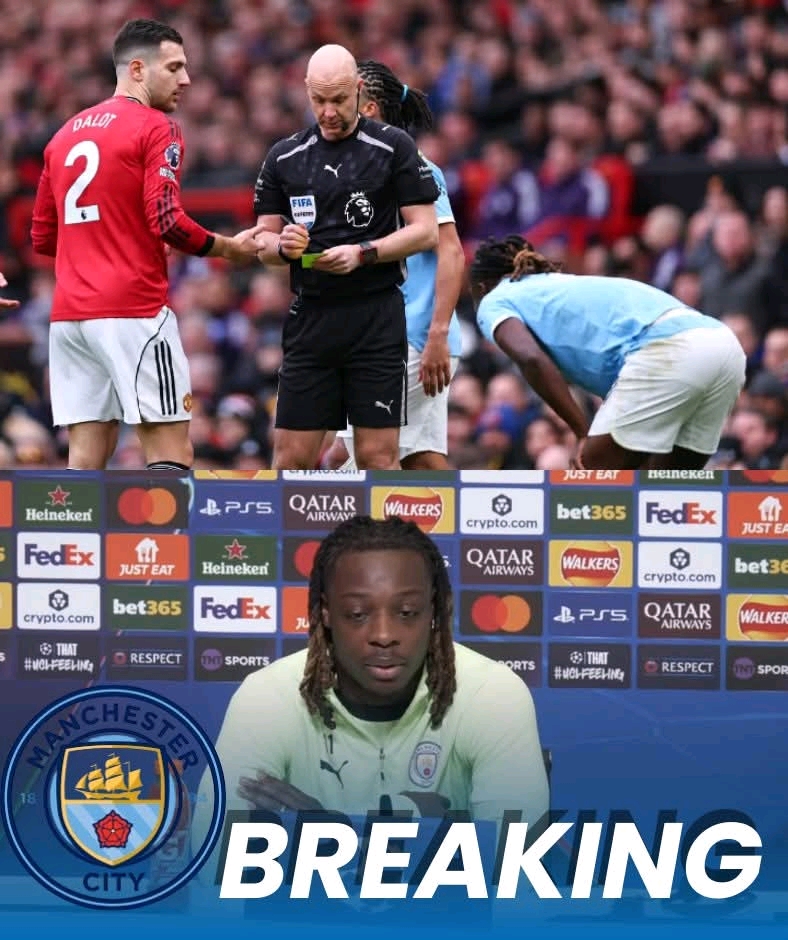
It was supposed to be another fierce Manchester Derby, another night of noise, pressure, pride, and passion. The stadium was alive. The tension was thick in the air. Every touch mattered. Every tackle carried weight. For Jeremy Doku, it was a chance to fight for his team, to prove himself again in one of football’s most unforgiving fixtures. But what happened next nearly changed everything.
The moment came suddenly. One tackle. One split second. One decision that could have ended his season, and maybe much more. When Jeremy Doku later described it, the words were raw, honest, and heavy with emotion. “It was painful,” he said. “Thankfully, I wasn’t seriously injured.” But behind those simple words was a terrifying truth. That challenge could have ruled him out for months. It could have damaged his career. It could have taken away everything he had worked so hard to build.
Doku felt the impact instantly. The pain shot through his body before he even hit the ground. His first thought was not about the foul, not about the referee, not about the crowd. His first thought was fear. Fear of injury. Fear of how serious it might be. Fear of the long road back that so many players know too well.
For a winger whose game is built on speed, balance, and explosive movement, a bad injury is not just a setback. It is a nightmare. It threatens everything. And in that moment, lying on the pitch, Doku knew how close he had come to disaster.
Yet he got back up.
Not because it didn’t hurt. Not because it was nothing. But because, as he admitted later, his love for the team pushed him forward. “I only continued playing because of my life for the team,” he said. That sentence revealed everything about his mindset. The pain was real. The risk was real. But the badge on his chest mattered more.
Related Posts:





Inside him, there was a battle. His body told him to stop. His instincts told him something was wrong. But his heart told him to continue. That is the reality of top-level football. Players are constantly forced to choose between safety and sacrifice. Doku chose sacrifice.
The derby moved on. The game continued. But that tackle stayed in his mind. Even after the final whistle, the feeling did not fade. When the adrenaline wore off, the pain returned. And with it came anger. Not just at the opponent, but at the situation that allowed such a moment to happen.
“He could have ended my career,” Doku said bluntly. No exaggeration. No drama. Just truth. A poorly timed tackle, a bit more force, a slightly different angle, and the outcome could have been devastating.
What made it worse was the response. Or lack of it.
“Refs should do they jobs,” he added. Those words carried frustration that had clearly been building for some time. This was not just about one challenge. This was about a pattern. About players like Doku, who rely on pace and dribbling, being repeatedly targeted, kicked, pulled, and fouled, often without proper protection.
Fast attackers are always vulnerable. When defenders cannot stop them fairly, they stop them physically. Late tackles. Cynical fouls. Dangerous challenges. It has always been part of the game. But for players like Doku, the line between aggressive defending and reckless endangerment is crossed too often.
In his mind, the referee failed him. Failed to protect him. Failed to control the game. Failed to send a message that such challenges will not be tolerated. And when referees fail, players pay the price with their bodies.
The Manchester Derby is already intense without adding fear of injury. Every duel is stronger. Every tackle is heavier. Emotions run high. But that does not excuse dangerous play. Doku believes that officials must step up in these moments, not hide behind the excuse of “letting the game flow.”
For him, flow means nothing if players are at risk.
As the story spread, fans reacted strongly. Some expressed sympathy, shocked by how serious the tackle was. Others debated whether it was truly that dangerous. That debate, however, misses the point. The player who felt the pain, who felt his leg twist, who felt his career flash before his eyes, is the one who knows the truth.
Doku also used the moment to respond to another accusation that has followed him since his arrival in England. Claims that he “dives.”
The word frustrates him deeply. For a winger who constantly takes on defenders, contact is unavoidable. When legs tangle at full speed, balance is lost. When someone clips your heel while sprinting, you fall. That is physics, not acting.
Doku made it clear that he does not go looking for fouls. He goes looking to beat his man. He goes looking to create chances. If defenders choose to stop him illegally, that is not his fault.
The “diver” label, he feels, is lazy. It is used to dismiss genuine fouls and justify rough treatment. Once a player gets that label, referees subconsciously hesitate. Fans boo. Opponents foul harder, believing they will get away with it.
That is a dangerous cycle.
Doku believes that reputation should not override reality. Each challenge should be judged on its own. Each foul should be punished properly. Otherwise, players like him become targets, and injuries become inevitable.
His comments were not reckless. They were not emotional outbursts. They were measured, honest reflections of someone who had just been reminded how fragile a football career really is.
One bad tackle. One wrong decision. Months on the sidelines. Endless rehab. Mental battles. Doubts. Fear of re-injury. Players live with that risk every time they step onto the pitch.
That is why Doku’s anger resonated. Because it was not just about him. It was about every winger who gets kicked because he is too quick. Every creative player who is punished for entertaining fans. Every attacker who is told to “stay on your feet” while being hacked down.
Manchester City staff were reportedly concerned after the match. They monitored Doku closely. Scans were done. Thankfully, there was no serious damage. Relief followed. But relief does not erase the memory.
Pep Guardiola values players like Doku not just for their talent, but for their courage. It takes bravery to keep running at defenders who want to stop you at any cost. It takes strength to get back up after heavy tackles and keep asking for the ball.
Doku showed that bravery. But bravery should not be mistaken for invincibility.
As the season continues, this incident will stay in the background. Every time Doku goes down, people will remember. Every time he is fouled, debates will restart. And every time a referee waves play on, the question will return.
Are players truly being protected?
For Doku, speaking out was necessary. Silence helps no one. If players do not talk, nothing changes. He knows there will be criticism. He knows some will accuse him of complaining. But he also knows that staying quiet would mean accepting the risk as normal.
And it should not be normal.
Football celebrates courage, but it must also value safety. It praises commitment, but it must also enforce responsibility. Referees are not enemies. But they are guardians of the game. When they fail, the consequences can be severe.
Doku’s words were not a demand for special treatment. They were a call for fairness. Judge tackles properly. Protect players properly. Do your job properly.
Because next time, luck may not be on his side.
This time, he walked away. This time, he continued playing. This time, the injury was not serious. But football does not always offer second chances.
And that is why this moment matters.
Jeremy Doku is still running. Still dribbling. Still fighting for Manchester City. But he will never forget how close he came to losing everything in one terrifying moment in the Manchester Derby.