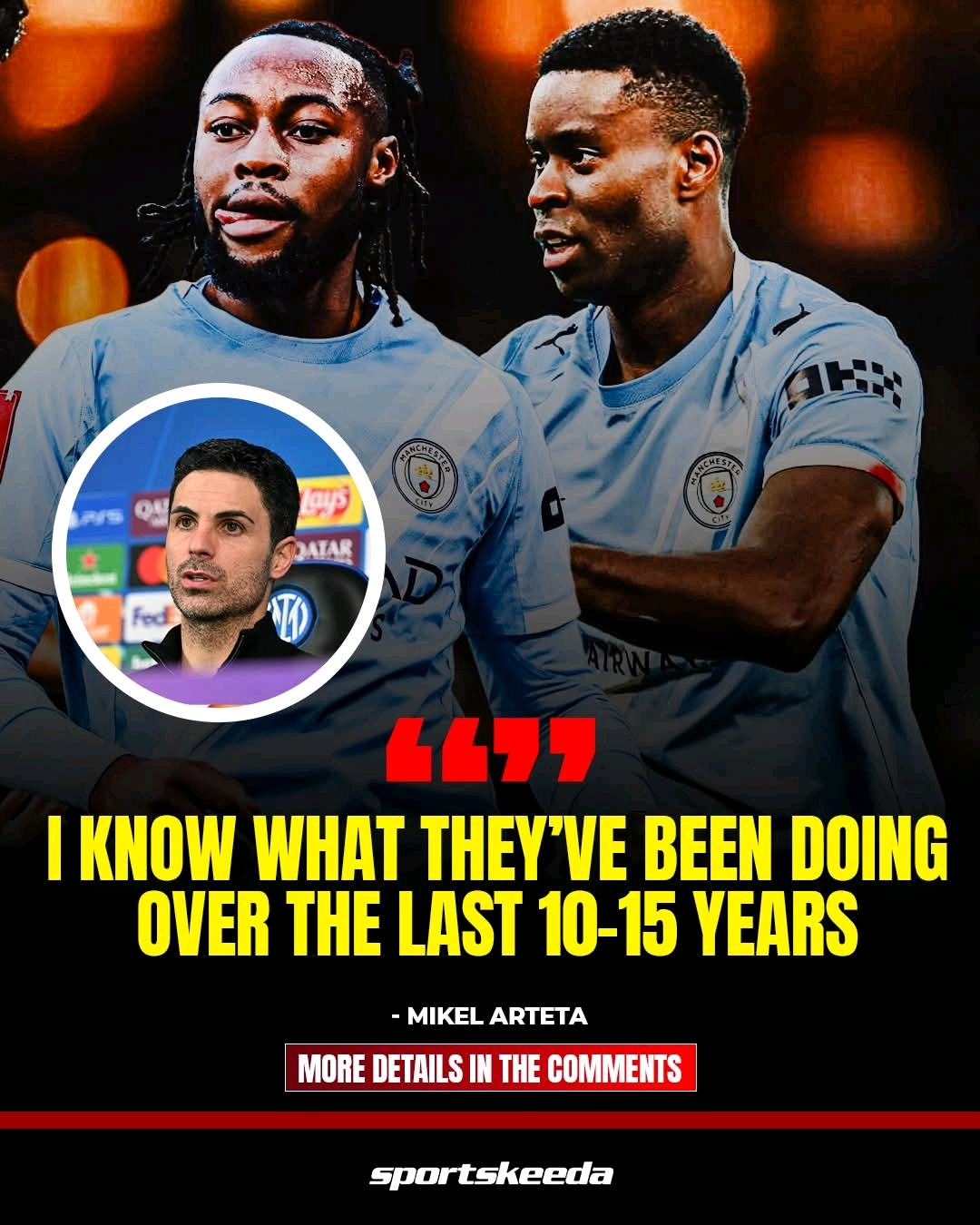
Mikel Arteta did not sound surprised. He did not sound angry either. Instead, he sounded like a man who has seen this story many times before, a man who understands exactly how Manchester City operate and what they are capable of doing when the pressure is on. When asked about City’s decision to strengthen their squad with the signings of Antoine Semenyo and Marc Guehi, the Arsenal manager chose his words carefully, but the message underneath was clear and powerful.
“This is their business,” Arteta said. “I know what they’ve been doing over the last 10 to 15 years. So obviously I’m not surprised. They want to win and they will do everything to win.”
Those words carried far more weight than they first appeared to. They were not just a casual response to a routine transfer question. They were the words of a man who once stood inside the Manchester City machine, who helped build it, who learned from it, and who now finds himself trying to stop it.
The Premier League title race in the 2025–26 season is once again shaping up to be a familiar battle. Arsenal are on top of the table, holding a four-point lead over Manchester City. But nobody at the Emirates is celebrating yet. Nobody is relaxing. Because history has taught them one painful lesson over and over again. Manchester City do not go away quietly.
For the last three seasons, Arsenal have come painfully close to lifting the Premier League trophy, only to fall short. Twice in those three campaigns, it was Manchester City who stood in their way, relentless, consistent, and ruthless. Each time, Arsenal pushed, believed, and hoped. Each time, City found another gear.
That is why Arteta’s reaction to City’s latest signings matters so much.
Earlier this month, Manchester City moved decisively in the transfer market. They signed Antoine Semenyo from AFC Bournemouth, a powerful, explosive forward who has grown steadily in the Premier League. They also secured Marc Guehi from Crystal Palace, one of England’s most reliable and composed defenders. These were not flashy signings made for headlines. They were targeted, strategic moves designed to solve specific problems.
City’s season had not started perfectly. In fact, it was far from it. They failed to win any of their opening four league matches of 2026, a run that raised eyebrows and invited criticism. Questions were asked. Doubts crept in. For a brief moment, it felt like City might finally be vulnerable.
Then came the response. A calm, controlled 2–0 victory over Wolverhampton Wanderers. A clean sheet. Authority restored. And now, with Semenyo and Guehi added to the squad, the message was clear. Manchester City were not panicking. They were preparing.
Semenyo wasted no time making his presence felt. On his debut, he scored a goal and provided an assist, instantly justifying the club’s faith in him. His energy, strength, and directness gave City something slightly different in attack, another weapon in an already frightening arsenal. Guehi, on the other hand, did his job quietly. He helped City keep a clean sheet, read the game well, and brought calm to the back line. Exactly what Pep Guardiola would have wanted.
From Arsenal’s point of view, this was worrying but not unexpected.
Arteta knows Guardiola better than most. He worked alongside him between 2016 and 2019, a period during which Manchester City dominated English football. Together, they won two Premier League titles, an FA Cup, and two EFL Cups. Arteta was not just an assistant who watched from the sidelines. He was deeply involved, learning the philosophy, the methods, the mentality.
That experience is what makes Arteta’s words so interesting now. When he says he knows what City have been doing for the last 10 to 15 years, he is speaking from the inside. He knows how City react to pressure. He knows how they use resources. He knows that when City feel challenged, they respond with action, not excuses.
Arsenal’s current position at the top of the table should be a source of confidence. They have been consistent, disciplined, and mature. They have learned from past mistakes. This season feels different in many ways. But the scars of previous title races are still fresh.
Finishing second once is painful. Finishing second three times, especially when you have led the race for long periods, leaves deep emotional marks. Arsenal fans have celebrated progress, but progress without silverware eventually starts to feel hollow. Arteta knows this. His players know this. The pressure is immense.
Meanwhile, City are chasing from behind, a position they actually enjoy. They thrive when written off, when doubts are raised, when others start believing the crown is slipping. It sharpens them.
When Arteta was asked about Guardiola calling Arsenal “the best team in the world,” he dismissed the idea of mind games almost casually. Guardiola had praised Arsenal for competing strongly in all four competitions: the Champions League, Premier League, FA Cup, and EFL Cup. For some managers, such praise would raise suspicion. For Arteta, it did not.
“With me? I don’t think so,” he said.
That short response said a lot. It showed confidence. It showed focus. And it showed that Arteta is no longer the apprentice trying to decode Guardiola’s words. He is his own man now.
When asked if he still speaks to Guardiola regularly, Arteta answered with a touch of humour. “I don’t talk with him like with my wife every three days,” he said. “We talk quite generally.”
There is respect there, clearly. But there is also distance. The relationship has changed. They are no longer colleagues chasing the same goals. They are rivals standing in each other’s way.
Arteta’s comments about mind games were also telling. “If there are mind games, there are mind games,” he said. “But I don’t pay too much attention because you have to win on the pitch and deliver.”
That sentence sums up Arsenal’s mindset right now. They are tired of narratives. Tired of praise. Tired of sympathy. They want results. They want trophies. And they know that none of it will be decided in press conferences.
The arrival of Semenyo and Guehi has added another layer of complexity to the title race. For Arsenal, it means City have more depth, more options, and more resilience. For City, it sends a message to the rest of the league that they are fully committed to the fight.
Arteta’s Arsenal have built something strong. They play with identity. They defend with discipline. They attack with purpose. But City’s strength has always been their ability to adapt. When something stops working, they change it. When a weakness appears, they fix it.
That is what Arteta was really referring to when he spoke about the last 10 to 15 years. City have been consistent not just in winning, but in how they respond to challenges. Ownership, structure, recruitment, and coaching all align towards one goal: winning.
Arsenal, by contrast, are still writing their story. The progress under Arteta has been undeniable, but the final step remains the hardest. Beating City over 38 games is not about moments. It is about sustaining belief when City start winning 10, 12, 15 games in a row.
This is why every City signing matters. It is not just about quality. It is about psychological pressure. It is about reminding rivals that City always have another move to make.
For Arsenal players, seeing City strengthen while sitting just four points behind is a test of nerve. Can they stay calm? Can they ignore the noise? Can they focus on their own performances rather than looking over their shoulders?
Arteta will be central to that process. His calm, measured responses are designed not just for the media, but for his dressing room. He does not want panic. He does not want obsession. He wants clarity.
The clash with Leeds United that Arteta was preparing for when he spoke is a perfect example of his approach. While questions swirl about City, transfers, and mind games, Arsenal still have to win their own matches. Dropped points against smaller teams are what cost them in previous seasons. That lesson has been learned the hard way.
City’s recent wobble showed they are not invincible. But their response showed why they are champions. A single win can reset everything. Momentum shifts quickly in football.
As the season moves deeper into its decisive phase, the battle between Arsenal and Manchester City will not be decided by words. But words still matter. They reveal confidence, fear, and belief.
Arteta’s words revealed acceptance rather than anxiety. He accepts that City will always push. He accepts that they will spend, adapt, and improve. He accepts that the challenge will be relentless.
What he now wants is for Arsenal to prove that they can withstand it.
The title race is no longer just about talent. It is about mentality. It is about memory. Arsenal remember losing. City remember winning. Changing that balance is the final hurdle.
Semenyo and Guehi are now part of that story. Not because they alone will decide the title, but because they represent City’s refusal to stand still. And Arteta, who knows that mentality better than most, has made it clear. He is not surprised. He is not distracted. And he is ready for the fight.