Football has a long memory. It remembers tackles, arguments, grudges, words spoken in anger, and moments that never truly fade. Some rivalries end when players retire. Others refuse to die, passing quietly from one generation to the next. The story involving Roy Keane and the Haaland family is one of those rare football feuds that time has never healed. And now, more than two decades after it all began, it has somehow found a new life on a modern football podcast, producing one of the most hilarious and unforgettable reactions in recent memory.
Roy Keane is not a man known for soft words or gentle reactions. He never was as a player, and he certainly is not as a pundit. Everything about him is direct, sharp, and unapologetic. When he speaks, people listen, partly because of his legendary status, and partly because they never know what he is going to say next. That reputation is exactly why what happened on Stick to Football became such a viral moment.
Stick to Football has quickly grown into one of the most popular football podcasts online. Hosted on YouTube and fronted by familiar faces like Jamie Carragher, Roy Keane, Gary Neville, and Jill Scott, the show blends serious football discussion with humour, honesty, and moments of chaos. It is not scripted. It is not polished. It feels like a group of former players sitting in a room, talking football the way fans imagine it happens behind closed doors.
The podcast has welcomed a wide range of guests. Some are footballers, past and present. Others come from different worlds entirely, like snooker legend Ronnie O’Sullivan, golf superstar Rory McIlroy, and darts sensation Luke Littler. But there is one football name that has never appeared on the show, and everyone knows why. That name is Alf-Inge Haaland.
To understand why Alf-Inge Haaland has never been invited, or at least never accepted, you have to go all the way back to the late 1990s and early 2000s. English football was a very different place then. The Premier League was faster, rougher, and far less protected by rules and cameras. Tackles were harder. Words were sharper. And grudges were personal.
In 1999, during a match between Manchester United and Leeds United, Roy Keane suffered what would turn out to be a serious anterior cruciate ligament injury. Alf-Inge Haaland, then playing for Leeds, accused Keane of diving and faking the injury. Those words stuck with Keane. They burned into his memory. For Roy Keane, accusations like that were not forgotten. They were stored.
Two years later, in April 2001, Manchester United played Manchester City in a derby that would go down in football history for all the wrong reasons. During that match, Roy Keane launched into a knee-high tackle on Alf-Inge Haaland. It was brutal. It was dangerous. And it was immediately recognised as one of the worst tackles the Premier League had ever seen.
Keane was sent off and later given a three-match ban and fined £5,000. At the time, that seemed like punishment enough. But the story did not end there. In 2002, Roy Keane released his autobiography, and in it, he admitted that the tackle was premeditated. He wrote openly that he had waited for Haaland, remembered the accusation from years earlier, and decided to exact revenge.
The Football Association reacted strongly. Keane was fined an additional £150,000 and given a further five-match ban. The damage was done. Not just to Haaland’s knee, but to the relationship between the two men. Alf-Inge Haaland’s career never fully recovered. Roy Keane’s reputation as a fierce and unforgiving competitor was cemented forever. Fast forward many years, and football had moved on. Players retired. Stadiums changed. Rules evolved. But the memory of that tackle never disappeared. And then something unexpected happened. Alf-Inge Haaland’s son, Erling, emerged.
Erling Haaland did not just arrive quietly. He exploded onto the football scene. Goals followed him everywhere. Salzburg. Dortmund. Manchester City. He scored with power, speed, and an almost unnatural calm in front of goal. By his early twenties, he was already being spoken about as one of the best players in the world.
At Manchester City, under Pep Guardiola, Erling Haaland became a goal machine. He broke records with ease. Defenders feared him. Fans adored him. And football history began to shape itself around his numbers.
But with success came attention. And with attention came the past.
Roy Keane, now a pundit, never softened his views. After a 0-0 draw between Manchester City and Arsenal last year, Keane criticised Erling Haaland, calling him a “spoilt brat”. The comment caused outrage among fans. Alf-Inge Haaland was reportedly furious. The old feud had found a new chapter.
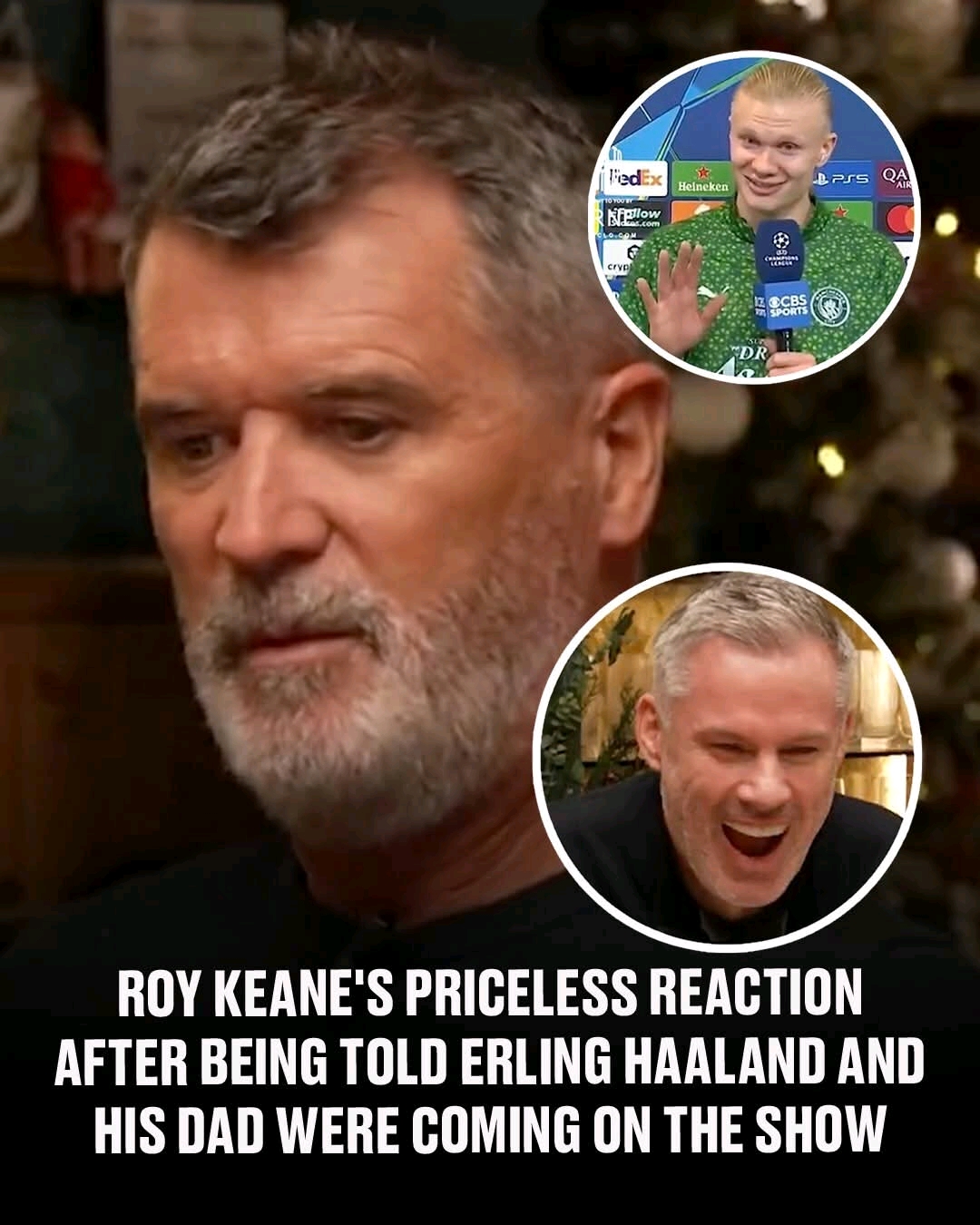
So when Jamie Carragher decided to ask Erling Haaland a question on CBS Sports last week, he knew exactly what he was doing. Carragher asked Haaland whether he would be willing to appear on Stick to Football, alongside Roy Keane.
Haaland smiled. Then he rreplied ith perfect timing and perfect awareness. He said that if Jamie Carragher and Roy Keane were there, he thought he would need to bring his father. That single sentence set the football world alight.
The idea of Erling Haaland and Alf-Inge Haaland sitting across from Roy Keane on a podcast felt almost impossible. Dangerous. Explosive. It was the kind of television people did not know they needed until the idea was planted.
A few days later, during the latest episode of Stick to Football, Jamie Carragher decided to push the idea further. He brought it up directly to Roy Keane. No warning. No soft introduction. Just straight into it. Carragher told Keane about Haaland’s response and the suggestion of bringing his father along. The room paused.
Roy Keane looked up and asked a simple question. Which Haaland?” That alone was enough to send laughter through the studio. Carragher clarified. Alf-Inge. Erling. The whole package.
And that was when Roy Keane delivered the line that instantly went viral.“Yeah, bring him in. Bring them all in. All his family. No problem. We’ll be ready.”
The words were calm. Almost casual. But the meaning behind them was pure Roy Keane. No fear. No backing down. No awkwardness. Just confidence, challenge, and that familiar edge.
Gary Neville burst out laughing. He could barely contain himself. Ian Wright joined in, adding his own joke, telling Haaland to bring his dinner, bring his friends, bring everyone. The room dissolved into laughter, but the tension underneath was unmistakable.
That is what made the moment so special. It was funny, yes. But it was also loaded with history. Decades of unfinished business wrapped up in a few seconds of television.
Social media exploded. Clips were shared everywhere. Fans debated whether such a podcast episode should ever happen. Some wanted it desperately. Others thought it would be too uncomfortable. Too awkward. Too risky.
But that is exactly why people cannot stop talking about it.
Roy Keane did not dodge the question. He did not shut it down. He did not soften his stance. He leaned into it, just like he always has. That reaction summed him up perfectly. Even now, years after retirement, he remains the same uncompromising figure.
For Erling Haaland, the situation is strange. He has nothing to do with what happened in 2001. He was a child. He built his own career, earned his own reputation, and carries his own legacy. Yet he is forever connected to that moment through his father.
For Alf-Inge Haaland, the scars are deeper. Physical and emotional. Sitting in a room with Roy Keane would not just be a podcast appearance. It would be a confrontation with history.
And yet, football has a way of turning pain into conversation, rivalry into content, and grudges into entertainment.
Stick to Football thrives on honesty. On uncomfortable truths. On moments that feel real. That is why the idea of the Haaland family appearing alongside Roy Keane feels so powerful. It would not be fake. It would not be staged. It would be raw Whether it ever happens is another matter. Some stories are better left untouched. Others demand to be revisited.
But for now, Roy Keane’s reaction has given fans exactly what they love. A reminder that football is not just about tactics and goals. It is about people. Memories. Emotions. And moments that refuse to fade, no matter how much time passes.
In just a few words, Roy Keane reminded everyone why he remains one of football’s most compelling characters. He does not hide. He does not retreat. And if the Haalands ever do walk into that studio, one thing is certain