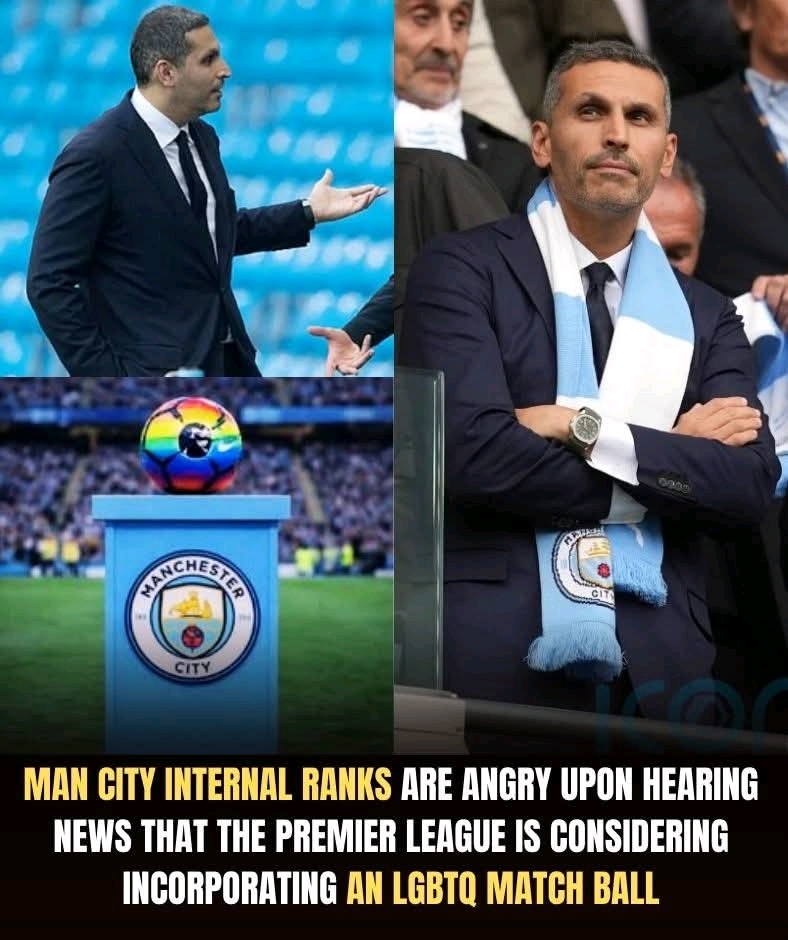
“UNACCEPTABLE!” — Manchester City are reportedly furious after news emerged that the Premier League is considering using a match ball featuring LGBTQ symbols
A quiet rumble grew into a loud roar. What had started as a simple idea inside Premier League offices had quickly turned into one of the most controversial stories in English football. The plan was simple — or so the league believed. A match ball, decorated with symbols meant to show inclusion and support for LGBTQ communities, would be used in an upcoming round of fixtures. To the league, it was another step toward a game that embraces everyone. To many fans and observers, it was a message of unity. But to Manchester City, one of the biggest football clubs on the planet, it was something else entirely. Furious. Unacceptable. A move that crossed a line no club believed should be crossed on a football pitch.
News of the Premier League’s proposal spread like wildfire. Journalists reported it. Fans talked about it. Social media erupted. Within hours, the atmosphere had shifted from curiosity to conflict. Manchester City were reportedly “furious.” That was the simple but explosive word repeated in multiple reports. Furious. Angry. Shocked. Frustrated. Those were the emotions inside the Etihad Stadium this week as officials, coaches, and club executives absorbed the news and tried to make sense of it.
To an outsider, a match ball might seem like an insignificant object — something fans barely notice beyond its movement on the grass. But in football, symbols and traditions matter. Logos, kits, chants, rivals, and yes, even match balls carry emotional weight. They are sacred to supporters. They are tools of competition. They represent the purity of the sport itself. When Manchester City learned that the Premier League was considering modifying that symbol with LGBTQ icons, many inside the club felt something profound had been overlooked — the power that football holds as a cultural institution and the responsibility that comes with that power.
It wasn’t just a disagreement. It was a clash of perspectives. The Premier League argued that the world has changed, that football must evolve, that inclusion should be visible, that diversity should shine from every corner of the game. To league officials, the match ball with LGBTQ symbols was meant to be a celebration of acceptance and support — a sign that football can stand with communities that have often felt excluded or underrepresented.
City, however, saw things differently. Inside the club, discussions quickly turned to concern — deep concern. Not just about the symbol itself, but about the message it would send, the implications it might have, and the way it could divide fans, players, clubs, and even nations. Where some saw inclusion, City officials worried about division. Where some saw a step forward, City feared a step too far.
The phrase “threatens to divide the league into two opposing camps” did not come from nowhere. That was exactly how many people began to view the situation. Two camps. Those who supported the idea and believed football should be used as a platform for social messaging. And those who opposed it, believing that football should stay neutral ground — a place free from symbols that might politicize the sport and drive wedges between fans.
Inside Manchester City, frustration was deep. Many felt blindsided. Some felt that clubs were not consulted properly. Others felt that no real discussion had been held with the teams most affected. The anger was not about being left out of a conversation — it was about a decision that could have far-reaching consequences for the sport and its stakeholders.
Fans also began to react strongly. Supporters of Manchester City around the world took to social media to express disbelief. Some defended the club, saying it was right to push back. Others questioned whether football should be a platform for social causes at all. Many felt that the game was becoming too political, too influenced by external issues that have no direct connection to the sport itself.
But there was another side to the story as well. Supporters of the Premier League’s proposal said that football has always reflected society, and that using its influence to send positive messages is a powerful thing. They argued that a match ball with LGBTQ symbols could be a step toward acceptance in communities where discrimination and fear still exist. They believed football should not shy away from standing up for equality, diversity, and human rights.
Yet for Manchester City, the concern was clear: football should unite, not divide. The club argued that introducing a symbol on the match ball — something that every player, official, and viewer must see during every minute of every game — risked pushing fans into separate camps. Supporters in favor could feel welcomed. Those who disagreed could feel excluded. There was a fear that the sport could become a battleground for cultural conflicts instead of a unifying force that brings people together through shared love of the game.
Critics of the plan pointed to the global nature of football as well. The Premier League is watched in every corner of the world. What resonates positively in one country might create discomfort, confusion, or even outrage in another. In cities and nations where LGBTQ rights are controversial or even illegal, the televised image of a match ball could spark tension. That was a fear that weighed heavily on Manchester City and other opponents of the idea.
Inside the club, executives discussed how football is a global product, a universal language watched by millions across continents, cultures, and belief systems. They feared that by giving the match ball a symbol associated with a deeply personal social movement, the league was unintentionally imposing a message that many supporters may not be comfortable with — or politically aligned with. For them, it was not about opposition to inclusion or support for discrimination. Instead, it was about protecting the sanctity of the sport and ensuring that football remains a space where fans of all backgrounds can connect without feeling judged or pushed into ideological corners.
The Premier League, on the other hand, stood firm in its intentions. Officials repeatedly emphasized that the proposal was not about politics but about human dignity. They described it as a gesture of solidarity — a way to let LGBTQ fans know they are seen, valued, and welcomed within the football community. To them, football is too powerful — and too visible — to ignore social issues that affect millions of its supporters.
This clash of values — tradition versus progress, neutrality versus visibility, unity versus expression — quickly became the heart of the controversy. When Manchester City’s reaction was described as “unacceptable” in media reports, it was a reflection of how high emotions had risen and how deeply people on both sides felt about the issue.
Within the corridors of the Premier League headquarters, debates grew intense. League officials argued that football is a reflection of society, and that the sport must be willing to embrace change rather than resist it. They pointed to past campaigns that supported diversity, anti-racism messages, support for women’s rights, and inclusion initiatives, saying that football has always been a platform for positive social messages.
City’s leadership, however, was not convinced. They asked hard questions: If a match ball can carry one symbol, what stops it from carrying another? When does this stop? Who decides what is represented and what is not? Where does football draw the line between social support and political messaging? For them, these were not hypothetical questions — they were concerns that could shape the future of the sport.
Fans began to form opinions as well. Some supporters stood with the Premier League, applauding the idea and praising the visibility it could bring. Others stood with Manchester City, worried that football was being drawn into issue after issue, losing its focus on competition, skill, and sportsmanship. Others were caught in the middle — agreeing with inclusion but uneasy about the method.
Commentators and experts joined the conversation. Some praised the Premier League’s courage. Others warned that the league had underestimated the emotional response it would trigger. Some argued that football must be a platform for good. Others said that social causes have no place on the pitch.
Amid this atmosphere, Manchester City’s response resonated because it was not just a statement of disagreement — it was a warning. The club reportedly warned that using a match ball with LGBTQ symbols has the potential to divide the league into two opposing camps: those who support the initiative and those who feel alienated by it. For City, that division was cause for serious concern. Football, at its best, should be a game that bridges differences — not a tool that risks amplifying them.
In training grounds and dressing rooms, players themselves reacted with curiosity and concern. Some supported the league’s message. Others empathized with fans who felt uneasy. Many took to social media, expressing personal views or sharing articles. The controversy even reached international audiences, with fans around the world sharing their voices. Some applauded the proposal. Others questioned it’s place in the sport. The world suddenly had an opinion on something as fundamental as a football used in matches.
In statements, Premier League spokespeople emphasized that no final decision had been made. They said discussions with clubs were ongoing and that the league valued the opinions of its teams and supporters. League officials stressed that the intention was never to force a symbol on anyone, but to encourage dialogue and understanding. They promised to listen and consider feedback carefully before taking action.
Manchester City, however, made it clear that their position was serious and deeply held. Reports suggested that the club was not simply making noise — it wanted influence. It wanted clubs to be consulted meaningfully before decisions are made that could impact the game at its core level. This was not about politics, they said — it was about respect.
As the debate continued, voices from outside football weighed in. Cultural commentators, activists, politicians, and social leaders shared their opinions. Some praised the Premier League’s bold stance. Others chastised it for venturing into territory they believed should be kept separate from sport. Some called for more thoughtful conversation. Others demanded action.
The divide reflected broader societal conversations happening around the world. Football, as always, became the mirror in which these debates were reflected. A sport meant to bring joy, competition, and unity was now the center of a conversation that touched on identity, representation, power, and belief.
Through it all, Manchester City stood firm. They did not apologize for their reaction. They did not back down. They did not soften their language. Furious and adamant, the club voiced its concern with clarity. In doing so, they forced a conversation not just about a match ball, but about football’s role in a changing world.
And so the controversy remains alive — vibrant, emotional, unresolved, and deeply significant. The Premier League, its clubs, its fans, its players, and its partners must now navigate a path forward. There will be discussions. There will be disagreements. There will be passion. But that is the nature of football at its core — it is a sport that reflects life itself, in all its complexity, intensity, and emotion.
In the end, what began as a proposal for a new match ball became a catalyst for one of the most important conversations in modern football. A conversation about identity. A conversation about values. A conversation about influence. And above all, a conversation about what football should be in a world that continues to change and challenge what we thought we knew.
Manchester City’s reaction, described by some as “unacceptable,” was really just a sign of how powerful football has become — and how deeply people care about it. Whether the league ultimately moves forward with the proposal or not, this moment will be remembered not for the ball itself, but for the storm of debate, feeling, and controversy it unleashed across the beautiful game.
—
If you want this **in a slightly different tone** — more dramatic, more emotional, more analytical, or even tailored to a specific audience — just tell me and I’ll rewrite it again!