Football is a game built on movement, trust, and understanding. When those things are in harmony, teams become unstoppable. But when trust breaks, even the strongest machines can suddenly shake. That is the situation Manchester City now find themselves in after shocking reports emerged that Erling Haaland refused to start a crucial match against Galatasaray because of a deep tactical disagreement involving the midfield setup. What looked like a routine European night quickly turned into one of the most dramatic internal moments of Pep Guardiola’s reign, and one that has left fans, pundits, and players asking difficult questions about authority, control, and the limits of even the most disciplined football systems.
According to reports, the disagreement did not come from emotion alone. It came from preparation, planning, and a feeling from Haaland that the midfield structure chosen for the match would reduce him to a passenger rather than the main weapon. Haaland, known for his directness both on and off the pitch, reportedly made his feelings very clear. This was not a quiet complaint or a hidden frustration. It was a firm stance. In simple terms, Haaland believed the way City planned to control the midfield would isolate him, starve him of service, and turn him into a runner chasing shadows instead of a striker deciding games.
For a player like Haaland, whose entire game is built on timing, supply, and devastating efficiency, the idea of being cut off from the ball is more than a tactical issue. It is an identity issue. Haaland does not drop deep like a false nine. He does not drift wide to link play endlessly. His power is in movement, space, and ruthless finishing. When he feels the system does not support that, frustration grows quickly. And on this occasion, that frustration reached a breaking point.
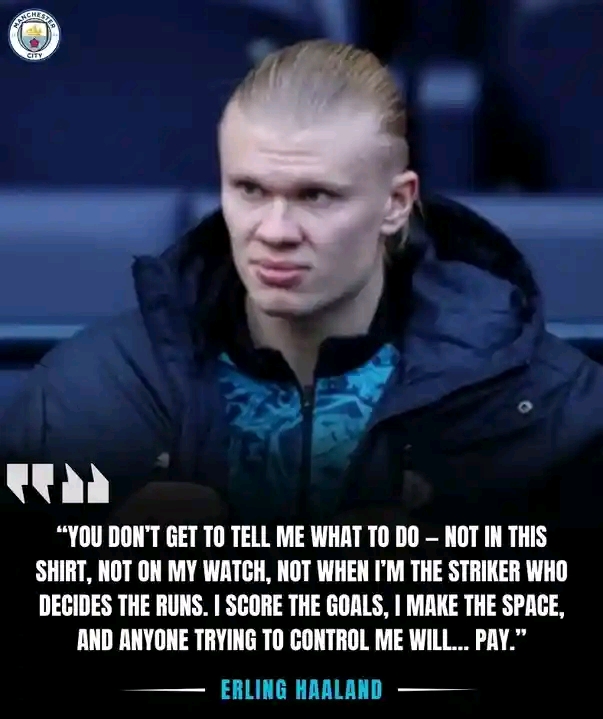
The reported words, “You don’t get to tell me what to do,” have echoed across the football world. Whether spoken exactly that way or not, the message behind them is clear. This was a rare moment where a City player, especially one so central to their success, challenged the authority of the coaching staff. At a club known for discipline, structure, and obedience to Pep Guardiola’s ideas, this was almost unthinkable. Guardiola’s system is famously non negotiable. Players adapt or they sit out. That has always been the rule. Until now.
What makes this situation even more explosive is the timing. Manchester City are not a club in crisis. They are serial winners. They dominate possession, control games, and suffocate opponents. Haaland himself has scored goals at a historic rate since arriving. From the outside, everything looks perfect. But football is not just about trophies. It is about feeling involved, trusted, and used correctly. And somewhere along the line, that feeling appears to have slipped for the Norwegian striker.
The Galatasaray match was expected to be intense, physical, and emotionally charged. Playing away against a hostile crowd requires precision and bravery. Guardiola reportedly wanted extra control in midfield, possibly using more technical players to dominate possession and slow the game down. From a coaching perspective, it makes sense. But from Haaland’s point of view, it meant fewer early balls, fewer crosses, fewer direct moments. It meant waiting. And Haaland does not like waiting.
Sources close to the situation suggest Haaland voiced his concerns during tactical meetings. He questioned how the midfield would connect with him. He asked where the chances would come from. He wanted clarity. When those answers did not satisfy him, the situation escalated. Instead of accepting the plan and hoping it worked, Haaland reportedly decided he would not start under those conditions. It was a bold move. A dangerous one. And one that has sent shockwaves through the dressing room.
Pep Guardiola is not a manager who takes public defiance lightly. His entire career has been built on control, detail, and collective discipline. Even legends like Lionel Messi, Xavi, and Kevin De Bruyne have had moments where Guardiola reminded them who makes the final call. For Haaland to push back so directly raises serious questions about the balance of power inside the squad. Is Haaland now too important to bench? Or is this the moment Guardiola draws a line in the sand?
Fans are deeply divided. Some believe Haaland was right to speak up. They argue that football is about maximizing strengths, and ignoring your main goal threat is poor management. They point to matches where City dominated possession but struggled to create clear chances for Haaland. They say his frustration is understandable. Others strongly disagree. They believe no player should ever refuse to start. They see it as disrespectful and dangerous for team unity. To them, if Guardiola says play this way, you play this way. End of discussion.
Pundits have also weighed in heavily. Former players understand the striker’s mindset. They know how isolating it feels to make runs again and again without reward. But they also warn that challenging a manager publicly can quickly damage trust. Once that trust is gone, it is very hard to rebuild. Especially at a club like Manchester City, where the system has always been bigger than any individual.
Inside the dressing room, the impact could be significant. Younger players may wonder what this means for authority. Senior players may feel caught in the middle. Some may privately agree with Haaland. Others may fear that allowing such defiance sets a dangerous precedent. Football teams are fragile ecosystems. One crack can spread fast if not handled carefully.
There is also the tactical side beyond emotion. Guardiola’s midfield experiments are not new. He constantly adjusts shapes, roles, and responsibilities. Sometimes it works brilliantly. Sometimes it looks confusing. Haaland’s arrival changed City’s attacking dynamics. In previous seasons, City played without a traditional striker. Goals came from everywhere. With Haaland, the team became more direct, but also more predictable at times. Balancing control and service has been an ongoing challenge.
Haaland’s concern reportedly focused on spacing and tempo. He felt the midfield would recycle the ball too slowly, allowing Galatasaray to stay compact. He worried that by the time the ball reached the final third, space would be gone. For a striker who thrives on early movement and sudden acceleration, that is a nightmare scenario. In his mind, starting under those conditions meant wasting energy and reducing his impact.
From Guardiola’s perspective, controlling the midfield is often the key to winning away European matches. Chaos benefits the home team. Control calms the crowd. Guardiola may have believed that once control was established, chances would come. But football plans do not always survive contact with player psychology. If your striker does not believe in the plan, execution suffers.
The question now is what happens next. Does Guardiola punish Haaland to reassert authority? Does he privately smooth things over to avoid escalation? Does Haaland apologize? Or does this become the first real sign of a deeper crack between player and manager? Manchester City have handled big egos before, but this situation feels different because of Haaland’s unique importance.
Haaland is not just another star. He is the focal point of City’s attack, the face of their goals, and one of the most marketable players in the world. His presence changes how opponents defend. His absence changes how City attack. Any prolonged tension involving him becomes a major issue not just tactically, but politically within the club.
There is also the long term question. Haaland has always been clear about his ambition. He wants goals, trophies, and a system that feeds him. If he begins to feel restricted or undervalued, speculation will grow. Real Madrid, Barcelona, and others will watch closely. Moments like this fuel transfer rumors, whether justified or not.
For now, Manchester City must manage the fallout carefully. Public silence may be the first step. Internally, honest conversations are required. Guardiola must explain his vision clearly. Haaland must feel heard, even if the final decision remains with the manager. Compromise does not mean weakness. It means understanding how to get the best from extraordinary talent without losing collective identity.
This incident also serves as a reminder that footballers are not robots. Even in the most structured systems, emotion matters. Feeling involved matters. Belief matters. When those things fade, resistance grows. Haaland’s refusal to start was not just about tactics. It was about control, respect, and identity within the team.
Whether fans agree or disagree with Haaland’s stance, one thing is certain. This moment will not be forgotten quickly. Every future team selection, every midfield tweak, every quiet substitution will be viewed through this lens. Trust once questioned is hard to fully restore.
Manchester City remain a powerhouse. Guardiola remains a genius. Haaland remains a goal machine. But football history is full of great teams undone not by lack of quality, but by internal tension. How City respond to this situation may define not just one match, but an entire season.
In the end, football always demands balance. Between structure and freedom. Between authority and dialogue. Between system and star. Erling Haaland’s stand against Galatasaray has forced Manchester City to confront that balance in the most public way possible. The coming weeks will reveal whether this was a temporary clash of ideas or the beginning of a much bigger story.