The Premier League say there was ‘no conclusive evidence’ that Benjamin Sesko handled the ball before scoring Manchester United’s second goal at Old Trafford

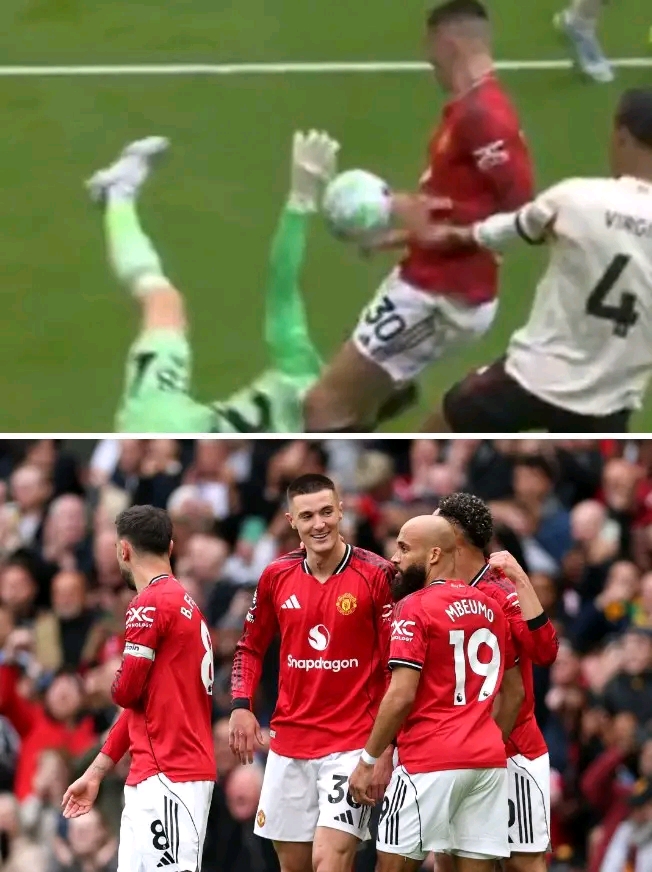
The moment the ball hit the back of the net inside Old Trafford, everything changed in an instant. The crowd reacted, players celebrated, defenders protested, and millions watching around the world immediately began asking the same question. Was that goal really clean? Or had something happened just seconds before that nobody could ignore?
It was one of those moments that reminds everyone why football is never just about what we see at first glance. It is a game of emotion, speed, pressure, and very fine margins. And sometimes, those margins create controversy that refuses to disappear.
At the centre of this storm was Benjamin Sesko, the young striker whose name suddenly became the most talked about topic across football discussions. His goal for Manchester United looked simple at first. A quick movement, a sharp finish, and the ball crossing the line. But within seconds, attention shifted away from the celebration and onto a possible handball in the build-up.
Players from the opposing team immediately raised their arms. Some shouted. Others surrounded the referee. The tension rose instantly. This was not just about a goal. This was about fairness, rules, and the integrity of the game.
As always in modern football, all eyes turned to VAR.
The Video Assistant Referee system has become one of the most debated additions to football in recent years. It was introduced to reduce mistakes, to bring more accuracy, and to ensure that big decisions are correct. But instead of removing controversy, it has often created new layers of debate.
This moment was no different.
The replay was shown again and again. Slow motion. Different angles. Zoomed-in frames. Every possible perspective was analyzed by fans, commentators, and pundits. Some believed the ball clearly touched Sesko’s hand before he scored. Others argued that there was no definite contact, or at least nothing strong enough to cancel the goal.
The problem was simple but frustrating. There was no clear, undeniable evidence.
And in football, especially with VAR, that matters a lot.
The rule is clear in principle. If there is a clear and obvious error, VAR can step in and correct it. But if the evidence is not strong enough, the original decision on the pitch stands.
That is exactly what happened.
After reviewing the incident, the Premier League released a statement that would only add more fuel to the debate. They confirmed that there was “no conclusive evidence” to prove that Benjamin Sesko handled the ball before scoring.
Those words quickly spread across social media.
No conclusive evidence.
To some fans, that meant the decision was correct. To others, it sounded like uncertainty. Like doubt. Like something had been missed.
And that is where the real controversy began.
Because in football, perception is just as powerful as reality.
If fans believe something is wrong, even if officials say it is right, the debate will continue. It will grow. It will spread. And it will not disappear easily.
For Manchester United fans, the focus was simple. The goal counted. The team benefited. And the rules had been followed. From their perspective, there was nothing more to discuss.
But for rival fans, it was a completely different story.
They saw something else.
They saw a possible handball that could have changed the outcome. They saw a decision that, in their eyes, should have gone the other way. And they questioned why VAR did not intervene more strongly.
This is the challenge of modern football.
Technology was supposed to bring clarity.
Instead, it has brought more detailed arguments.
Every decision is now examined in extreme detail. Every frame is studied. Every angle is debated. And sometimes, even with all that information, there is still no agreement.
That is exactly what “no conclusive evidence” represents.
It is not a strong yes.
It is not a strong no.
It is a middle ground that satisfies nobody completely.
For referees, this situation is incredibly difficult. They must make decisions in real time, under pressure, with thousands of fans watching and millions more at home. Even with VAR, they still have to interpret what they see and apply the rules as best as possible.
And the rules themselves are not always simple.
Handball decisions, in particular, are some of the most complicated in football. Was it intentional? Was the arm in a natural position? Did it directly lead to a goal? These questions are not always easy to answer, even with slow-motion replays.
In Sesko’s case, the lack of clear evidence meant that the benefit of the doubt stayed with the attacker.
And that decision stood.
But the conversation did not end there.
Pundits began discussing it on television. Fans argued online. Former players gave their opinions. Some defended the decision. Others criticized it heavily.
This is what football does.
It creates moments that go beyond the pitch.
Moments that turn into debates, discussions, and sometimes even long-term controversies.
For Benjamin Sesko, it was a strange situation. On one hand, he had scored an important goal for his team. On the other hand, that goal was now surrounded by questions.
Instead of pure celebration, there was noise.
Instead of simple joy, there was debate.
And that is something many players experience in the modern game.
Because today, every action is analyzed.
Every touch is reviewed.
And every decision is questioned.
For Manchester United, the focus remained on the result. Goals win matches. And in a competitive season, every point matters. They will not care how the goal is debated outside. What matters to them is that it counted.
But for the Premier League, moments like this are more complicated.
Because every controversial decision affects the league’s image.
Fans want consistency.
They want clear rules.
And most importantly, they want fairness.
When a decision is explained with “no conclusive evidence,” it can feel unsatisfying. It can feel like there is no strong answer. And that can lead to frustration.
This is why VAR continues to divide opinion.
Some believe it has improved the game.
Others believe it has made things worse.
But one thing is certain.
It has changed football forever.
There is no going back.
Every goal, every penalty, every red card now comes with an extra layer of review. And that means more accuracy, but also more debate.
The Sesko incident is just one example.
A single moment that shows how complicated football decisions have become.
In the past, this goal would have stood without question. There would be no replays, no slow motion, and no detailed analysis. The referee’s decision would be final, and the game would move on.
But today, things are different.
Fans expect perfection.
They expect every decision to be correct.
And when there is even a small doubt, it becomes a big story.
That is the reality of modern football.
As the season continues, there will be more moments like this. More controversial decisions. More debates. And more discussions about VAR and the rules of the game.
Because football is not just about goals.
It is about moments.
And sometimes, those moments create stories that last much longer than the match itself.
For now, the official position is clear.
The goal stands.
No conclusive evidence.
Case closed.
But in football, is anything ever really closed?
The debate will continue.
The opinions will remain divided.
And the next controversial moment is always just around the corner.
Because that is the beauty, and the frustration, of the game.