Footballers are not usually famous for their self-awareness in the minutes after a big win. The adrenaline is still running, the cameras are pointed at them, and the easy thing to do is to soak up the praise and move on. Badredine Bouanani did something different on Saturday evening. Named Man of the Match after Rangers’ 1-0 semi-final victory over Aberdeen at Hampden, he was asked about his night, and instead of dwelling on what had gone well, he dwelt on what had not. He had created chances and he had missed them, and he made no attempt to disguise how much that bothered him. It was a revealing moment from a young winger who is still in the early stages of finding his place at one of the biggest clubs in Scotland.
The words themselves were simple. Bouanani said he had a few chances, that he needed to work in training, and that he ought to have scored one or two goals, though he accepted that it was okay. He added that he would put in the work during the following week and hoped to score in the next game. There was no drama in it, no excuses and no attempt to pass the blame onto anybody else. It was the kind of straightforward self-assessment that managers love to hear, and it said a lot about the mentality of a player who had just been handed an individual award at the end of a big night.
To understand why this matters, it helps to know who Bouanani is and how he came to be at Ibrox. He is a 21-year-old Algerian international who arrived on the final day of the summer transfer window, and his arrival was a late addition to a busy few months for the club. He joined on a loan deal from VfB Stuttgart, as Derek McInnes’s squad was strengthened on deadline day. It was Rangers’ fourteenth signing of the summer, which gives you some idea of how much rebuilding was done, and the arrangement includes an option to buy. If that option were ever taken up, he would become the most expensive signing in the club’s history and in Scottish football, which tells you how highly he is regarded.
His route to Glasgow was far from straightforward. He came through the youth system in France, representing his country at several youth levels before committing his senior international future to Algeria. He made his name at Nice, where he scored five goals and set up seven in seventy appearances, and he spent time on loan at Lorient before moving to Germany in 2025. At Stuttgart, his opportunities were limited. He made twenty-eight appearances for the club but played only 1,002 minutes and started just eleven games. For a young player trying to develop, that kind of rotational role can be frustrating, and it is one reason why a loan to a club that could offer regular football made sense for everyone involved.
His record in front of goal over that period explains why his comment about finishing carries weight. Across Nice and Stuttgart combined, he has scored only a handful of goals, and he has never been regarded as a prolific scorer. His strengths lie elsewhere, in his dribbling, his creativity and his ability to pick a pass. Those are valuable attributes, and they are what have made him an exciting prospect. But they also mean that the final piece of the puzzle, putting the ball in the net, is something he has had to work on throughout his career. When he says he needs to improve, he is not being coy. He is being accurate.
There is a nice piece of history attached to his arrival as well. He has already experienced playing against Rangers, having scored for Nice in their 4-1 Europa League victory over Philippe Clement’s side in 2024. That goal made an impression on supporters at the time, and it was one of the reasons that his name was circulated when the club went looking for a winger. The comparison that has followed him around, with some labelling him a Riyad Mahrez regeneration, is a flattering one, but it also puts a degree of pressure on a young player. Mahrez was a player who combined dribbling skill with end product, and Bouanani knows that he will need to produce numbers if he wants to justify the hype.
On the pitch at Hampden, there was plenty to admire. Against a compact and well-organised Aberdeen defence, he was one of the few Rangers players who looked capable of unlocking things. His movement between the lines was intelligent, his first touch was reliable, and he showed a willingness to take on defenders even when the game was tight. In a match that offered few moments of quality, those traits stood out, and it was no surprise to see him recognised at the end. Nobody would argue that the award was undeserved, and the fact that he was involved in the move that led to the winning goal only underlined his influence.
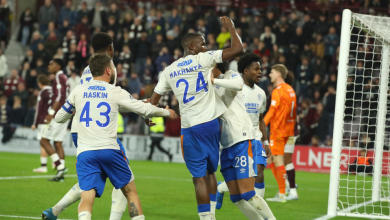
That build-up is worth recalling. Bouanani’s delivery was cleared to Penrice, whose low ball found Naderi for the finishing touch. The cross itself was not the final pass, but it was the start of the sequence, and it kept the pressure on Aberdeen’s defence at a moment when the visitors were beginning to believe they might survive. It was a reminder that a winger’s contribution is not always measured in goals and assists. Sometimes it comes from keeping the ball alive, forcing a clearance or dragging defenders into positions where they are vulnerable. Bouanani did all of those things, and he did them consistently.
It is also important to remember how he got into the side. He had been left out at Hearts in favour of Djeidi Gassama, only to come off the bench and deliver the free-kick that Olwethu Makhanya headed home for the equaliser. Before that, he had been the most dangerous attacker in the draw at Dundee, hitting the target with every shot. Those performances made a strong case for a starting place, and the semi-final was the moment the manager finally agreed. It was a reward for patience, but it was also a reflection of the player’s growing influence, and it shows how quickly things can change when a young winger seizes his chance.
The decision to drop Gassama was not taken lightly. The Frenchman has been a regular this season and has shown real flashes of quality, but his end product has been criticised, and his display at Tynecastle was one of his worst. Barry Ferguson has urged him to show more calm in the final third, and the manager’s decision to start Bouanani at Hampden sent a clear message. That does not mean Gassama’s time is over, because wingers go in and out of form all the time, but it does mean the competition for places is serious. Bouanani’s performance will have increased that pressure, and it will make the manager’s selection decisions more interesting in the weeks ahead.
His teammates were quick to recognise the importance of the win, and their comments help to put his own into context. James Penrice said that Rangers have turned a corner, and that they are now eleven games unbeaten. The defender, who had played in a more central midfield role before moving back to left-back, also pointed to the previous meeting with Aberdeen as a turning point, and he was delighted for Ryan Naderi, describing the goal as a proper striker’s goal. He added that there is still a lot more to come. That blend of satisfaction and ambition is exactly what McInnes will want to see, and it mirrors the tone of Bouanani’s own remarks.
That tone is perhaps the most encouraging thing to emerge from the evening. A squad that is content with a narrow win in a semi-final is likely to be vulnerable in the final, whereas one that wants to be better is more likely to rise to the occasion. Both Penrice and Bouanani made it clear that they see room for improvement, and that they are not satisfied with merely getting through. McInnes has talked about the importance of character and mentality, and these comments suggest that the message has landed. Players who criticise themselves publicly are, by and large, players who are taking responsibility for their development.
There is a further point about the atmosphere at Hampden that deserves mention. Bouanani was full of praise for the supporters, describing their backing as crazy, and he clearly felt the effect of the noise. A winger who plays with the crowd behind him tends to feel braver, and braver wingers take more risks. That is not a bad thing for a team that wants to create chances, and it explains why home and neutral crowds can have such a big influence on cup games. The Rangers fans filled their end, sang throughout and stayed positive even when the football was dull, and that energy undoubtedly helped the team to keep pushing.
Looking forward, the question is how Bouanani can turn his promise into consistent output. The answer, in part, is the one he gave himself: work in training. Finishing is one of the most trainable skills in football, and many wingers have improved their conversion rate through repetition and confidence. Getting into the right positions is the first step, and he is already doing that. The second step is making the right decision, whether that is shooting, squaring the ball or taking an extra touch, and the third is executing under pressure. All of these can be practised, and with the coaching staff at Rangers, he has the resources to do it.
There is also an element of mentality involved. Young players who start to worry about missing chances can become hesitant, and hesitation is the enemy of good finishing. The best approach is to treat each miss as information, not as a source of anxiety, and to carry on creating opportunities. Bouanani’s attitude suggests that he is capable of doing that. He was disappointed, but he was not despondent, and he talked about the next game as a chance to put things right. That resilience is a valuable trait in a forward, and it will help him to handle the ups and downs of a long season.
The wider context of the team’s attacking development also matters. Rangers have been strong defensively this season, keeping more clean sheets than anyone in the league, but they have sometimes struggled to turn possession into goals. The semi-final was a good example, with the team managing only a single shot on target in the first half and needing a late goal to break down a deep defence. If the wingers can become more clinical, the team will be harder to stop, and the pressure on the strikers will ease. Bouanani, with his technical ability, is well placed to be part of that evolution, and his determination to improve is a promising sign.
The final in December will be the next big test. Whether Rangers face Hearts or Hibernian, they will meet an opponent that is organised, motivated and capable of causing problems. The pressure will be intense, with a three-year trophy drought hanging over the club, and the players who thrive will be those who can stay calm and execute their roles. Bouanani has shown that he can perform when it matters, and if he can add goals to his game, he could be one of the key figures on the day. The manager will have several weeks to prepare, and the competition for places will make sure that everyone stays sharp.
It is also worth noting what the performance means for his future. He is on loan, with an option to buy, and the way he performs in the coming months will go a long way towards deciding whether that option is exercised. A Man of the Match display in a semi-final is the sort of thing that gets noticed by club officials, and a trophy win would only strengthen his case. At the same time, the fee involved would be substantial, so the club will want to see consistent output, including goals. That makes his comment about needing to improve even more pertinent, because it shows that he understands what is required.
For the supporters, the message is an encouraging one. They have a winger who is talented, committed and honest, and who wants to get better. Those are the sorts of qualities that fans take to heart, and they often forgive a lot of mistakes when they see a player who cares. If Bouanani can add a few goals to his game, he will become a real favourite, and the sight of him weaving past defenders at Ibrox will be one that many look forward to. For now, he is a work in progress, but a very promising one.
In the end, the story of the night is about attitude as much as ability. A young player was handed the spotlight, and instead of basking in it, he looked for ways to improve. That mindset is what separates good players from great ones, and it is what makes managers believe that a player can go further. If Bouanani continues to approach his football with the same humility and hunger, there is every reason to think that the goals will come, and that his Man of the Match display at Hampden will prove to be the beginning of something significant rather than a one-off