McInnes Challenges Makhanya’s “Lack of Character” Claim as Rangers Prepare for the League Cup Semi-Final

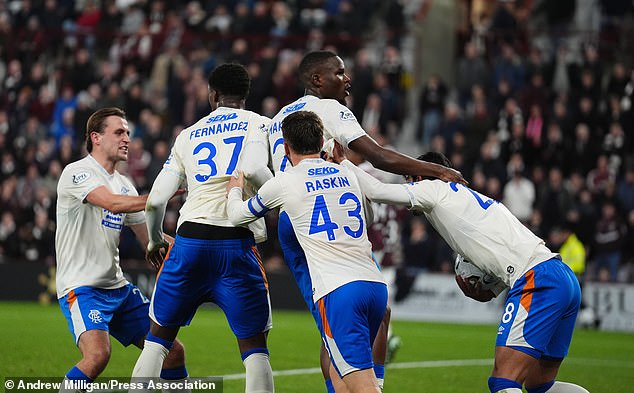
There are few things a manager likes less than a public discussion about his team’s character. It is a loaded word in football, one that implies weakness, softness and a failure of will, and it tends to stick. So when Olwethu Makhanya used it to describe the start of Rangers’ second half at Tynecastle, just moments after heading in an equaliser in the eighty-ninth minute, it was always going to be picked up and debated. By the time Derek McInnes sat down to preview Saturday’s Premier Sports Cup semi-final against Aberdeen, he had clearly decided that the claim needed to be answered, and he did so with a mixture of firmness, diplomacy and a touch of irritation.
The context for the comment matters, because it was made in the heat of the moment. Makhanya, the South Africa defender, said there had been a lack of character in the team at the start of the second half, after he had headed the late equaliser. He was speaking on Sky Sports straight after the match, the adrenaline still flowing, with the relief of a point rescued from a game that had looked lost. Players do not tend to weigh their words carefully in those circumstances. They say what they feel, and what Makhanya felt was that Hearts had worked harder than his team during a crucial spell of the game and that Rangers had paid for it.
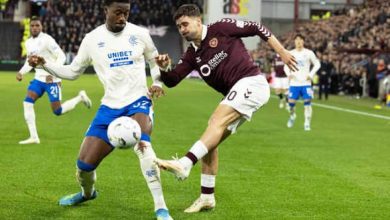
His assessment was not without evidence. Rangers had taken an early lead through Kevin Kelsy, and for a while it looked as if they were in control. But Hearts came out after the break with far more energy, and the visitors looked a step behind. The Rangers Review described the start of the second period as lethargic, with Rangers conceding twice in quick succession to goals from Claudio Braga and Calvin Miller. In the space of a few minutes, a lead had become a deficit, and the home crowd, which had been shaken by the early goal, was back in full voice. For anyone watching, it was easy to understand why a player on the pitch might have concluded that his teammates had been outworked.
The defender went further than simply describing what he saw. According to one report, he said that he felt Hearts had been outworking Rangers at times, and that this was the reason he used the word character. That is a more specific criticism than a general complaint about the team’s attitude. It suggests that the problem was not a lack of ability or tactics, but a failure to match the intensity of the opposition in the second-half period when the game turned. For a team with title ambitions, that is a serious accusation, and it is not the kind of thing that a manager can ignore, especially when it comes from one of his own players.
What made the comment more interesting is that the manager did not completely disagree with the underlying point. McInnes admitted that Rangers had failed to show enough authority after going in front, saying he was disappointed they did not control the game more. That is a candid admission, and it shows that the manager shares at least some of the frustration. A team that scores early at a difficult ground should be able to build on that advantage, either by keeping the ball and dictating the tempo or by defending in an organised way. Rangers did neither, and McInnes knows it. The difference between him and his defender is not whether the performance was flawed, but how it should be described.
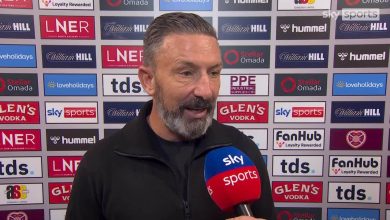
That is where the pushback came in. McInnes was told about Makhanya’s comments, and he addressed them directly. He accepted that there had been a spell when Rangers looked second best, but he insisted that the picture was more nuanced than the word character suggested. He said the running statistics showed Rangers had not been second best in terms of effort, and that it was too easy to point fingers at character, a word he said gets bandied about at the club. It was a deliberate and careful response, designed to defend the squad without undermining the player who had just saved them a point.
The reference to running statistics is a revealing one. Modern football is awash with data, and managers increasingly use physical metrics to judge whether a team has met its standards. Distance covered, number of sprints and intensity of pressing can all be measured, and they give a sense of whether a team is working as hard as it should be. If McInnes is right that the numbers did not show a drop in effort, it suggests that the problem was one of quality and organisation rather than commitment. A team can run a lot and still be outplayed if it runs in the wrong places or at the wrong moments, and that appears to be what happened at Tynecastle.
It is also worth noting how McInnes framed the larger story. He said that the squad has plenty of character and has shown it already this season, and that they found the resilience to bounce back and get a result when it looked as if they would not. That is a strong counter-argument. A team that fights back from a losing position to rescue a draw at a difficult ground, in front of a hostile crowd, is demonstrating exactly the quality that Makhanya says was missing. The goal itself, a header in the dying minutes, was the product of persistence and belief. It is hard to claim that a team lacks character when it is capable of that kind of response.
The two views are not as far apart as they might seem. Makhanya was talking about a specific period of the game, while McInnes was talking about the season as a whole. Both can be true at the same time. A team can show tremendous resilience over the course of a campaign and still have lapses in concentration or intensity during individual matches. In fact, most successful teams are not those that never have bad spells, but those that recover from them quickly. The question for Rangers is whether they can reduce the frequency and duration of those spells, and whether they can learn from the experience at Hearts.
There is also a question about the way criticism should be delivered. Football dressing rooms have their own culture, and many managers and players prefer that frank assessments are made behind closed doors rather than in front of a television camera. When a player speaks publicly about his team’s shortcomings, it can create a sense of tension, even if the comments are intended constructively. Some pundits have taken a more generous view, though. One commentator suggested that if McInnes shares the view that there needs to be an improvement in character, he will be happy to see a leader in his team being honest about it. The same analyst argued that Makhanya has exactly the sort of competitive edge that Rangers have been missing.
That is a reasonable perspective. Honesty is often a sign of a healthy squad, and a player who is willing to hold himself and his teammates to a high standard is usually a valuable asset. Makhanya is young, ambitious and clearly cares about the team’s performance, and his willingness to speak up is a sign of leadership. A manager can work with that. The risk, of course, is that a comment taken out of context can be interpreted as criticism of individuals, and that is a risk McInnes has tried to minimise by emphasising unity and describing the remarks as having been misinterpreted.
The manager’s wider message was about togetherness. He praised the effort and focus the players have given him, described them as a tight squad, and stressed that the bond between them is important to the evolution of the team. That emphasis on cohesion is a theme McInnes returns to repeatedly. He knows that a squad assembled over a single summer, with a large number of new arrivals, needs time to gel, and he is keen to avoid anything that might disrupt that process. In that context, a public discussion about character is an unwelcome distraction, and it is no surprise that he wanted to close it down as quickly as possible.
It is also important to remember the timing. The comments were made just days before a major cup semi-final, which is the worst possible moment for any kind of internal controversy. Rangers are strong favourites to beat Aberdeen, who have been struggling for form, but favouritism brings its own pressure. A trophy would be a huge boost for a club that has gone two seasons without silverware, and McInnes is acutely aware of how much is at stake. He has said that winning a first piece of silverware would be hugely important for confidence and belief, and he has also warned that semi-finals are often tense and difficult occasions.
His own experience reinforces that caution. McInnes reflected that he has both won and lost semi-finals, and he knows how big the contrast is between the two. That is not a throwaway line. It reflects a manager who has been through the highs and lows of cup football many times, and who understands that the margins are tiny. A single lapse in concentration, such as the one Makhanya described at Tynecastle, can be the difference between a place in the final and a damaging defeat. For that reason, there is a certain irony in the fact that the very comments he has pushed back on are about exactly the kind of mentality he will need his team to show on Saturday.
If there is a lesson from the Hearts game, it is that Rangers cannot afford to relax after taking the lead. The first goal at Tynecastle was well taken, but it was followed by a passage of play in which the team lost its shape and its focus. Against Aberdeen, who will be desperate to turn around a poor run of results, the same drop in intensity could be punished just as severely. McInnes will have spent the week drilling his players on how to manage games, on keeping the ball and on staying alert when they are in front. It is a simple message, but it is one that wins matches.
There is another angle to the story, which is the way it highlights the pressure on the manager. McInnes took over at Rangers in the summer, and the expectations on him are enormous. Every result is analysed, every comment is dissected, and every sign of weakness is pounced upon. In that environment, the word character becomes a convenient label for anything that goes wrong, and it is easy for critics to attach it to a team that drops points. McInnes has been through that process before at other clubs, and he knows that the best response is to stay calm, defend his players and let the results do the talking.
At the same time, he is not blind to the need for improvement. The admission that Rangers did not show enough authority after going in front is a sign that he recognises the problem, and the fact that he addressed it publicly suggests he intends to fix it. There is a difference between defending a squad and ignoring its flaws, and McInnes seems to understand that. His message to the players is likely to be that they have shown plenty of character already, but that they need to demonstrate more consistency if they want to win trophies. That is a challenge, not a criticism, and it is the kind of message that good teams respond to.
For Makhanya, the episode may well turn out to be a positive one. He has shown that he has the courage to speak his mind, and the quality to back it up with a decisive goal in a critical moment. If he can maintain that standard, and if he can combine his honesty with the discipline of working within the team structure, he could become one of the leaders of the squad. The manager’s reaction suggests that there is no lasting damage, and the way McInnes defended the group while recognising the defender’s contribution shows that the relationship is on solid ground.
As for the team, the next few days will tell us a great deal. A strong performance against Aberdeen, followed by a place in the final, would quickly bury any talk of weakness. A poor display, on the other hand, would revive the questions and give critics fresh ammunition. That is the nature of the pressure at Rangers, and McInnes has accepted it. His approach has been to focus on what he can control, which is preparation, selection and tactics, and to trust that his players will respond.
When all is said and done, the debate about character is probably less important than it seems. Every team has moments when it plays badly, and every player occasionally loses concentration. What matters is how a squad responds, and so far, Rangers have responded well. They have lost very few games, they have shown resilience in difficult situations, and they have a manager who knows how to get the best from them. If they can reproduce that spirit at Hampden, the discussion about character will fade, and the talk will turn to a first trophy of the McInnes era.
In the end, the exchange between a defender and his manager was a small drama, but it said something larger about the culture McInnes is trying to build. He wants honesty, but he also wants unity. He wants high standards, but he also wants confidence. Balancing those demands is one of the hardest tasks in management, and so far he has done it with skill. On Saturday, in front of a packed Hampden, his players will have the chance to show that they have the character to match their talent, and that the word has no place in the conversation any mor