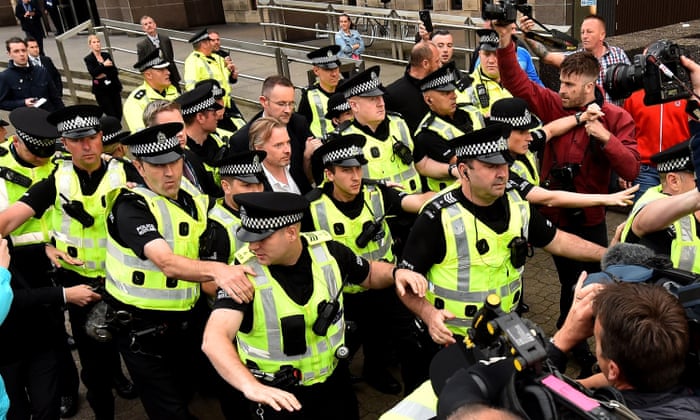
Football matches are meant to begin with anticipation. Supporters gather, scarves go on, and the walk to the ground becomes part of the ritual. On the evening of Friday 3 April 2026, in south Belfast, the build-up to an Irish Cup semi-final turned into something very different. Before Cliftonville and Dungannon Swifts had kicked a ball at Windsor Park, police officers were dealing with fireworks, flares and bottles being thrown around them, a child had been struck by a bottle, and at least nine officers had been injured.
The scale of the disorder was set out by the Police Service of Northern Ireland the following day. A 19-year-old man was arrested, and he has since been charged with a series of offences: riotous behaviour, doing a provocative act, possession of fireworks or flares at a regulated match, indecent behaviour and attempted criminal damage. Police described the scenes as the product of conduct they had warned against in advance. The match itself went ahead, and Dungannon Swifts won it on penalties after a 1-1 draw, but for many people the result became a footnote to what had happened outside.
To understand why the evening ended as it did, it helps to begin with the occasion. An Irish Cup semi-final at the national stadium is a significant fixture. Windsor Park is the home of Linfield and the Northern Ireland national team, a ground with its own history and its own place in the geography of Belfast. It sits in a densely populated part of the south of the city, surrounded by residential streets, and any large match there requires careful planning. When the visiting club’s supporters come from a different part of the city and a different community, that planning becomes more complex still.
Cliftonville are a north Belfast club with a loyal and vocal following. They were facing Dungannon Swifts, a side that had already been a source of frustration for them. The two teams met in the previous year’s Irish Cup final, which Cliftonville lost on penalties, and which was itself followed by disorder in the Broadway area as supporters made their way home. The semi-final was therefore a repeat of an earlier, bruising occasion, and police had good reason to treat it as a fixture requiring close attention.
A feature of the evening was a supporters’ procession, sometimes described as a fan walk, from the Falls area of west Belfast towards Windsor Park. Such processions are not unusual, and this one had been approved by the Parades Commission, the body that regulates public parades in Northern Ireland. Estimates of its size varied slightly between reports, with figures of around 200 to 250 people cited. A substantial policing operation accompanied it, with officers escorting the group through the streets towards the stadium. The route took it past areas where tensions have historically run high, including the Broadway roundabout and the neighbouring Village area.
According to the senior police officer in charge of the south Belfast district, Superintendent Finola Dornan, officers witnessed provocative conduct during the procession and the heavy use of pyrotechnics and fireworks, despite repeated warnings against it. Police said there were numerous breaches of the conditions set out in the Parades Commission’s determination for the procession, and that these would be investigated. In other words, the event that had been approved on the basis of certain conditions was, in the police’s assessment, not conducted within them.
It was at this stage that the disorder developed. Fireworks, flares and bottles were thrown, and the injuries that followed were considerable. At least nine police officers were hurt over the course of the operation. A child, reported by some outlets to be nine years old, was struck by a bottle. For anyone who attends football with their family, that detail is the one that lingers. A match day is supposed to be a place where children can be taken safely, and the image of a child hit by a missile on the way to a game sits uneasily with that expectation.
Police made an arrest before kick-off, and the 19-year-old was held in custody while inquiries continued. He was later charged, and the list of offences gave a sense of how police viewed the behaviour: not simply a single act of misconduct but a combination of disorder, provocation, the use of pyrotechnics at a regulated match and attempted damage. Possession of fireworks and flares at a designated football match is a specific offence in Northern Ireland, one of several measures designed to curb the pyrotechnics that have become a feature of supporter culture in many countries and are widely regarded as dangerous.
The senior officer’s language in the aftermath was measured but pointed. Police said they would conduct a thorough evidence-gathering operation in the wake of the evening’s events, a phrase that signals a long investigation involving footage, witness accounts and, in all likelihood, further arrests. In policing terms, an arrest on the night is rarely the end of the matter. Modern operations are heavily recorded, from officers’ body-worn cameras to fixed CCTV and the footage that members of the public capture on their phones. Identifying individuals after the fact is often possible, and it can take weeks or months.
The political reaction was swift. Edwin Poots, the Democratic Unionist Party MLA for South Belfast, responded to the unrest in strong terms. He told the BBC that local residents had been engaging with police over the previous two years and that the community would not accept the situation any longer. He said that on this occasion fireworks, bottles and eggs had been thrown, and he made allegations about chanting and singing during the procession. He went further, suggesting that residents might have to block the road to stop supporters reaching the ground. Those are his claims and his proposals, and they reflect the anger felt by some in the communities along the route. They also illustrate how quickly a football-related incident in Belfast can take on a wider political and sectarian dimension, given the city’s history.
It is important to be careful here. Football supporters are not a single entity, and the actions of a minority do not define a club’s entire following. Most of those who travelled to Windsor Park that evening, like most of those who attend any match, simply wanted to watch their team. But disorder of this kind does not stay confined to those who cause it. It affects residents who live along the route and who find their streets turned into a flashpoint. It affects police officers who are injured doing their jobs. It affects the club, whose name is attached to the behaviour, and it affects the wider reputation of the sport in Northern Ireland.
That last point was made by a group from within Cliftonville’s own supporter community. About a week after the semi-final, a supporters’ club publicly criticised Cliftonville for its silence in the face of what had happened. The group said it did not want the club dragged into the past, and it called on the club’s management committee to condemn the behaviour seen at the semi-final and at other recent fixtures. It also urged the introduction of educational initiatives to promote respectful, football-focused supporter conduct. The intervention is significant because it came from inside the club’s own orbit. It suggests that many supporters are as dismayed as anyone by what occurred and want to see their club take a firmer stance.
The question of how clubs should respond to supporter disorder is a difficult one. Clubs have limited control over what happens away from the ground, particularly during a procession that sets off from several miles away. They can issue statements, work with police, ban individuals identified as having taken part and encourage good behaviour among their followings. But they cannot stop every individual from throwing a bottle or lighting a flare. At the same time, silence can be read as indifference, and in a situation where a child has been hurt and officers injured, many people feel that a clear public condemnation is the least that should be expected.
There is a further complication in the nature of the policing challenge. Large fan processions are a double-edged tool. For supporters, they are an expression of identity and togetherness, and for many they are among the most enjoyable parts of a big match day. For police, they require significant resources and carry risk, especially where routes pass through sensitive areas. The Parades Commission determinations that govern them in Northern Ireland exist precisely because of the potential for confrontation, and compliance with their conditions is central to the whole system working. When those conditions are breached, as police said they were here, the argument for allowing such processions in future is weakened.
Looking at the wider picture, the Belfast incident is one of a number of recent episodes across European football in which pyrotechnics and thrown objects have been used against police around major cup fixtures. In Croatia, the Cup semi-final between Dinamo Zagreb and Hajduk Split once ended in clashes in which police were attacked with flares, bottles and stones, and dozens of people were detained. In Spain, officers were injured by fireworks and bottles before a Copa del Rey semi-final between Athletic Bilbao and Atletico Madrid, prompting both clubs to condemn the supporters responsible. The details differ, but the pattern is familiar: a high-stakes match, an organised or semi-organised supporter presence, and a minority determined to use the occasion for confrontation.
Pyrotechnics deserve particular attention. In some supporter cultures, flares and smoke bombs are seen as a legitimate part of the atmosphere, a spectacle that adds colour and noise. Authorities take a very different view. Flares burn at extremely high temperatures and can cause serious injuries, including burns to supporters standing nearby. Fireworks thrown or launched in a crowd, or at police, carry obvious risks, and the combination of smoke, noise and panic can lead to dangerous crowd movement. This is why possession of such items at football matches is a criminal offence in Northern Ireland, in Scotland and in many other jurisdictions.
The injuries to the officers also deserve to be taken seriously. Police officers involved in football policing are often expected to stand in lines, absorb provocation and avoid escalation, even as objects are thrown at them. The injuries reported in Belfast, at least nine in total, represent a real human cost. Each of those officers has colleagues, family and a life outside the job, and the recovery from even relatively minor injuries can take time. When people talk about disorder at football, it is easy to focus on the spectacle and forget the individuals on the receiving end.
Equally, the child struck by a bottle is a reminder that the consequences of such behaviour fall on people who had nothing to do with it. A nine-year-old walking to a football match with family or friends cannot be held responsible for the tensions of adults. The fact that a child was hurt will, for many readers, be the detail that crystallises the unacceptability of what happened. It is also the kind of detail that tends to harden public opinion and prompt calls for stronger measures.
What those measures might be is a matter of debate. Some argue for tougher sentencing and a more aggressive use of football banning orders, which can prevent convicted individuals from attending matches for years. Others point to the importance of engagement: working with supporter groups, community organisations and clubs to shift the culture over time. There is evidence that the most effective approaches combine enforcement with dialogue, targeting the small number of individuals responsible while building trust with the majority. The supporters’ club statement criticising Cliftonville’s silence is, in that sense, an example of the kind of internal pressure that can help change norms.
Residents have their own concerns, and they should not be overlooked. Communities along the route to a major stadium bear the burden of match days whether they care about football or not. They deal with road closures, noise, litter and, on occasions like this, genuine fear. Their frustration is understandable, and it is reasonable for them to expect that the authorities and the clubs involved will take their concerns seriously. Proposals such as blocking roads are, by their nature, a sign of how strongly some feel, and also a sign of how much work remains to be done to rebuild trust.
The sporting dimension, meanwhile, should not be forgotten. Dungannon Swifts progressed to the final after a penalty shoot-out, a result that would ordinarily have been the main story of the night. For the Swifts and their supporters, it was a moment of triumph. For Cliftonville, it was a second consecutive disappointment against the same opponents in the Irish Cup. The football deserved better than to be overshadowed, and the players on both sides had no say in what took place beforehand.
It is worth considering, too, what the incident says about the relationship between football and wider society in Northern Ireland. The sport has long been bound up with questions of identity, community and history, and incidents of disorder are rarely simply about football. They draw on older divisions and anxieties, and they are interpreted through those lenses by those who witness or hear about them. That does not mean football is doomed to repeat the past. There are many examples of clubs and supporters working to build inclusive, welcoming environments, and of match days that pass with nothing more dramatic than a good atmosphere and a close result. But it does mean that the stakes of getting things right are higher than in many other places.
The investigation will continue, and further developments are likely. The police have said they will examine the breaches of the procession’s conditions, and the 19-year-old charged in connection with the disorder will go through the court process. Others may yet be identified and arrested. The Parades Commission, the clubs, the Irish Football Association and the police will all be asked to consider what lessons can be learned and what changes might be necessary before the next big fixture.
Among the questions that will be debated are whether processions of this kind should continue to be approved, whether stricter conditions or additional monitoring are needed, whether clubs should be given greater responsibility for the conduct of their supporters en route to matches, and how to protect residents and families who simply want to get on with their evenings. None of these has an easy answer, and each involves a balance between the freedoms of those who wish to take part and the rights of those who may be affected.
For now, the facts that are known are stark enough. A procession approved on the understanding that it would be conducted within certain limits became the setting for the use of fireworks and flares and the throwing of bottles. Police officers were hurt, a child was struck, and a young man faces serious charges. A club’s supporters are asking its leadership to speak out, and a local politician is warning that his constituents’ patience is wearing thin.
What happens next will say a great deal about whether the lessons are learned. If the response is a serious combination of enforcement, dialogue and accountability, there is a chance that the next semi-final will be remembered for the football. If not, the risk is that the pattern repeats, and that Windsor Park’s big nights become occasions that residents, officers and parents dread rather than welcome. Everyone who cares about the game has an interest in making sure it is the former.