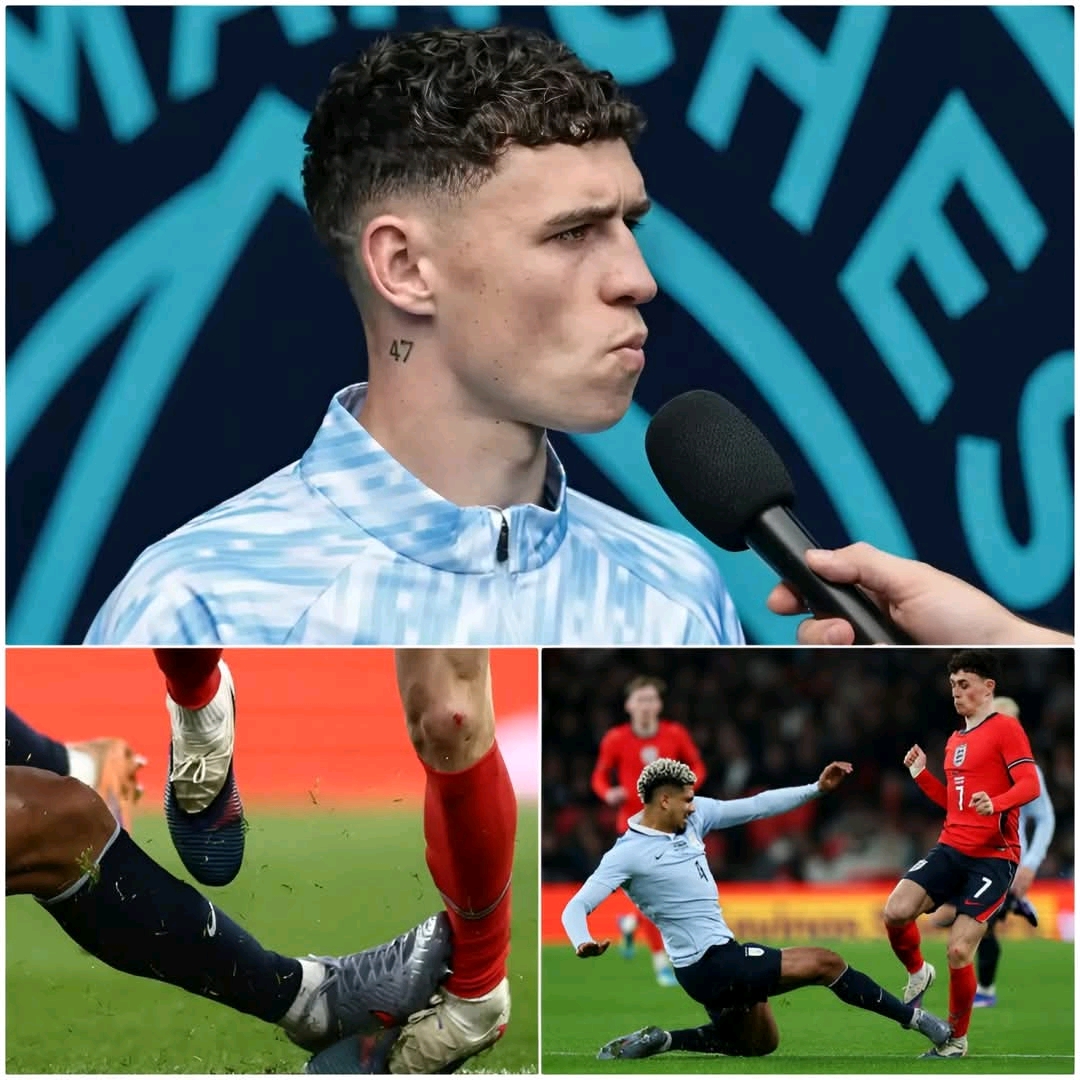
“HE WANTED Phil Foden spoke out after the controversial tackle by Ronald Araújo during the friendly match between Uruguay and England in the 67th minute, involving a dangerous and unnecessary challenge in a game with no real stakes. Foden threatened to take Araújo to FIFA over this unsportsmanlike behavior. Araújo immediately fired back by revealing the reason behind his tackle on Foden, further angering fans toward the Uruguayan defender

The tension inside the stadium that night felt different from a normal friendly match, the kind of difference that fans could sense even before anything dramatic happened. It was supposed to be just another international game, a chance for players to build rhythm, test combinations, and prepare for bigger competitions ahead. But when England national football team faced Uruguay national football team, nobody expected that the match would turn into one of the most talked-about controversies of the year.
Everything seemed calm in the beginning. Players moved the ball with confidence, both teams showing flashes of quality. Supporters in the stands were enjoying the flow of the game, even though it did not carry the weight of a tournament final or a must-win qualifier. But beneath that calm surface, something was building, something that would explode in a moment that changed everything.
At the center of it all was Phil Foden, a player known for his creativity, his sharp movement, and his ability to change a game in seconds. Foden was enjoying himself on the pitch, drifting between defenders, linking play, and looking like a man ready to take control of the match. Every touch he made carried confidence, and it was clear he wanted to make a statement.
On the other side was Ronald Araújo, a defender known for strength, aggression, and no-nonsense defending. Araújo has built a reputation as someone who does not back down, someone who treats every challenge seriously no matter the type of match. Friendly or not, he plays like it is a final.
For most of the game, their paths crossed naturally. Foden trying to create space, Araújo trying to shut him down. It was a normal battle between attacker and defender, the kind fans love to watch. But in the 67th minute, everything changed in a flash.
Foden received the ball in a dangerous position, turning quickly as he looked to drive forward. For a split second, it looked like he was about to glide past his marker and create something special. But before he could take his next step, Araújo came in with a challenge that immediately froze the stadium.
It was not just a tackle. It was heavy, aggressive, and, to many watching, completely unnecessary for a friendly match. Foden went down, and the reaction was instant. Players rushed in, some shouting, some pushing, all trying to understand what had just happened.
Fans watching could not believe it. In a game that had no real stakes, why would a defender risk such a dangerous challenge? The referee stepped in quickly, trying to calm things down, but the damage had already been done. The mood had changed. What was once a calm game had turned into something heated and emotional.
Foden stayed on the ground for a moment, clearly shaken. Medical staff rushed over, and for a few seconds, everyone held their breath. England fans feared the worst. With major competitions always on the horizon, any injury to a key player like Foden is a nightmare.
When he finally got back on his feet, there was relief, but also anger. You could see it in his face. This was not just about pain. It was about what that tackle could have taken away from him.
After the match, Foden did not hold back. His words were strong, emotional, and filled with frustration. He made it clear that he believed the challenge crossed a line. According to him, it was not just a bad tackle, it was something that could have ended his chance to play at the highest level.
He spoke about the fear every player carries, especially when big tournaments are approaching. One moment, one reckless action, and everything you have worked for can disappear. For Foden, that thought was real in that moment.
He even went as far as suggesting that he could take the matter to FIFA. That statement alone showed how serious he felt about the situation. Players do not usually talk about going to FIFA over a tackle in a friendly match. This was different.
His reaction quickly spread across social media. Fans, pundits, and former players all began to debate the incident. Some supported Foden, saying he had every right to be angry. Others felt that football is a physical game and that tackles like that, while unfortunate, are part of it.
But the story did not end there.
Araújo responded, and his response added even more fuel to the fire. Instead of apologizing or trying to calm the situation, he explained his side of the story in a way that surprised many people.
He claimed that his intention was not to injure Foden but to stop a dangerous attack. In his view, it was a defensive action, one that any committed defender would make in that situation. He insisted that he plays every match with intensity, regardless of whether it is a friendly or a final.
But what really caught attention was when he revealed what he believed led to the moment. According to him, there had been small incidents earlier in the game, moments of tension that built up between players. He suggested that the challenge was not random, but part of the natural heat of the match.
This explanation did not calm fans. In fact, it made many of them even more angry. Supporters of England and neutral fans questioned how any situation in a friendly could justify such a risky challenge.
The debate quickly became bigger than just one tackle. It turned into a discussion about player safety, about respect between professionals, and about how far is too far in a game that is supposed to prepare players, not endanger them.
For Foden, the situation remained personal. This was not just about opinions or debates. It was about his career, his future, and the risks that come with stepping onto the pitch.
Footballers train every day, pushing their bodies to the limit, all for moments on the biggest stages. The idea that one unnecessary challenge could take that away is something that stays in the back of every player’s mind.
That is why his reaction felt so real. It was not just anger. It was fear mixed with frustration, the kind that comes when you realize how quickly things can change.
Meanwhile, within the England camp, there was support for Foden. Teammates stood by him, making it clear that they believed the challenge was too much. Coaches and staff also shared concerns, especially with important matches always ahead.
On the Uruguay side, things were different. Araújo’s teammates backed him, defending his style of play and his commitment. For them, he did nothing wrong. He played the game the way he always does, with intensity and focus.
This difference in perspective is what made the situation even more complicated. Two sides, two completely different views of the same moment.
As the days passed, the incident continued to dominate headlines. Clips of the tackle were shared everywhere. Slow-motion replays were analyzed again and again. Every angle was examined, every movement discussed.
Some experts argued that the tackle deserved punishment, even though it happened in a friendly. Others said that taking it further would set a dangerous precedent, where every strong challenge becomes a legal issue.
The mention of FIFA added another layer to the story. If the governing body were to get involved, it could open the door to more cases like this in the future. That is something football authorities would need to consider carefully.
For now, no official action has been confirmed. But the conversation continues, and the incident remains fresh in the minds of fans.
What makes this story so powerful is not just the tackle itself, but what it represents. It is a reminder of how thin the line is in football. One moment of brilliance can create magic, but one moment of recklessness can create chaos.
For Phil Foden, it was a warning. A reminder of the risks that come with the game he loves. For Ronald Araújo, it was a moment that put his style of play under the spotlight.
And for football fans, it was a moment that sparked debate, emotion, and reflection.
As future matches approach and players step onto the pitch again, this incident will not be forgotten quickly. It will stay in conversations, in analysis, and in the minds of those who watched it unfold.
Because sometimes, even in a game with no real stakes, everything can change in a single moment.