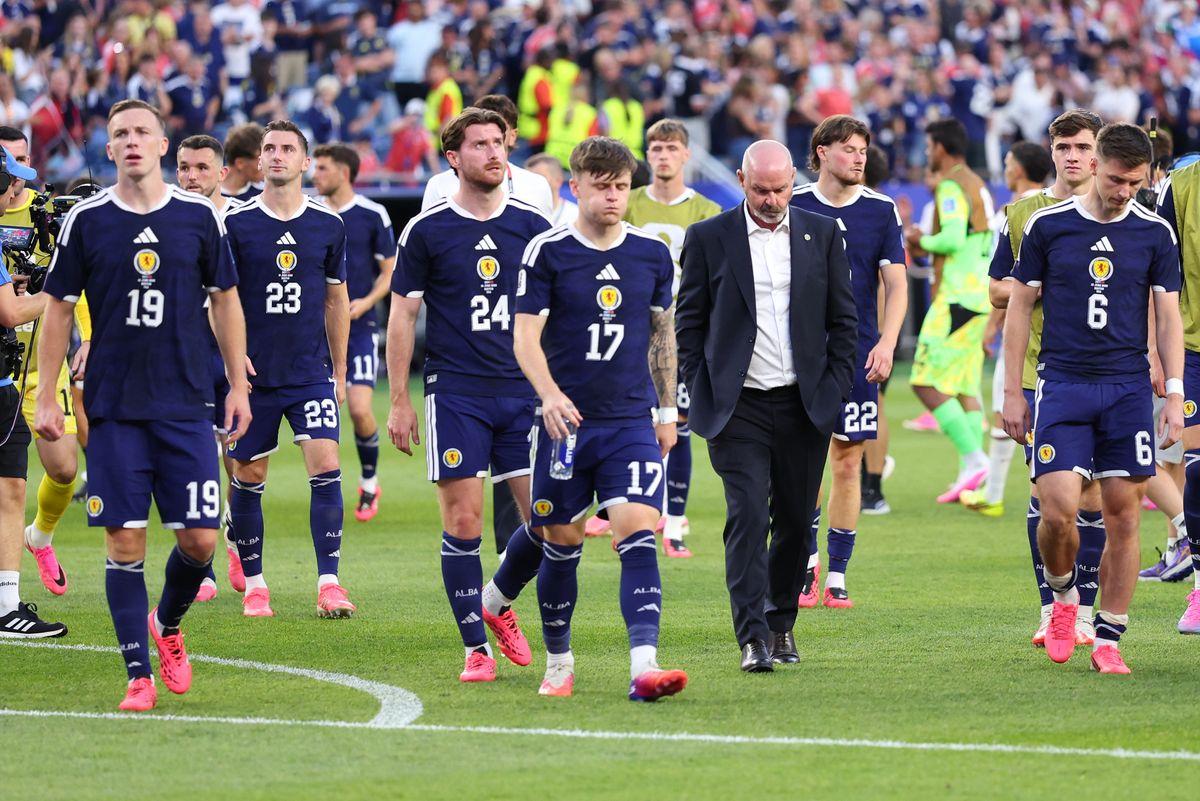
It was supposed to end differently. When Scotland landed their opening World Cup fixture against Haiti in Boston and came away with a 1-0 victory — their first win at a World Cup since 1990 — the dream felt real in a way it rarely has for the Tartan Army. Thirty-six years of hurt, washed away in one warm June evening on the east coast of America. A generation of players who had fought through qualification campaigns, near-misses, and heartbreak, finally delivering the moment their supporters had been waiting for across decades.
Three weeks later, Scotland are sitting in the third-place standings with three points and a goal difference of minus three, watching results come in from other groups with the desperate, fractured hope of a nation that has been here too many times before and knows, deep down, that the fairy tale is almost certainly over.
Steve Clarke himself said it plainly after the 3-0 defeat to Brazil in Miami — his side were “probably going home.” Those three words, delivered with the quiet resignation of a man who has given everything to this job and knows when the mathematics are working against him, captured everything about Scotland’s position in this tournament. Not definitively eliminated. Not mathematically certain to go home. But close enough that hope feels like an act of defiance rather than a rational assessment of the situation.
And yet, the Tartan Army have never been short of defiance. So let us look at exactly what Scotland need, exactly what has to happen across three groups and multiple fixtures, and exactly how slim but real the possibility of a miracle still is.
Scotland were drawn in Group C alongside Brazil, Morocco, and Haiti — a group that immediately presented a significant challenge but also a realistic path to the knockout rounds. Beat Haiti. Keep it tight against Morocco. Give Brazil a game and hope the goal difference holds.
The opening match in Boston delivered exactly what the script demanded. Scotland defeated Haiti 1-0 in their opening fixture — a result that broke a 36-year drought without a World Cup win and sent the Tartan Army into celebrations that lit up the streets of the Massachusetts city long into the night. It was not always pretty. It was not always comfortable. But in a World Cup group game, the only thing that matters is the result, and Scotland got it.
The second game against Morocco was where things began to unravel. A 1-0 defeat, with the only goal arriving in the second minute through Ismael Saibari, left Scotland needing a result against Brazil in their final group match to guarantee safe passage through. Morocco controlled large portions of the game, and Scotland’s inability to find an equaliser — despite having legitimate claims for a penalty that was not given — left them in a precarious position with everything riding on the Brazil game.
What followed in Miami was, ultimately, the result that most neutral observers had expected but that Scotland supporters had desperately hoped to avoid. Brazil were clinical, controlled, and at times genuinely breathtaking — the kind of opponent that exposes the gap between a good European nation and the genuine elite of world football. A 3-0 defeat was harsh in scoreline terms but honest in footballing terms, and it left Scotland with the worst possible combination for a team hoping to advance as a third-placed side — three points and a goal difference of minus three.
From that moment on, Scotland’s fate has been out of their own hands entirely. Their tournament — at least the playing part of it — is over. All that remains is the waiting, the watching, and the hoping.
Scotland owe what little hope they still have to the expanded format of the 2026 World Cup. With 48 teams across 12 groups, the tournament allows not just the top two finishers from each group to advance but also the eight best third-placed teams from across all twelve groups.
That means Scotland — sitting third in Group C — are not automatically eliminated. They simply need to finish among the eight best third-placed finishers across the entire competition. With 12 groups, 12 third-placed teams will compete for those eight spots, meaning four will go home while eight advance. The question is which category Scotland fall into.
The answer, based on the results that have come in so far, is looking increasingly bleak. To understand where Scotland currently stand, you need to understand how third-placed teams are ranked. The criteria, in order, are: points, then goal difference, then goals scored, then disciplinary record, and finally FIFA world ranking if all else is equal. Scotland have three points and a goal difference of minus three — a figure that has proven deeply problematic as results from other groups have come in overnight.
The overnight and morning results have delivered blow after blow to Scotland’s qualification hopes, and the damage has been systematic and cumulative.
South Africa’s victory over South Korea in Group A pushed the third-placed finisher there above Scotland’s goal difference. Ecuador’s stunning triumph over Germany in Group E — one of the more remarkable results of the entire tournament — produced a third-placed team with a positive goal difference that immediately leapfrogged Scotland in the standings. Each positive result from another group’s third-placed team is effectively a negative result for Scotland, pushing them further down the ranking toward the four spots that do not advance.
The most damaging blow came from Group I, where Senegal stormed past Iraq with a dominant performance, finishing third on three points but with a goal difference significantly better than Scotland’s minus three. Senegal’s result alone effectively pushed Scotland toward the danger zone, and the cumulative impact of multiple strong results from other groups’ third-placed teams has left Clarke’s side sitting precariously close to elimination.
Iran also complicate the picture, holding a goal difference of zero after their draw in Group G — three points, zero goal difference, significantly better than Scotland’s minus three. With Iran and Senegal both above them, and multiple other third-placed teams likely to finish with better records, the mathematical reality has become stark.
The one piece of good news arrived when Spain defeated Uruguay in Group H, eliminating the South American nation from the competition. Uruguay finished with just two points — worse than Scotland’s three — meaning at least one third-placed team has done worse than Clarke’s side. But one team below them is not nearly enough when several are above them and still counting.
Here is the situation as it currently stands. Scotland need specific results in three separate groups — all playing their final fixtures on Saturday night and into Sunday morning — to have any realistic chance of surviving. Not just good results. Not just roughly favourable outcomes. Specific, precise, and in some cases quite unlikely results that all need to happen simultaneously.
The most immediate and most important result for Scotland comes from Group L, where Croatia face Ghana at 10pm BST on Saturday night in Philadelphia. This is the fixture that could end Scotland’s World Cup before the night is out.
If Croatia earn a point or better against Ghana — meaning a draw or a Croatia win — then the third-placed finisher in Group L will have at least four points, which is more than Scotland’s three. That would eliminate Scotland before the other groups have even finished playing. It would be over.
Scotland need Ghana to win. Not just win — win by three goals or more. A one-goal or two-goal Ghana victory would lift the West African side above Scotland on points, but their goal difference would still need to be examined in context of the full standings. A three-goal Ghana victory would give them a sufficiently positive goal difference to leapfrog the teams currently above Scotland while simultaneously eliminating Croatia from the race.
Ghana beating Croatia by three goals is not impossible. Ghana are a talented and physically imposing side. Croatia, for all their tournament experience and technical quality, have looked vulnerable at times in this competition. But a three-goal winning margin in a World Cup group game, between two competitive nations, is statistically uncommon and requires things to go right in a very specific way.
Assuming Ghana deliver the result Scotland need in Group L, attention turns to Group K, where DR Congo face Uzbekistan at 12.30am BST in Atlanta — a fixture that starts in the early hours of Sunday morning for fans watching from Scotland.
The situation in Group K is complex but manageable for Scotland if it goes the right way. A draw between DR Congo and Uzbekistan would be Scotland’s preferred outcome — it would leave the third-placed team in that group with limited points and a goal difference that does not threaten Scotland’s position. A narrow Uzbekistan win — by three goals or fewer — would also likely work in Scotland’s favour given Uzbekistan’s current goal difference of minus seven after two group games.
The danger scenario for Scotland is a DR Congo victory. If DR Congo win, they finish third in Group K with four points — a point more than Scotland — which would automatically place them above Clarke’s side in the standings and eat further into the available spots. Scotland therefore need DR Congo to fail to win their final group game. Given that Uzbekistan have proven competitive in this tournament despite their results, that is not an unreasonable outcome to hope for. But it is still not guaranteed, and Scotland need it to go the right way.
The final piece of Scotland’s qualification puzzle arrives in the small hours of Sunday morning, when Austria and Algeria meet in Group J at 3am BST in Kansas City — a fixture that will have Scotland supporters setting their alarms for deeply unsociable hours in the hope of one last favour from the football gods.
Both Austria and Algeria currently have three points — the same as Scotland. Their goal differences heading into the game are different, and the outcome of their match against each other will determine which of them finishes third in the group and what goal difference they carry into the third-place standings.
Scotland need Austria to win, and to win by two goals or more. A narrow Austria victory — by a single goal — would likely not be sufficient to lift Scotland above the relevant comparison points. But a two-goal or larger Austria win would push Algeria’s goal difference to a level that drops them below Scotland in the overall third-place rankings, while simultaneously giving Austria a goal difference that the Scottish side can live with.
There is an alternative scenario — if Algeria were somehow to win by four goals or more, Austria’s goal difference would drop to minus four or worse, which would theoretically lift Scotland above them. But banking on Algeria winning a World Cup group game by four clear goals against a competitive Austrian side stretches the boundaries of realistic hope into pure fantasy.
Every Scotland supporter reading this will already know, in their heart, what the probability of all three of these results happening simultaneously actually is. It is very small. Not zero — football produces remarkable results every single tournament, and the group stage is exactly the moment when upsets, unusual scorelines, and unexpected outcomes are most likely — but very small.
The Scotsman’s own analysts put Scotland’s chances of survival at just four per cent before Saturday’s fixtures began. That figure reflects the combination of individual probabilities — the likelihood of a three-goal Ghana win, the likelihood of DR Congo failing to win, and the likelihood of an Austria victory by the required margin — and multiplies them together to produce a combined probability that reflects just how unlikely the full sequence of required results actually is.
Four per cent is not zero. But it is not the kind of number that encourages rational optimism. It is the kind of number that belongs to the realm of extraordinary sporting moments — the upsets and surprises that people talk about for decades because they were so improbable that their occurrence feels almost miraculous.
Scotland need a miracle. Scottish football has produced remarkable moments before. But the honest assessment of the situation is that Clarke’s side are heading home, and the Tartan Army will be making their travel arrangements back across the Atlantic sooner rather than later
For the sake of completeness — and because hope, however small, deserves to be fully explored — it is worth noting what would await Scotland if the impossible sequence of results somehow materialised.
Should Scotland squeeze through as one of the eight best third-placed teams, they would almost certainly face Group A winners Mexico in the round of 32, with that game scheduled to be played in Mexico City. Playing in the Mexican capital, in front of a predominantly hostile crowd, against one of the tournament hosts — it would be another enormous challenge, another story within the story of Scotland’s World Cup adventure.
But first, the miracle needs to happen. The results need to go the right way. And Scotland need the football gods, who have not always been kind to the Tartan Army at World Cups, to smile on them one more time.
The wait goes on. The vigil continues. And somewhere in Charlotte, a group of Scottish footballers who have given everything they have for their country are watching the same results that their supporters are watching, hoping for the same outcomes, holding onto the same slender thread of possibility.*