He left Bouanani fuming: McInnes must axe 4/10 Rangers dud who lost the ball 19 times – opinion

The context matters, because the draw was not a bad performance by Rangers overall. McInnes’s side had around sixty per cent of the ball and took twenty-one shots to Dundee’s ten, a gap that normally produces a comfortable win. They fell behind to Bradley Fink’s composed finish, recovered through Badredine Bouanani’s sumptuous curling equaliser before the break, and then took the lead through Nico Raskin’s thunderbolt from distance in the sixtieth minute. At that point the visitors were in control and the title race was theirs to shape. They would have gone top of the Scottish Premiership if they had held on, and they would have done it by winning at a ground where plenty of good teams have struggled. Instead they dropped points for the first time in eight games, and the manner of it is what hurts. A team that dominates possession and the shot count should win at Dens Park.
Bouanani is central to this argument, because the reason Sterling’s afternoon stands out so sharply is the standard set by the man playing ahead of him. The twenty-one-year-old Algeria international, on loan from VfB Stuttgart, had not been a regular. He had come off the bench in each of the previous three matches, and McInnes gave him only his second start for the club, making one change to the side that beat Kilmarnock by replacing Kevin Kelsy. Bouanani repaid that faith in spectacular fashion. He was the only real threat Rangers carried in the first half, he scored a goal of genuine quality just five minutes after Dundee went ahead, and he kept asking questions of his opponents after the break. McInnes said afterwards that the winger had justified his selection, and few watching would disagree. When a winger is in that kind of form, the sensible thing for every teammate is to get the ball to him in good positions as often as possible.
That is exactly where Sterling’s game went wrong. Playing directly behind Bouanani, he had the ideal chance to build a partnership down the right flank, to overlap, to play quick passes into the winger’s feet and to let the Algerian’s creativity do the damage. Instead he too often decided to force the issue himself. Eight attempted crosses with only one finding a teammate is a poor return in any context, but it is a particularly poor return when a colleague in outstanding form could have been given the ball instead. Crossing is not wrong in itself, and a full-back who delivers regularly is doing part of the job. The trouble comes when the deliveries are hopeful, hurried or aimed at nobody in particular, because each one hands the ball back to the opposition for free. Seven of Sterling’s eight crosses did precisely that, and each one meant Bouanani spent a few more seconds waiting for a pass that never came.
The nineteen lost possessions are the number that lingers longest. In a match where Rangers had the majority of the ball, a full-back giving it away that often is a serious problem, because every turnover in the opposition half invites a counter-attack and every turnover in the middle third puts pressure on a defence already stretched by the demands of attacking. Dundee under Steven Pressley are built to exploit exactly that. They press aggressively, they win second balls and they run themselves into the ground for ninety minutes, which is why the game felt more open and nervy than it should have for a side holding so much of the ball. Handing a team like that possession nineteen times from one position is generous, and it contributed to a sense, particularly in the first half, that Rangers were playing at a lower tempo than the occasion required. A winger as sharp as Bouanani needs service, and he was not getting enough of it.
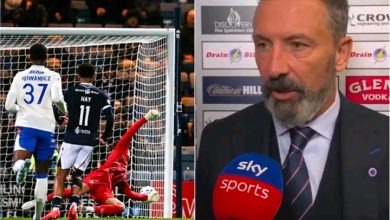
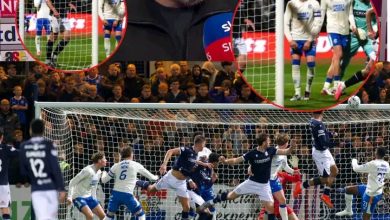
Then there is the opening goal. FootballFanCast argues that Sterling made a significant error in the build-up to Fink’s finish, and I think it is a fair reading of what happened. The Sky Sports report described the goal as coming from a routine long ball that Rangers failed to deal with, which fits the picture of a defensive lapse rather than a piece of brilliance from the home side. Fink read the situation quickly, rounded the goalkeeper and finished calmly, but he was handed the opportunity by Rangers’ own hesitation. In a high-stakes league match, a right-back who contributes to conceding the first goal and then fails to contribute anything meaningful going forward has had a difficult afternoon by any measure. The combination of defensive error and attacking ineffectiveness is what turns a mark of four out of ten from a generous grade into a fair one, and it is why the criticism feels less like piling on and more like a straightforward assessment.
It would be wrong to build the whole case on one player, however, and a thoughtful account of the draw has to acknowledge that Sterling was not alone. The most obvious turning point of the match, in the eyes of McInnes himself, was Dan Neil’s error in the sixty-ninth minute. The stand-in captain dwelt on the ball, Callum Jones took it from him and slotted past the goalkeeper, and a lead that had felt secure was gone. McInnes described the moment as having the effect of a balloon popping on Rangers’ momentum, and he chose not to criticise Neil publicly, which is typical of how he handles his squad. He pointed out that football is not only a physical game but a mental one, and that an error like that gives the opposition something to cling to while draining confidence from your own side. That is a far more decisive moment than anything Sterling did, and any honest account of the draw has to place it at the centre of the story.
There were other disappointments too. Ryan Naderi struggled as the lone striker, and Minsu Kim, who has been excellent since arriving from Girona, looked lost in the number ten role behind him. Rangers’ attack leaned heavily on moments of individual quality, with Bouanani’s curler and Raskin’s strike carrying the team while the patterns of play around them were scrappy and slow. Kris Boyd made the point on Sky Sports that Rangers needed two wonder strikes to score twice and that there was a lack of creativity at the top end of the pitch. McInnes himself said that his team needed to feed their wide players much more quickly and with far more purpose, and that they also needed to defend with greater certainty. Both of those criticisms apply to the right-back position as much as anywhere, because a full-back is the first link in any attack down that side and the last line of protection when an attack breaks down.
None of that excuses Sterling, but it does explain why the question of his place is more nuanced than a simple catalogue of mistakes. A manager has to ask not only whether a player had a bad game but whether the alternative is likely to be better, and whether dropping him sends the right message to the squad. In this case the alternative is Kosta Nedeljković, and FootballFanCast is right to suggest him as the obvious replacement. He gives McInnes something different on the right-hand side, and at a moment when the team’s attacking problems are partly a problem of tempo and ideas, a change at full-back offers a way to alter the dynamic without tearing up the entire system. It is a straightforward, low-risk selection decision, and that is exactly what makes it worth making. The manager does not have to rewrite his tactics or abandon his principles to get a different kind of contribution from the right.
The deeper issue is what kind of team McInnes wants Rangers to be. His side was praised for the resilience and quality shown after the break, when they raised the tempo and forced Owen Goodman into a series of smart saves, and the wingers were at the heart of it. McInnes singled out Bouanani and Djeidi Gassama as magnificent in the second half, and he was right. The wide men were the reason Rangers looked dangerous, which means the full-backs behind them carry real responsibility. Their job is to support the wingers rather than compete with them for the ball. A full-back who overlaps intelligently, offers an option when the winger is double-teamed and delivers accurate crosses when space opens up is a force multiplier for the whole attack. A full-back who forces play, wastes possession and leaves the winger isolated is the opposite. On Saturday, Sterling fell into the second category far more often than the first, and the team paid for it.
There is also a question of timing. Rangers had the chance to go top of the league on Saturday night, and a team with title ambitions cannot afford to leave points behind against opponents they should beat. Celtic were due to face Hearts the following day, and any slip from McInnes’s team hands the initiative to their rivals. The margins in a title race are small, and one dropped point can decide the outcome in May. That is why selection decisions matter so much, and why McInnes cannot afford to be sentimental about a player who struggled. Experience is valuable, and Sterling has plenty of it, but experience alone does not justify a place in the team when the evidence from the previous match points the other way. The table does not care about reputations, and neither should the person picking the side. Rangers finished the night second and one point behind Celtic, and that is close enough that every choice counts.
Some will argue that a single poor performance should not cost a player his place, and there is a respectable case for that view. Managers who rotate constantly in response to individual errors risk unsettling the squad and losing the consistency that wins leagues. Sterling has been a reliable member of the group, and one bad afternoon does not erase that. But the argument weakens when the poor performance is as comprehensive as this one. It was not a single mistake in an otherwise solid display. It was a pattern across ninety minutes of wasted crosses, lost possession and missed chances to link up with the best player on the pitch. When the pattern is that clear, and when a capable alternative is available, the manager is entitled to make a change without apologising for it. Consistency matters, but so does responding to what the evidence shows, and the evidence from Dens Park is not ambiguous.
It is worth saying, too, that dropping a player does not have to be a punishment. Managers rest and rotate for tactical reasons all the time, and a spell on the bench can give a footballer the chance to reset, watch the game from a different angle and return sharper. Sterling is a good enough professional to bounce back, and the best response to a night like Saturday’s is usually a determined one. If McInnes does pick Nedeljković for the next match, the message to the squad is not that Sterling has failed but that every place has to be earned in every game. That is a healthy culture for a team chasing a title, and it keeps everybody alert. Bouanani’s selection is the proof of the principle, because the winger earned his start through patient work in training and on the bench, and he took the chance when it came. The same path is open to Sterling.
The broader lesson from the Dundee draw is that Rangers are close to being very good but are not quite there yet. They have players capable of moments of brilliance and a manager who understands what the team needs. What they lack, at times, is the collective sharpness to turn dominance into victories. The fix is not dramatic. It involves cleaner decisions in possession, quicker movement of the ball into the wide areas and a little more certainty at the back, and each of those can be improved through training and selection. Each also starts with individuals playing their roles more effectively. The two goals Rangers scored were outstanding, but a title is not won on wonder strikes alone. It is won by controlling matches and punishing mistakes, and Rangers did the first for long stretches on Saturday without managing the second. That is the gap McInnes has to close.
Sterling’s own path back is easy to describe even if it is not easy to follow. He needs to simplify his game, make better decisions about when to cross and when to pass, and put the winger in front of him at the centre of his thinking. The physical qualities that earned him a place in the squad have not disappeared, and one afternoon of poor choices can be corrected by a few weeks of cleaner ones. If he returns to the side later in the season with a sharper sense of how to support the likes of Bouanani and Gassama, the benefit to Rangers will be considerable. Nobody should be writing off a player after a single bad match, but equally nobody should pretend that match did not happen. The best way to handle it is to acknowledge it, make the change and move on.
So the case is a simple one. Bouanani shone, Raskin scored a contender for goal of the season, and Rangers had the lion’s share of the ball and the shots. They still dropped two points, and part of the reason was a right-back who could not turn his time on the ball into anything useful and who contributed to the goal that put Dundee in front. McInnes does not need to make a big statement or a dramatic reshuffle. He needs to pick the best team for the next match, and on the evidence of Saturday night, that team does not include Dujon Sterling at right-back. Kosta Nedeljković deserves his chance, Bouanani deserves a partner who will feed him the ball, and Rangers deserve a right flank that looks more like the dominant force it was for most of the game and less like the weak link that let a point slip away at Dens Park.