View: 9/10 ace sensational, but 4/10 regular stunk out Dens – Rangers player ratings vs Dundee


Rangers left Dens Park on Saturday night with a point that felt like a loss, and it is hard to argue with the way their manager and their supporters read it. A 2-2 draw against a Dundee side who ran themselves ragged for ninety minutes would be a perfectly respectable result on most away days. It was not respectable on a night when Celtic had dropped within reach and a win would have lifted Derek McInnes’s team to the top of the Scottish Premiership. Instead, they finished second and one point behind the leaders. They also finished with the nagging sense that they had handed a point to a team who had not looked capable of taking all three without a generous helping hand.
The story of the game is a story of individuals as much as systems, so it is worth going through the evening player by player. There was one performance on the visiting side that deserves the highest mark in the Rangers ranks, one decision-making error that deserves the lowest, and a collection of honest, committed displays from a Dundee team that gave Steven Pressley plenty to be proud of.
Start with Nicolas Raskin, who gets a nine out of ten from me and would have been a clear man of the match had Rangers gone on to win. The Belgian midfielder had been quiet in the first half, as most of the Rangers midfield were, because Dundee pressed aggressively and made the middle of the pitch an uncomfortable place to be. But when the opportunity came in the sixtieth minute, he did not hesitate. His shot from outside the area flew in off the underside of the crossbar, and the quality of the strike was striking even in a league that regularly produces long-range goals. Struck cleanly, hit with real conviction and placed precisely enough that the goalkeeper had no chance of intervening, it was the sort of goal that wins matches and settles nerves. That it did not win this match is no fault of Raskin’s. A midfielder’s job is to tie the team together, to keep the ball moving and to offer something in the final third when moves break down. Raskin did all of that after the break, and the goal was a bonus that most players in the Premiership could not have produced.
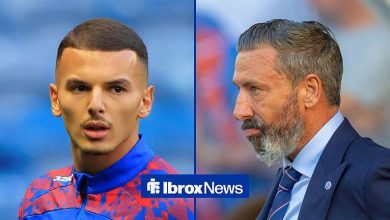
Badredine Bouanani deserves nearly as much credit, and an eight out of ten feels fair for a player who scored his first goal for the club at exactly the moment Rangers needed a response. Dundee had just gone ahead, the home crowd was loud, and Rangers looked as though the game might slip away from them before the break. Bouanani took the ball, cut inside onto his stronger foot and curled a shot into the top corner. The finish was clean and the timing was perfect, arriving only five minutes after the Dundee goal, and it stopped the home side from carrying a lead into the interval. For a player still settling into a new club, a first goal of that quality is a significant moment, and it earned him the confidence that was visible in the way he took the ball in the second half. He wanted it, he ran at defenders, and he made Dundee’s full-backs think twice about stepping out to press.
The other side of the ledger belongs to Dan Neil, and it is not a comfortable thing to write about a player who wears the captain’s armband. The Rangers captain gets a four out of ten from me, and the mark comes almost entirely from one moment. In the sixty-ninth minute, with Rangers in front and in reasonable control, Neil received the ball and dwelt on it. Callum Jones, reading the situation with the sort of instinct that separates forwards who score from forwards who simply run, stole it from him and slotted past the goalkeeper to level the match. It was a straightforward mistake, a moment of hesitation in a dangerous area, and it cost Rangers two points. A captain is supposed to be the player who protects the team in exactly those situations, who takes the safe option and plays it simply, and Neil did the opposite. There is some mitigation, because he did work his way into a good position in the six-yard box late on and could have won it for Rangers, only for Dundee to scramble the ball clear. But the mistake is the thing that will be remembered, and a captain has to accept that.
Dundee’s goalscorers both deserve high marks, though for different reasons. Bradley Fink gets an eight for the opening goal, which came after Rangers failed to deal with a long ball that should have been routine. Fink was alert, got ahead of the cover, rounded the goalkeeper and slid the ball home with composure. Strikers are often judged on whether they take their chances, and Fink took his without fuss. He also did the other work that Pressley demands from his forwards, pressing from the front and forcing Rangers to play quickly out of defence when they would rather have taken their time. Jones also gets an eight. His equaliser was a poacher’s goal, a reward for staying alert and refusing to give up on a loose ball, but his overall display was more than that single moment. He ran the channels, harried the Rangers back line and was a constant nuisance, which is exactly what a Dundee side without a wealth of individual quality needs from its attackers.
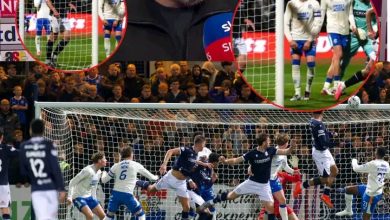
The rest of the Dundee side deserve credit for how they approached the match. Pressley said afterwards that he thought his team were outstanding in the first half, aggressive and strong on second balls, and the evidence supports him. Dundee created chances early, with Hay shooting from distance, Forrest driving forward from midfield and Hamilton working a free kick that Astley headed towards goal, only for it to be tipped behind. Hay also leapt to meet a corner and rattled the crossbar, a reminder that Dundee were not simply defending and hoping. That sort of intensity is hard to sustain, and it is to Dundee’s credit that they managed it for the whole of the first half and then found a second wind after absorbing a long spell of Rangers pressure. Hamilton gets a seven for the quality of his deliveries and his willingness to take responsibility in dangerous positions. Astley gets a six for his defensive work and his threat from set pieces. Hay and Forrest each get a six for the energy they brought to the midfield and the way they forced Rangers to defend.
Rangers’ attacking players, apart from Bouanani, were harder to praise. Kim had an early opportunity in the eighth minute that was blocked with the goal gaping, and while Rangers appealed for a handball, the referee was unmoved. That was the sort of chance that a forward in form would expect to convert or at least force a save from, and it set the tone for a frustrating evening in which Rangers rarely looked sharp in the final third. Kim gets a five from me, because he did get into good positions but could not make them count. Djeidi Gassama gets a six. His shot from the edge of the area early in the second half forced a one-handed save, and he was a willing runner who gave Rangers some of the width they needed. But the Rangers manager spoke afterwards about wanting to feed the wide players in one-against-one situations, and that plan never fully materialised, which is a verdict on the whole attacking unit as much as on any individual.
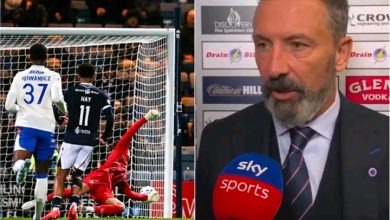
The question that hangs over the performance is why a team with the resources and ambition of Rangers struggled so badly to create clear chances against a side that was happy to sit in a compact shape and press in short bursts. McInnes was candid about it afterwards. He said Dundee’s press had been good, as he expected, and that Rangers had tried to draw the centre-backs out and find space for their wide men. He accepted that the plan never quite worked. He also said that Rangers should not need to score three goals to win away from home, and that two goals should have been enough. That is a fair point, because the goals that Rangers did score were two moments of individual brilliance, one curled finish and one thunderbolt, rather than the product of sustained, patterned attacking play. Kris Boyd, the former Rangers striker now working as a pundit, made a similar observation, saying that it took wonder strikes to get Rangers two goals and that there was a lack of creativity at the top end of the pitch. He described that as something Rangers would have to improve, and he is right. Great goals mask a lot of problems, but they do not fix them.
The defensive side of the game is where Rangers will have most to reflect on. The first Dundee goal came from a simple long ball that nobody dealt with, which is the kind of thing a good defence does automatically. The second came from a captain’s moment of hesitation. Neither was the product of a well-constructed Dundee move or a clever piece of tactical play, and that is what will frustrate the Rangers coaching staff most. In the first instance, Rangers’ back line failed to track the runner or to clear the danger. In the second, Neil failed to recognise the threat or to play the safe pass. Both are fixable, and both are the sort of lapses that a manager can address on the training pitch, but they are also the sort of lapses that cost points in a title race. Pandur in the Rangers goal had a fairly comfortable evening, gathering most of what was thrown at him and tipping Astley’s header behind, but there was little he could do about either of the Dundee goals, and I would give him a six for a solid if unspectacular display.
What makes the draw especially hard for Rangers to accept is the way the second half unfolded. They came out after the break with real purpose and spent the best part of twenty-five minutes pinning Dundee back and creating the sort of sustained pressure that usually produces goals. Raskin’s strike was the reward for that period, and for a while it looked as though Rangers would see the game out. But they did not push for the third goal that would have settled it, and Dundee, who had been hanging on, found a second wind. Boyd made the point that Dundee were not in their position in the table by fluke, and that Pressley has a group of players willing to run themselves into the ground for him. That willingness showed in the closing stages, when Dundee came back at Rangers and asked questions of a team that suddenly looked uncertain. Neil’s mistake was the moment that changed the match, but it came in a context where Rangers had lost some of their control, and the equaliser did not feel entirely like a bolt from the blue.
Pressley, for his part, was pleased with what he saw. He described the performance as a game of two halves, with his team outstanding in the first and under heavy pressure in the second. He praised the grit and determination his players showed, and he said Jones had earned his reward for a strong display. It is a fair summary. Dundee did not deserve to win, probably, but they deserved their point, and they earned it by refusing to be overwhelmed during the period when Rangers were on top. For a club operating on a far smaller budget than Rangers, a draw at home against a team with title ambitions is a result worth celebrating, and Pressley will use it as evidence that his approach is working. The aggressive pressing, the organisation out of possession, the willingness to compete for every second ball, all of it was on display, and all of it was effective.
There is also context in the recent history between the two clubs. Rangers had won their previous two meetings with Dundee, both by three goals to nil, one at Dens Park in November and one at Ibrox in January. Dundee had been beaten comfortably on both occasions, and there was every reason to think this fixture would follow a similar pattern. That it did not says something about how far Pressley’s side have come, and also something about how Rangers approached the match. A team that had beaten Dundee 3-0 twice in recent months might be forgiven for expecting an easy afternoon, but there was no sign in the Rangers performance of complacency as such. What there was, rather, was a lack of cutting edge, a failure to turn possession into clear chances, and a couple of defensive lapses that Dundee punished.
Looking ahead, the table tells its own story. Rangers remain second, one point behind Celtic, who host Hearts on Sunday afternoon. If Celtic win, the gap will grow to four points, and the pressure on McInnes will intensify. A draw at a ground like Dens Park is not a disaster in the abstract, but in the context of a tight title race it is the sort of result that looks worse the longer it sits. Rangers had the chance to go top, at least for a day, and they failed to take it. The psychological effect of that missed opportunity should not be underestimated, particularly for a squad that is still finding its feet under a manager in his first full season in charge. McInnes has already shown he is not afraid to be honest in public about his team’s shortcomings, and that honesty will be important in the coming weeks, because the issues that cost Rangers on Saturday are not impossible to solve.
The attacking problem is the biggest one. Rangers have the players to create chances, but they struggled to do so against a compact, aggressive Dundee side, and that suggests a need for more variety in their approach. If the plan is to draw the centre-backs out and find space for the wide players, there has to be a Plan B for when the opposition does not take the bait. Boyd’s comment about a lack of creativity at the top end of the pitch is worth taking seriously, because it points to a structural issue rather than a one-off bad day. The midfield needs to be more incisive, the forwards need to be more mobile and the wide players need to be given the ball in positions where they can actually hurt defenders. Raskin and Bouanani showed what they can do when they are given room, but they cannot be expected to produce a wonder goal every week.
The defensive issues are more fixable, but they are no less important. A team that wants to win a league title cannot afford to give away goals from long balls and from captains dwelling on the ball. Those are errors of concentration rather than ability, and they tend to disappear when a team is playing with confidence and rhythm. The concern for McInnes is that Rangers do not currently look like a team playing with that kind of rhythm. They have flashes of quality, as the two goals on Saturday demonstrated, but they also have stretches of the match where they look disjointed and uncertain. Eliminating those stretches is the next stage of their development, and it is the difference between a good team and a great one.
As for Neil, the best thing he can do is move on quickly. Captains make mistakes, and the good ones learn from them. The mistake on Saturday was costly, but it was a single moment in a match where he also showed some of the qualities that earned him the armband, including a late run into the six-yard box that nearly won the game for Rangers. A four out of ten is harsh, perhaps, for a player who contributed in other ways, but the scoring system has to reflect the impact of the error, and the impact of this one was a lost two points. The question now is how he responds, and how McInnes handles a player whose confidence may have taken a knock.
So the final verdict on a strange, entertaining and ultimately frustrating match is a mixed one. Raskin’s goal was the best thing about it, and Bouanani’s finish was a close second. Fink and Jones showed why Dundee are a difficult team to beat, and Pressley can be proud of the character his side displayed. Rangers, meanwhile, will want to forget the evening quickly, and they will have to if they are to stay in the title race. The next few weeks will tell us whether Saturday was a minor stumble or the first sign of a deeper problem. For now, Dundee have a point they will cherish, Rangers have a point they will regret, and the Premiership race remains tight enough that every dropped point feels like a lost opportunity