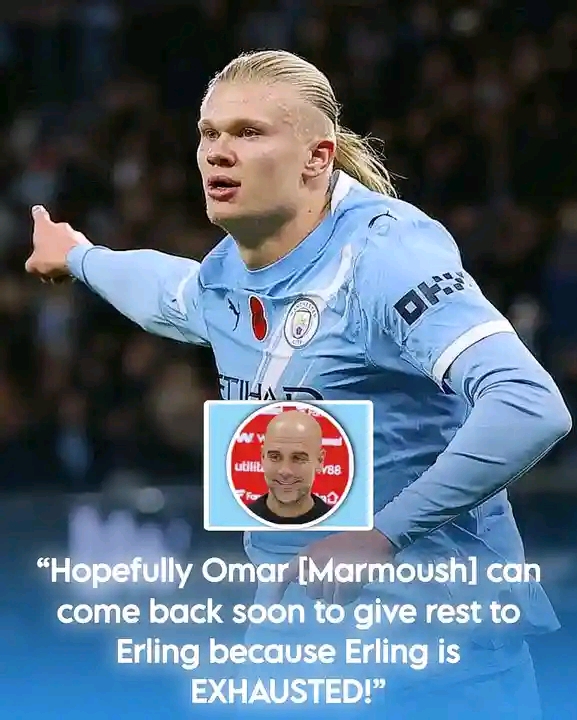
⅘Pep Guardiola did not shout it, he did not make a big drama out of it, and he did not try to hide it either. He simply said it in his calm, thoughtful way. Erling Haaland really needs some rest. Those words may sound simple, but behind them is a much deeper story about modern football, pressure, expectation, physical limits, and the human side of a player who is often treated like a machine. When Guardiola speaks like this, it is never random. It is usually a message, and sometimes it is a warning.Erling I
Erling Haaland has become one of the most talked-about footballers in the world. Every week, every match, every chance he misses or scores becomes headline news. He is judged by impossible standards because he has set those standards himself. When he scores, it is expected. When he does not, questions begin immediately. That is the reality of being Erling Haaland in modern football, especially at Manchester City, where winning is not enough and excellence is demanded every single game.
Since arriving at City, Haaland has barely stopped. Club football, international duty, domestic cups, European nights, long travel, intense training sessions, constant attention. His body has been pushed to extreme levels. His mind too. Pep Guardiola sees this more clearly than most because he watches Haaland every day. He sees the small signs that others might ignore. A tired run. A heavy touch. A moment where the sharpness is just slightly missing. For Guardiola, these details matter.
When Pep says Haaland needs rest, it is not criticism. It is protection. Guardiola understands that football today does not allow players to breathe. The calendar is full. The demands are endless. Top players are expected to be available all the time. Fans want to see them. Broadcasters want them on the pitch. Sponsors want them visible. National teams want them ready. There is very little space for recovery, especially for a striker who plays with such physical intensity.
Haaland’s game is not gentle. He explodes into runs. He battles defenders. He absorbs contact. He accelerates again and again. His body is constantly under stress. Even when he is not scoring, he is working. Pressing. Pulling defenders away. Creating space. None of that is easy, and none of it is free.
Guardiola knows that if Haaland breaks down, the cost is huge. Not just for City, but for Haaland himself. Injuries can change careers. Fatigue can lead to mistakes. Overuse can shorten peaks. Pep has seen this before with other players. He has learned that sometimes the bravest decision is to rest your best player, even when the world is screaming for him to play.
But resting Haaland is not simple. Manchester City are competing on multiple fronts. Every match matters. Every point is important. The margins are small. Guardiola has to balance long-term health with short-term needs. That is one of the hardest parts of managing a club like City. When you have a player like Haaland, leaving him out feels risky. Playing him too much also feels risky.
The conversation around Haaland’s form often ignores the context. People look at goals and nothing else. If he scores, everything is fine. If he does not, something must be wrong. Very few people stop to think about workload. About fatigue. About the mental strain of being the focal point every single week. Guardiola is trying to shift that conversation, even slightly.⁶
Haaland himself is not the type to complain. He wants to play. He wants to score. He wants to help his team. He has the mentality of a warrior. He believes he can push through tiredness. Many great players think like that. Sometimes they need to be protected from themselves. That is part of Guardiola’s role as a manager and as a mentor.
64⁴⁴
There is also the question of adaptation. Defenders across the league have studied Haaland. They know his movements. They know his strengths. They plan specifically for him. That means every game is a battle. He is double-marked. He is kicked. He is crowded. That physical punishment adds up over time. Rest is not just about energy. It is about healing.
Pep Guardiola has always been careful with his words. When he publicly says Haaland needs rest, it is also a message to the wider football world. A message to decision-makers. To organisers. To those who control the calendar. Football cannot continue like this forever. Players are not robots. Even the strongest bodies have limits.
Manchester City have options. They have other attackers. They can rotate. They can adjust systems. Guardiola has always valued flexibility. But there is no perfect replacement for Haaland. That is why managing his minutes becomes so important. Playing him fresh for the biggest moments is better than playing him tired for everything.
Some fans worry when they hear talk of rest. They fear injuries. They fear decline. They fear weakness. But rest is not weakness. Rest is strategy. Guardiola knows that the season is long. He knows that the biggest matches often come at the end. That is when you want Haaland at his sharpest, his strongest, his most dangerous.
There is also the mental side. Being under constant spotlight can drain even the most confident player. Haaland is young, but he carries enormous responsibility. Every missed chance becomes a clip online. Every quiet game becomes a debate. That noise can be exhausting. A short break can help reset the mind as much as the body.
Guardiola has always cared deeplmy .about the mental health of his players. He talks to them. He listens. He watches their body language. He understands that football is not just tactics and fitness. It is emotion. Confidence. Motivation. Burnout is real, even if it is rarely discussed openly.
When Pep speaks about rest, he is also speaking as someone who has been in football for decades. He has seen careers rise and fall. He has seen players pushed too far. He has learned from mistakes. That experience informs every decision he makes now.
Haaland’s importance to City cannot be overstated. He is not just a goalscorer. He changes how teams defend against City. He creates space for others. He forces opponents to drop deeper. Even when he does not touch the ball, he influences the game. That influence is only maximised when he is fresh.
The challenge for Guardiola is finding the right moments to rest him without weakening the team too much. That requires trust in the squad. It requires confidence in rotation players. It requires courage. Guardiola has never lacked courage, but this is still a delicate balance.
Fans may not always like it. Pundits may question it. Opponents may celebrate it. But Guardiola is thinking long-term. He is thinking about trophies in May, not headlines in January.
There is also the international factor. Haaland plays for Norway, and those matches matter to him deeply. National duty adds another layer of physical and emotional demand. Coordinating rest between club and country is one of the hardest challenges in modern football. Guardiola has to consider that too.
When Pep says Haaland needs rest, it is not a sign of panic. It is a sign of care. It is a sign of planning. It is a sign that Manchester City are trying to protect their most valuable asset in a sport that often forgets to slow down.
Haaland will score again. He will have big nights. He will dominate matches. That is not in doubt. The question is how to keep him at that level for as long as possible. Rest is part of that answer.
Modern football celebrates toughness, but true toughness also means knowing when to step back. Guardiola understands that. He wants Haaland to be strong not just this season, but for many seasons to come.
The words may have been simple, but the meaning is deep. Erling Haaland really needs some rest. Not because he is weak. Not because he is failing. But because he is human, and because Manchester City want him at his best when it matters most