Pep Guardiola Takes Ruthless Action as Manchester City Rocked by Nightclub Scandal

The shock wave hit the football world before dawn. It started as a whisper — a small rumour online that sounded too wild to be true. But by sunrise it was everywhere, spreading fast like fire on dry grass. Manchester City, the team that has dominated English football for years, had been rocked by a **nightclub scandal involving first‑team players**, and the whole club was reeling from the fallout. The whispers became headlines, the rumours became reports, and the quiet streets near the Etihad Stadium were buzzing with confusion and disbelief. People couldn’t believe what was happening. City fans were in chaos. The media was in overdrive. Rivals were celebrating. And at the centre of it all was one name: **Pep Guardiola**.
No one expected it to unfold like this. Manchester City had always prided itself on discipline, professionalism, and an image of elite standards. But this time, everything seemed to be unraveling. The story that broke online wasn’t just a small issue or a harmless night out. It was something big. Something explosive. So explosive that it immediately changed the mood around the club.
The report said that several City first‑team players had been involved in a scandal at a high‑profile nightclub. No one knew all the details at first. Only fragments — photos, videos, messages, and wild posts on social media. Some showed players smiling after midnight. Others suggested out‑of‑control behaviour. Fans looked at the images in disbelief, wondering if their eyes were deceiving them. It looked like a normal night at first, but it ended in chaos. Rumours flew that the players had been involved in fights, arguments, and behaviour that raised serious questions about discipline and professionalism.
City supporters were stunned. This was Manchester City, not some small club with little attention. This was a team filled with world‑class players, leaders, role models. Yet suddenly, here they were, at the centre of a scandal that had everyone talking. News outlets around the world picked up the story by morning. Headline after headline echoed the same shock: “Manchester City in Turmoil After Nightclub Scandal.” “Guardiola Furious as Players Involved in Late‑Night Controversy.” “Discipline Questions as City Faces Unwanted Headlines.” Football fans everywhere took notice.
The fans closest to the club felt a mix of disbelief, confusion, and anger. Some defended their heroes, saying everyone needed time off and that players were human after all. Others said this was not the behaviour expected of elite professionals. Supporters at local pubs and fan gatherings talked in low voices, some shaking their heads, others yelling in frustration. “This cannot be real,” one fan said. Another replied, “If it is real, Pep will sort it out.” But even those words — meant to comfort — carried worry, because Pep Guardiola was not a manager who tolerated anything that threatened the integrity of his team.
As the story spread, journalists rushed toward the Etihad. Cameras waited outside the training ground. Reporters shouted into microphones, demanding reaction. But inside, the situation was much more tense than anyone outside could imagine. The first hours after the scandal broke were like a storm. The players involved were called in. Staff were alerted. Managers, assistants, and club officials huddled behind closed doors, trying to figure out the truth and what to do next.
And at the centre of all this was Pep Guardiola — a man known for his calm, his wisdom, and his ability to steady even the roughest moments. But now, for the first time in a long time, he faced a problem that couldn’t be solved with tactics or analysis or team talks. This was different. This was personal. This was about discipline. This was about values. This was about the reputation of the club itself.
Pep Guardiola was more furious than anyone expected. People close to the club said that behind the scenes he was not just angry — he was devastated. Guardiola built this team with effort, precision, focus, and discipline. He expected his players to behave like professionals on and off the pitch. He never tolerated excuses or behaviour that distracted from the mission. Now he was staring at a situation that threatened everything he had worked for.
Sources inside the club said that Pep called an emergency meeting late that very morning. Players were gathered. Staff were waiting nervously. Outside, the cameras were still flashing. Inside, Guardiola stood in front of the squad, calm at first, but with a seriousness that sent chills through the room. He spoke slowly, each word deliberate, heavy with meaning. He reminded the players of what it meant to wear the Manchester City shirt. He reminded them of the standards of professionalism they agreed to uphold. He reminded them of the fans, the critics, and the world watching their every move.
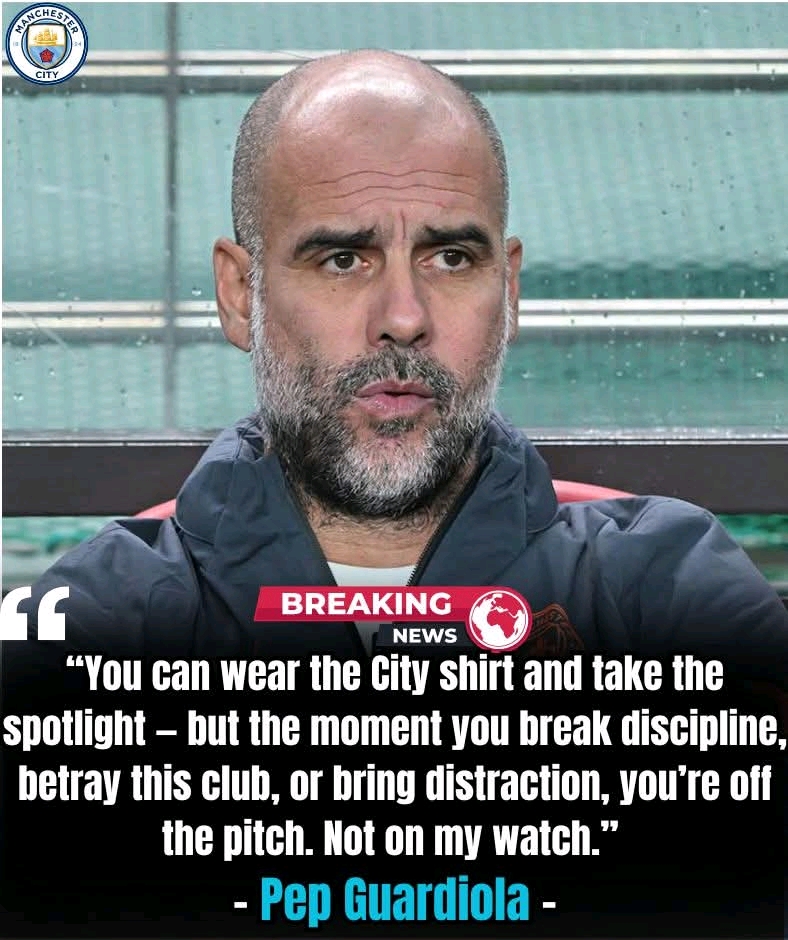
Then the unthinkable happened. Pep didn’t just lecture them. He took **ruthless, decisive action** — actions no one saw coming. Several of the players involved were disciplined. Some were left out of the squad immediately. Some were fined. Some were put on internal suspension. And Pep didn’t just stop there — he issued one of the strongest loyalty messages any player had heard from him in years. He made it clear that no one, not even the biggest stars, was above the rules. If someone breached the code of conduct at Manchester City, they would feel the consequences. That was Pep’s message — simple, firm, non‑negotiable.
The reaction inside the club was mixed. Some players felt shocked, even angry. Others nodded in approval. They understood that discipline was important, that standards had to be maintained. But the world outside had already made up its mind — this was not a simple disciplinary action, it was a **turning point for City’s season**. Journalists and fans began debating endlessly — had Pep’s punishment been too harsh? Or was it just what the club needed to restore order? Was this scandal going to break City’s confidence, or was it the moment they regained focus?
Meanwhile, the social media world exploded with commentary. Fans from rival clubs celebrated with glee. They shared memes and jokes, mocking City’s misfortune. Some wrote that Manchester City had been sleeping on discipline for too long. Others said that Pep had shown weakness by allowing the incident to happen in the first place. But many others — even those who didn’t support City — applauded Pep’s swift action. They said he showed leadership. They said he proved that standards matter. They said that a manager who cares deserves respect even in difficult times.
Still, no matter what anyone said, one thing was certain: the scandal was reshaping the narrative around Manchester City’s season. Just a week ago, people were talking about the team as title favourites, Champions League contenders, and the benchmark for excellence. Now the conversation had shifted. Now people were talking about discipline, team culture, leadership, and the possibility that off‑field issues might affect on‑field performance. Reporters asked Pep about the scandal every day. Journalists wrote long columns about what the incident meant for the team’s character. Fans argued about whether the punishment would strengthen or weaken the squad.
Pep himself never backed down from his decision. In interviews after the incident, he spoke like a leader who believed in accountability above all else. He didn’t offer excuses. He didn’t dodge questions. He stood tall, and he spoke honestly about what he expected from his players. When asked whether the disciplinary measures would affect team morale, he said with calm intensity, “Discipline is the foundation of any successful team. If we lose that, we lose everything.” That quote alone became one of the most shared lines of the week.
City’s training ground after the scandal became a place of mixed emotions. Some players trained with extra determination, pushing harder in drills, as if trying to prove that they were unfazed by the controversy. Others looked more subdued, eyes lowered, focused and silent. Everywhere you looked, there was a sense that something bigger than football was happening — that this was about identity, principles, and what it truly means to be a professional.
Fans outside the stadium tried to make sense of it all. Some waved flags in support of Guardiola. Others shouted in anger, demanding more answers. A few brave supporters organized meetups outside the training ground, discussing tactics, transfers, and the culture clash that had come into their beloved club. Even in the pubs, conversations were dominated by the scandal. People debated whether this incident would cost City points, momentum, or even trophies. Others said this was just another challenge, and true champions would rise above it.
But as the team prepared for their next match, the tension was clear. The scandal had not disappeared. It was still there, like a shadow looming over every pass, every training drill, every pep talk. And yet — something unexpected began to emerge from the chaos. A sense of unity. Not from fear, not forced, but from the realization that this moment defined something bigger than football. It was a moment of truth. A moment that would test the character of players, staff, and the club itself.
Journalists continued to predict outcomes. Some said City would crumble. Others said they would fight back stronger than ever. Football analysts talked about how Pep’s actions might change the dynamic of the squad. Some predicted internal rivalries would worsen. Others believed the punishment would act as a wake‑up call, forcing players to focus and tighten their discipline on and off the pitch. The truth was — no one could know for sure. This was not simply a football story anymore. It was a human story, full of pressure, consequences, and the unpredictable nature of life in the spotlight.
In fan communities, discussions became deeper and more personal. Supporters didn’t just talk about football anymore; they talked about respect, loyalty, leadership, and what they expected from the men who wore their club’s colours. They questioned whether big‑name stars should be treated differently than young players. They wondered whether fame and money had taken priority over commitment and focus. And through all this debate, one name continued to stand tall — Pep Guardiola. Love him or criticize him, his choices had sparked discussion far beyond tactical formations and goal statistics.
Some weeks later, as the team regrouped, something remarkable began to happen. The players that remained started to play with a renewed spark. Not reckless aggression, but disciplined determination. It was as if the scandal had refocused them on what truly mattered: football, unity, and effort. It didn’t erase the incident itself, but it did change the way the team carried themselves. They trained harder. They communicated better. They protected the ball with more intensity. They fought together. And while the world continued to watch, analyse, and judge, their results on the pitch began to reflect a team that refused to be defined by controversy.
For Manchester City fans, this was a rollercoaster of emotion — from panic to support, from anger to pride. They saw their club in a moment of crisis, and watched as a manager faced that crisis with unshakeable resolve. The story of the nightclub scandal became more than just a headline — it became a turning point in the club’s journey. Some said it was Pep’s toughest challenge in years. Others said it revealed a strength that was always there but rarely tested this publicly.
And for the world of football, this chapter reminded everyone that elite sport isn’t just about goals, wins, and trophies. It’s about character, accountability, and the reality that players are humans too — capable of mistakes, growth, and redemption. Some people will judge. Others will forget. But the scandal and the way it was handled will remain a story talked about for seasons to come — a story about a club rocked by controversy, and a manager who chose discipline over comfort, standards over popularity, and truth over fear.
Because in football, as in life, there are moments that define us — not by what we win, but by how we respond when everything seems to be falling apart. And for Manchester City, this was that moment.