Rangers can’t keep shooting themselves in the foot as Dundee draw exposes familiar flaws that must stop

There is a particular kind of frustration reserved for a team that does the hard part well and then gives it all back. Rangers left Dens Park on Saturday night with a point they will not enjoy and a table that tells the story. They sit second, one point behind Celtic, having had the chance to climb to the summit of the Scottish Premiership. They didn’t take it. And the manner of the 2-2 draw with Dundee will bother Derek McInnes far more than the scoreline.
Nobody looks at a match like this and says the better side lost out. Rangers scored two goals, and both were good enough to win a game: one a curled finish from a player who had waited for his first Rangers goal, the other a long-range strike that arrived via the underside of the crossbar. Teams that score goals like that on the road should be leaving with three points. Instead they left with one, because at either end of the pitch they did the sort of thing that keeps coming back to haunt title-chasing sides: they handed the opposition a goal and then a second.
This is not a crisis. It is a draw at a ground that has never been easy, against a Dundee side that is where it is for good reasons. But it is a pattern, and patterns matter more than individual results. Rangers shot themselves in the foot twice in a single evening, and until that stops, a one-point deficit to Celtic can quietly grow into something much harder to close.
Start with the opening goal, because it set the tone for everything that followed. Dundee did not carve Rangers open with a flowing move or a clever set piece. They played a long ball, a perfectly ordinary one of the sort every defence in the country faces several times a game, and Rangers simply failed to deal with it. Bradley Fink took advantage, rounded the goalkeeper and slid the ball home in the 37th minute.
That sequence is the heart of the problem. It is easy to forgive a defence for being beaten by quality: a through ball threaded between two centre-backs, a cross whipped in from the byline, a shot from distance that nobody could have stopped. It is much harder to forgive being undone by the football equivalent of a punt upfield. The routine nature of the ball is what makes the failure so damning. There was no great build-up to defend against, no tactical masterstroke to analyse. There was a simple ball and a simple decision, and Rangers made the wrong one, or perhaps didn’t make one at all.
What makes it more irritating is the context. For much of the first half, Dundee’s threat was about pressure rather than penetration. They harried Rangers, won the second balls and kept the visitors from settling. But for all that territorial and psychological control, the home side had not created much that genuinely troubled the Rangers goal. Shots that came their way were handled without fuss. A header from a free kick was tipped behind. A leap at a corner rattled the bar, the closest they came to scoring before Fink’s goal, and even that was a moment of misfortune for Rangers rather than a defensive collapse. Rangers were not being overrun. They were being irritated, and then, in the 37th minute, they irritated themselves.
That distinction is important. A team that concedes because it has been outplayed can point to the opposition and find lessons in how the game was lost. A team that concedes because of an avoidable error has to look inward, and the inward look is usually less comfortable. Rangers’ first-half display was not good, but it was not disastrous either. The goal made it feel worse than it was, and it handed Dundee a lead they had done little to earn through attacking play.
To Rangers’ credit, the answer came quickly. Five minutes after Fink’s goal, Badredine Bouanani cut inside and curled a shot into the top corner. It was his first goal for the club and the sort of finish that makes a supporter lean forward in the stand: a bit of space, a decisive touch inside, then a strike with enough bend and pace to leave the goalkeeper stranded. The timing mattered as much as the quality. Levelling so soon before half-time meant Rangers went into the break on level terms rather than chasing the game, and it sent a message that the visitors still had the individual quality to hurt Dundee whenever the chance arose.
That is the other side of the Rangers story, and it shouldn’t be lost in the frustration. They have players capable of the spectacular. The second goal proved it again. Nico Raskin, shortly after the hour, let fly from outside the penalty area, and the ball went in off the underside of the bar. It was the goal of the game by a distance, and the kind of thing that can make a manager’s evening on its own.
So Rangers were ahead on the road, having scored twice, with the better of the individual moments and a chance to move to the top of the table. That should be the end of the story. Teams with title ambitions are supposed to take those positions and turn them into three points. The fact that Rangers couldn’t is the real subject of this piece.
It is worth being honest about the quality of the goals, though, because it points to something uncomfortable. Both Rangers goals were individual efforts from range or from a cut-inside. Neither came from a sustained passage of creative football that dissected Dundee’s shape. Sky Sports pundit Kris Boyd made this point after the game, noting that it took two wonder strikes to get Rangers their goals and that there was a lack of creativity in the final third. Spectacular goals are wonderful, but they are not a plan. A team that relies on a moment of brilliance to score, while conceding to moments of carelessness, is walking a tightrope.
McInnes said afterwards that he expected Dundee’s press to be good, and it was. His plan, as he described it, was to draw the home centre-backs out of position at times, find spaces behind them and feed Rangers’ wide players into one-against-one situations. The idea is sound. Pressing teams are vulnerable to exactly that kind of manipulation, because every player who steps out to win the ball leaves a gap behind him.
By his own admission, though, it never quite materialised. And this is where the match turned into something more than a simple tale of defensive errors. Rangers had a method for beating the press and could not consistently execute it. The ball did not reach the wide players in the positions the plan required. The one-against-one duels that were meant to be the reward for patient build-up didn’t arrive often enough. Dundee, with their aggression and their strength on second balls, kept the game compressed and kept Rangers from finding rhythm.
This is why the long-ball goal stings so much more. Rangers spent the first half struggling to play through a high-energy press, and then conceded because they couldn’t deal with a direct ball over the top. Dundee’s approach was straightforward. They won the physical battle, they made the game scrappy, and when a moment of simplicity arrived, they took it. There is no shame in being pressed by a good side, but there is a real problem when the answer to the press is hesitant and the answer to a long ball is worse.
Dundee manager Steven Pressley called his team outstanding in the first half: aggressive, in control of much of the play and strong on second balls. He added that his side perhaps should have capitalised on a couple of moments to give Rangers even less. That’s a fair assessment, and a slightly worrying one for the visitors. Rangers were limited for long stretches of the opening period and yet still went in level, which says something about the quality of the Bouanani goal and something else about Dundee’s inability to turn their dominance into a bigger lead.
If the first half belonged to Dundee’s energy, the early part of the second belonged to Rangers’ response. Pressley acknowledged as much, saying he had expected a reaction and got one, with his team put under a lot of pressure. Rangers came out with more urgency and more intent. Gassama had a shot from the edge of the area that was saved one-handed. Then came the Raskin strike, and with it the feeling that Rangers had found the way to win the match.
Boyd described the period as a spell where Dundee had to dig in and suffer, something like the first 20 or 25 minutes of the second half. This is the point where the game was there to be won. Rangers had the lead, the momentum and the opposition on the back foot. The task at that stage is not to play beautifully. It is to manage the game: keep possession, make the most of the territory, slow the tempo when needed and, ideally, find the third goal that ends the contest.
Rangers did not do that. What happened instead was a gradual loss of control. Dundee, having absorbed the pressure, found what Boyd called a second wind and began to ask questions of the visitors again. A side that has just conceded the initiative can sometimes be most dangerous in precisely these moments, because it has little left to lose and a crowd lifting it forward. Dundee got that lift, and Rangers, who should have been closing the game down, found themselves defending a narrow lead against renewed home
The equaliser arrived in the 69th minute, and in a way it summed up the entire evening. Dan Neil, the Rangers captain, dwelled on the ball. Callum Jones, reading the situation, nicked it off him and slotted past the goalkeeper to make it 2-2.
There is nothing complicated about what went wrong. A player in possession took one touch, or one second, too long, and a sharp opponent punished him for it. It was not the result of a tactical failure or a structural weakness. It was a small lapse of concentration, the type that happens to every footballer at every level, which is exactly why it is so damaging when it comes from the player wearing the armband.
It would be unfair to pin the draw on one man. Neil is not the first captain to lose the ball in a dangerous area, and he will not be the last. And to his credit, he was on hand a few minutes later when the ball fell to him in the six-yard box and Dundee had to scramble it clear. That was a chance that could easily have restored Rangers’ lead, and it reminded everyone how fine the margin was between a captain’s error and a captain’s redemption.
But the criticism is not about Neil alone. It is about the culture of the moment. When you are leading away from home against a team that is pressing you, the safest, simplest option is often the right one: play it long, play it out of play, take the pressure out of the situation. Rangers had spent much of the match struggling against Dundee’s intensity, and by the 69th minute they should have known exactly how dangerous a lingering touch could be. Dundee’s whole approach was built on winning the ball back high. Giving them the opportunity is almost an invitation.
Taken together, the two Dundee goals formed a cruel symmetry. The first came from Rangers failing to deal with a long ball. The second came from Rangers losing the ball while trying to play. One was too passive, the other too casual. Different mistakes, same outcome, and the same worrying implication: Rangers are good enough to create their own problems without any help from the opposition.
There was one more footnote to the night, and it came very early. In the eighth minute, a Rangers player named Kim had a shot blocked with the goal gaping. The Rangers players appealed for handball, but nothing was given. It is tempting to treat that as an unlucky moment, and in part it was. If the shot goes in, or if the decision goes the other way, the game takes an entirely different course.
But it also belongs in the ledger of missed opportunities. A team that wants to win a title cannot rely on refereeing decisions or deflections. When there is an open goal, the finish needs to be clean. When the finish is not clean, the match can hang on lines that later feel unbearably thin. McInnes made this point in his own way afterwards: Rangers had a few chances at 2-2, and two goals, in his view, should have been enough on the night.
Late in the game, as the draw settled in, the Neil chance in the six-yard box and the scramble that cleared it were the last real opportunities. It is the nature of football that these moments arrive in a blur, but they are what separate a good result from a frustrating one. Rangers can’t change that they didn’t take them. They can only ask why they were still needing to take them at all
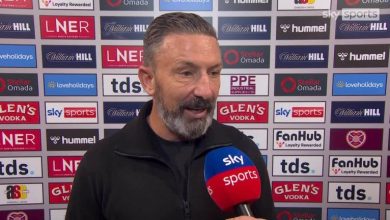
McInnes did not dress it up. He said his side shouldn’t need to score three goals to win a game away from home, that two should have been enough, and that Rangers had effectively gifted away the opportunity to take all three points. He admitted the disappointment at leaving without the win.
That candour is useful, and it is the right tone. A manager who tried to spin the draw as a decent away point would risk sounding detached from the reality his supporters saw. By acknowledging that the result was self-inflicted, McInnes places the responsibility where it belongs: on the standards of the team, not on the quality of the opposition.
It is also a reminder of the margins title races are decided on. Rangers are one point off the top, which is not a gap that should alarm anyone. But a point dropped in a game they led, through errors that were avoidable, is the sort of dropped point that tends to feel heavier in April than it does in October. The challenge for McInnes is to ensure it does not become a
It would be wrong to write this entirely as a story of Rangers’ failings, because Dundee deserve a good deal of the credit for the point. Pressley’s side were aggressive from the start, organised in their pressing and strong on the second balls that decide games like this. They created the early pressure that unsettled Rangers, took the lead when the chance came and, crucially, refused to fold when Rangers hit back and went in front.
Pressley praised his players’ grit and determination, and spoke of a game that seemed to be getting away from them before they kept going and got their reward. Jones, he said, was rewarded for a really strong performance. That detail matters. This was not a team that stumbled into a draw through luck. It was a side that suffered through a difficult spell, stuck to its principles and took its chance when Rangers handed it over.
Boyd’s assessment was blunt and generous in equal measure. Dundee, he said, are not where they are in the table by fluke or luck. They have a clear style, a manager with a group willing to run themselves into the ground for him, and the resilience to survive a period of sustained pressure and come back stronger. A draw, in his view, was a fair result.
That is worth remembering as Rangers digest the evening. The temptation after a game like this is to assume the visitors were the only story, that their mistakes were the only reason the outcome wasn’t better. But Dundee made it hard. They forced the errors by playing in a way that rewarded pressure and punished hesitation. Rangers should take that as a lesson about how teams will approach them: with energy, with directness and with the belief that a title-chasing side can be rattled.
Beneath the defensive lapses lies a second issue that is just as important for the season ahead. Boyd spoke of a lack of creativity at the top end of the pitch, and the evidence from Dens Park supports him. Rangers’ two goals were individual pieces of quality, a curler and a long-range thunderbolt, not the result of sustained, intricate attacking play. McInnes’s own pre-match plan to pull Dundee’s centre-backs out of shape and release the wide players never fully worked.
That raises a fair question about where Rangers’ goals will come from when the inspiration dries up. Players like Bouanani and Raskin can produce moments that win games on their own, but a team cannot build a title challenge around the hope of the spectacular. Over a long season, you need a reliable supply of chances, created through movement, interplay and the ability to break down organised, aggressive opposition. When a side presses as hard as Dundee did, the response has to be sharp and varied, and for large parts of Saturday’s match it wasn’t.
The two problems also feed each other. If a team struggles to create, the margin for defensive error shrinks, because every goal conceded becomes harder to recover. Conversely, a side that gives away goals cheaply is forced to take more risks going forward, which stretches the structure and invites more pressure. Rangers can break that loop from either end: tightening up at the back so the creative players don’t have to rescue every game, or developing a more consistent attacking threat so one lapse doesn’t cost
The remedy is not mysterious, which is partly why the frustration runs so deep. Rangers need to be cleaner in the simple moments. That means clearing the long ball properly when it comes, with whatever decisiveness and communication that requires. It means reading the situation when pressed and choosing the safe option, especially when leading. It means managing the key phases of a game, such as the period after scoring and the final 20 minutes, with the cold professionalism that champions show.
None of this requires a reinvention. It requires discipline, concentration and the kind of leadership that starts with the captain and runs through the spine of the team. The best title-winning sides are rarely the most spectacular. They are the ones that don’t hand away points they should have taken, and that treat a lead on the road as something to protect rather than something to admire.
There is also a psychological dimension. Teams that repeatedly find ways to drop points from good positions can start to carry that tension into games, and tension breeds exactly the sort of hesitancy that produced Neil’s lingering touch. Breaking that cycle means building habits so ingrained that the right decision becomes automatic, even when the pressure rises.
And Rangers have time. It is October. One point off the top is not a disaster; it is an invitation. Celtic were due to play Hearts on Sunday, giving them the chance to stretch the gap, but the season is long and the margins are small. If Rangers can turn a frustrating draw into a lesson, this could be remembered as the night that sharpened them rather than the night that cost them.
Rangers produced two goals of real quality at Dens Park and still failed to win. That sentence should bother everyone connected with the club, because it points to the one thing entirely within their control. They were not beaten by a superior side. They were held by a good, committed, well-organised Dundee team that took the chances Rangers handed it.
The long ball that wasn’t dealt with. The touch that was one too many. The press that was never fully solved. The chances that stayed out. Individually, each is the kind of incident every team suffers. Together, in one evening, they add up to a pattern that McInnes himself seemed to recognise in his post-match words.
Title races are rarely lost in a single game. They are lost in the accumulation of nights like this one, where a team that is good enough to win settles for a draw because it can’t get out of its own way. Rangers have the quality, as Bouanani and Raskin showed. What they need now is the consistency, and the ruthlessness about the basics, to make sure the next time they score twice away from home, it is enough