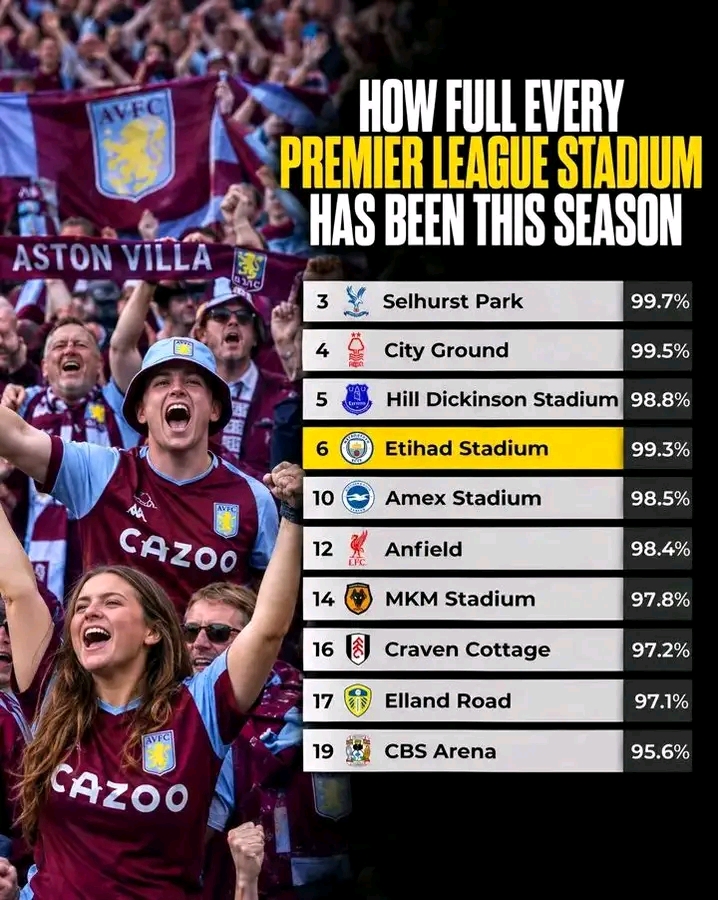
Villa Park topped the Premier League’s stadium-fullness table this season, and the reason is not what most fans would expect. The headline numbers have been flying around, with Manchester City’s near-total capacity at the centre of the chatter, so here is what the data I could find actually says.
Start with Villa Park, because that is where the surprise sits. After Matchweek 4, Villa Park was 99.23% full against an estimated capacity of 37,000, with the official figure reduced by the building works. That put Aston Villa at the top of the occupancy chart, ahead of Old Trafford at 99.04%. It happened in a week when Villa were stuck in 19th place with a single point. A club with one point from four games out-filled everyone, and that has fans doing double takes. (insideworldfootball) (insideworldfootball)
The catch is the denominator. A stadium can look fuller simply by being smaller, and Villa’s ground is temporarily smaller. Last season’s average crowd was close to 42,000, and the club is redeveloping the North Stand, which will eventually push capacity beyond 50,000 and make the ground a Euro 2028 venue. So Villa Park’s position is partly an illusion created by construction. Strip out the building work and it would sit in the pack. It is still a fair tribute to a fanbase packing out a shrunken ground while the team struggles for results. (footballgroundguide)
Now to Manchester City. The Etihad has long been the butt of empty-seat jokes, and the numbers show why the banter stuck. Over 2025-26 the club averaged 52,640, even after nearly 8,000 seats were added, which made it the fourth-largest ground in the league. Earlier seasons were similar: City filled 96.8% of their stadium on average in one recent campaign. The ground’s listed capacity is now 61,038 for 2026-27, so keeping the stadium close to full is a far bigger ask than it used to be. I could not find a source confirming a 99.3% figure for City this season. Single matchdays can touch the high 90s, as they did in 2024 when City entered the 99% club for the first time that season with over 55,000 in the ground, but a season-long average of that size would be a real jump. If you are publishing a 99.3% claim, check it against the club’s official attendance data first. (article 627d1ed6 8bb2 503f af3c 9787bc0109ee +3)The wider picture is the real story. Matchweek 4 saw 422,215 fans across ten games, a combined occupancy of 97.78%, with only 9,588 seats empty. Even the weekend’s quieter grounds were strong, and Arsenal’s win at Sunderland drew 46,861, or 96.21% of capacity. English top-flight football is close to a sell-out product every week, regardless of form, ticket prices or kick-off times. (insideworldfootball) (insideworldfootball)
That is why percentage tables mislead as often as they inform. A reduced-capacity ground like Villa Park will always look strong, and a huge, newly expanded one like the Etihad will always look softer. Raw attendance tells you who has the biggest crowds, percentage tells you who is closest to full, and neither tells you who has the loudest. The Villa Park result is a surprise, but it comes with a footnote, and the City figure needs verifying before anyone shouts it from the rooftops.