Recent history proves McInnes will fume at new SFA announcement on Rangers v Hearts

Derek McInnes was never going to get a quiet return to Tynecastle. Walking back into the ground he left in June, as manager of Rangers and not Hearts, with his old club’s supporters in full voice, was always going to be an emotional night. Then the Scottish FA made the evening a little spicier by confirming who will be in the middle. Don Robertson has been appointed referee for Wednesday’s Premiership meeting at Tynecastle, as McInnes returns to Gorgie for the first time since leaving for Ibrox in the summer. It is the sort of appointment that looks entirely routine on paper and feels anything but when you remember what happened last May.
The match officials, as announced, are straightforward enough. Robertson will be assisted by Ross MacLeod and Calum Spence, with Colin Steven as fourth official, while Matthew MacDermid is on VAR duty alongside Peter Stuart. There is nothing unusual about that line-up in isolation. Robertson is a senior referee who gets big games, and the governing body has to put someone in charge of every fixture. The difficulty is not the appointment in a vacuum. It is the memory attached to it, and the fact that McInnes, more than most managers, has a long and public record of how he reacts when decisions do not go his way.
That memory is the final day of last season. Robertson was the referee who took charge of the last game of the campaign, when McInnes’s Hearts lost the title to Celtic, and the match had to be brought to an early close because of a pitch invasion by home fans. It was a chaotic, heartbreaking afternoon for a club that had come within touching distance of its first league championship in 66 years. Hearts had led the race for much of the season, built a squad that genuinely believed it could finish top, and then watched it all slip away at Parkhead. The aftermath was messy too, with headlines about the SFA releasing audio from the closing moments of the game and about Hearts’ owner, Tony Bloom, claiming that his players had been assaulted at Celtic Park.
It is important to be precise here, because the title race was decided by more than one afternoon. The most controversial moment came a week earlier, in the penultimate round of fixtures. Celtic won 3-2 at Motherwell thanks to a stoppage-time penalty, awarded by John Beaton after a VAR intervention for a handball by Motherwell’s Sam Nicholson, and Kelechi Iheanacho converted to win the match. McInnes was apoplectic. He called the decision “disgusting” and said he did not believe it was a penalty at all. For a manager whose team was chasing history, a late penalty for the team directly above him in the table was the sort of moment that sticks in the throat.
Events then moved in a way that McInnes would argue proved him right. The SFA’s independent Key Match Incident Panel later concluded that the referee’s original decision was correct and that VAR should not have intervened. In other words, the very panel that reviews these calls effectively agreed that the penalty should not have been given. That did nothing for Hearts, who had already lost two points of ground they could never recover. But it gave McInnes a degree of vindication, and it meant that when the disciplinary process eventually arrived, he could say with some justification that he had been punished for pointing out something the governing body itself later acknowledged.
The punishment itself was significant. The SFA charged McInnes under Disciplinary Rule 72, which prohibits remarks that indicate bias or incompetence on the part of a match official or that impinge on his character. He had moved to Rangers by then, and the timing meant the ban threatened to affect his very first games in charge. He was initially handed a four-match touchline ban for his comments, and Rangers announced they would appeal. The club’s argument was that the principle mattered, with a statement that managers must be able to speak honestly. The appeal was a partial success, with the ban reduced and McInnes watching from the stands for two league games before returning to the dugout against St Mirren.
All of this helps explain why the Robertson appointment lands the way it does. McInnes has spent months being reminded, officially and repeatedly, about what he said and what it cost him. He then returns to Tynecastle, a ground that holds some of the most painful memories of his career, under the control of the referee who was in charge when his title hopes finally died. It is not that Robertson did anything wrong in the way the Motherwell penalty was wrong. The pitch invasion was not the referee’s fault, and nobody sensible blames him for the way the season ended. But football is an emotional business, and managers do not separate their memories neatly into fair and unfair parts. The association alone is enough to put a man on edge.
This is where the view in the headline comes from. McInnes has a track record of voicing his frustrations in blunt language, and he did it in the most high-stakes circumstances imaginable. He told reporters at the time that it felt like the whole world was against his team, which is the sort of remark that tells you how a manager’s mind works under pressure. Put a man like that on the touchline at Tynecastle, in a fixture loaded with narrative, and give him a referee who is bound up with his worst night, and it takes very little to imagine how a single contentious call might trigger a reaction. A mistimed tackle, a free-kick that does not go Rangers’ way, a booking that feels harsh, and the old resentments could come rushing back.
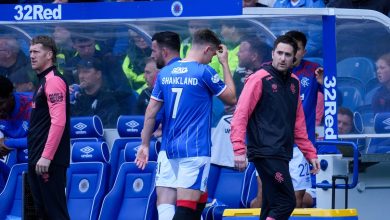
The setting makes that more likely. Hearts sit third in the Premiership and have a four-point cushion over the team below them, after a 2-0 win at Motherwell, and a hostile reception is expected for McInnes. Hearts striker Claudio Braga has said he holds no ill will towards his former manager, but he has also made it clear that the Tynecastle crowd are unlikely to roll out a red carpet. That is understated. Supporters who watched their manager leave weeks after the heartbreak of the title race, then saw captain Lawrence Shankland follow him out of the door, are not going to be generous. Shankland left Hearts for Ibrox for free, and midfielder Cammy Devlin followed McInnes and Shankland across to Rangers, so three of Hearts’ main figures from last season now play for a rival club.
McInnes will also be in unfamiliar territory in the away technical area, and he will face his successor. Wouter Vrancken is now in charge at Hearts, which means McInnes is up against the man who inherited the squad he built. That is its own source of tension. Vrancken will want to show that the team can thrive without the manager who took it so close to a championship, and he will have the crowd with him from the first whistle. McInnes, on the other hand, knows the players, the stadium and the weaknesses of the squad better than almost anyone, but he cannot rely on any of that if the match is defined by decisions rather than football.
For Rangers, there is also a practical need to keep a clear head. They arrive on the back of a 4-0 home win over St Johnstone, which gives McInnes’s side momentum, and they need to build on it against a well-organised opponent. A team that is playing well can be undone by distraction, and there is nothing more distracting than a manager who is arguing with the fourth official while his players are trying to defend a corner. The best thing McInnes can do for his team on Wednesday night is keep his temper, keep his voice down and trust his players to get on with it. That is easier said than done, but it is what the occasion demands.
The disciplinary angle makes it more important still. McInnes has already learned that the SFA takes Rule 72 seriously, and that criticism of a referee, even in the heat of the moment, can lead to a ban. He has now served that punishment, or at least most of it, and he will not want to repeat the experience. A manager who is fined or banned again for comments about Robertson would be handing an advantage to his critics, and he would be doing it at a time when Rangers need him on the touchline. Whatever he thinks of the appointment, he has every reason to say nothing, however hard that might be.
That does not mean he will not feel it, and it is worth considering what exactly would cause him to fume. A penalty decision, either way, would be the obvious flashpoint. Given what happened at Fir Park, McInnes is acutely sensitive to anything involving VAR intervention, and a review that goes against Rangers, or a decision that Hearts benefit from, would bring that flood of memories back. A red card or a series of bookings for his players would do the same. Even something small, like a time-wasting incident or a perceived lack of protection for his wide players, could be enough to get him out of his seat. At a ground where the atmosphere will be intense and the margins thin, any of these could become a turning point.
It is only fair to give the opposite argument, because there is one. The SFA appoints referees on the basis of availability, form and experience, not on the emotional history between a manager and an official. It would be both impractical and unfair to ban a referee from a fixture because he happened to work a game that ended badly for one of the clubs involved. Robertson has done nothing to deserve being treated as a symbol of a season that went wrong for Hearts. The pitch invasion was the responsibility of those who ran onto the field, and the controversial penalty at Motherwell was a decision for a different referee and VAR team. Blaming Robertson for either would be a stretch.
There is also a case that McInnes, now at a bigger club with higher expectations, may feel less aggrieved than he did when he was the underdog. At Hearts, he had to fight for every point, and any decision against his team felt like another obstacle in a battle he was not supposed to win. At Rangers, the narrative is different. The club has more resources, more fans and more pressure to win every week, which means a manager has less time for complaints and more need for results. McInnes may well decide that the best response to a bad decision is to ignore it and get on with the next job, and the experience of the ban could have taught him that lesson more thoroughly than any speech.
Hearts supporters will see the situation differently again. Many of them believe their team was wronged last season, both by the Motherwell penalty and by the way the title decider played out. For them, a referee who was involved on that day is not a symbol of unfairness but a reminder of what might have been. If anything, they might feel that McInnes has no right to complain, having walked out on them after a campaign in which so much was at stake. That emotional counterpoint adds another layer to an evening that is already thick with feeling, and it makes the officials’ task all the harder.
In the end, the headline is a prediction about temperament, and temperament is hard to forecast. McInnes may spend the night calmly watching his team and show nothing more than the usual annoyance at a few decisions. He may also find that the combination of the ground, the crowd and the referee proves too much, and that the frustrations he thought he had left behind come bubbling up. The evidence from recent months suggests the second possibility is not far-fetched. A manager who described a crucial penalty as disgusting, who was banned for it and who fought the ban publicly is not a man who has made peace with the way last season ended.
On the pitch, I expect a tight, tense game. Hearts are well organised and confident, and they will feed off the atmosphere. Rangers have quality in attack, and with Shankland leading the line against his old club, they have a player who knows exactly how to hurt his former teammates. If Robertson and his team get the big calls right, the story will be about the football and the reunions. If they do not, the story will quickly become about McInnes, the technical area and the history that brought him there.
Either way, one thing is certain. This is not just another league match for McInnes, and the appointment of Don Robertson only adds to that. Recent history suggests he will notice every decision, and it would be a surprise if he did not feel some of the old anger. Whether he lets it show is another matter, and it may turn out to be the biggest test of his temper since he arrived at Ibrox.