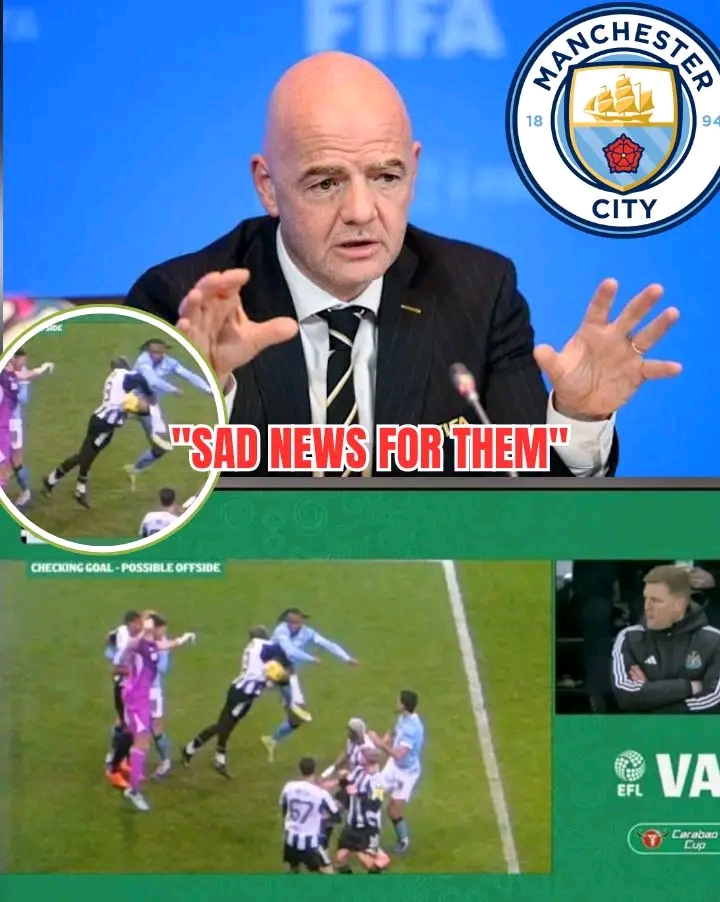
BREAKING NEWS: FIFA has officially announced the dismissal of the officials and referees from the recent Manchester City vs Newscastle United match. This decision comes after the referee declared Antoine Semenyo Goal Offside after VAR Check. Justice has been served for Manchester City, and this sets a strong example for other referees to maintain fairness and integrity in the game.

The night was supposed to be about football. About goals, intensity, and two strong teams fighting for a place in a cup final. Instead, it became another chapter in the growing war between managers, referees, VAR, and the people who run the game.
Manchester City travelled to Newcastle knowing the importance of the moment. A place in the League Cup final was within reach, and Pep Guardiola wanted control, focus, and professionalism. His players delivered the result on the pitch. But once again, the conversation after the match was not about tactics or quality. It was about VAR. It was about referees. And it was about frustration that has been building for years.
The flashpoint came when Antoine Semenyo thought he had doubled Manchester City’s lead.
The ball came in from a corner. Bodies were everywhere. Shirts were pulled. Arms were raised. In the chaos, Semenyo reacted first and finished cleanly. The ball hit the net. City players celebrated. Guardiola punched the air. For a moment, it felt done. Then came the pause.
At first, nobody understood why play had stopped. The assistant referee kept his flag down. The referee pointed to the centre circle. Everything looked normal. But VAR had other ideas.
What followed was one of the longest and most confusing delays of the season.
Six minutes.
Six minutes of players standing in the cold. Six minutes of fans whistling and shouting. Six minutes of uncertainty that drained emotion from the stadium. Even the players on the bench began warming up again because nobody knew when play would restart.
Behind the scenes, chaos was unfolding.
The semi-automated offside system had failed. The technology that was supposed to make decisions faster and clearer simply was not working. Stuart Attwell, the VAR official, was forced to manually draw offside lines. Camera angles were reviewed again and again. Every movement was frozen, replayed, zoomed, and analysed.
Eventually, Attwell sent referee Chris Kavanagh to the pitchside monitor.
That alone told everyone trouble was coming.
After studying the screen, Kavanagh made his decision. The goal was ruled out. Erling Haaland, he decided, was offside and interfering with play. Semenyo’s goal was chalked off. The reaction was instant. Pep Guardiola exploded. The Manchester City manager stood on the touchline shaking his head in disbelief. He shouted. He gestured. His body language screamed anger. This was not just about one goal. This was about years of frustration pouring out all at once.
Guardiola has never been a man who hides his emotions. But this timefelt different. This time, it felt personal.
He had seen this movie before. And always, it seemed to end the same way when City played at St James’ Park. He remembered November.
He remembered the defeat at Newcastle earlier in the season. He remembered Phil Foden going down in the box after a challenge that was not even reviewed. He remembered Jérémy Doku being denied a penalty when he was clearly impeded. He remembered Harvey Barnes scoring after another long VAR check that somehow found no issues.
And he remembered the FA Cup final last season.
Dean Henderson handling the ball outside his area. A clear red card in Guardiola’s eyes. Nothing given. Too many moments. Too many decisions. Too many explanations that never came. After the match, Guardiola did not hold back. He spoke calmly at first, but the message was sharp. He questioned consistency. He questioned logic. And most of all, he questioned accountability.
“How can four officials struggle for six minutes to draw lines for offside,” he asked, “but in other moments, decisions are made instantly?”
He pointed out the irony. Newcastle’s goal in the earlier league meeting had been checked quickly with perfect lines. But City’s goal required guesswork and broken technology. To Guardiola, it made no sense.
For over a decade at Manchester City, he said, he had stayed quiet. He had accepted mistakes. He had respected officials. But now, he wanted answers. Not private explanations. Public ones.
He made it clear he expects PGMOL chief Howard Webb to speak openly about the decision. About the technology failure. About why some incidents are reviewed and others ignored.
This was not a manager throwing excuses after a loss. City had won 2–0. They were close to the final. This was about principle. And the anger spread through the squad.Bernardo Silva spoke honestly. He admitted the team felt it again. That same feeling of injustice at the same stadium. He said it was becoming a pattern, even though he was careful with his words.
Antoine Semenyo himself was furious. The forward had already scored earlier in the match, his second goal in four days since completing his big-money move from Bournemouth. He felt confident. Sharp. Alive. When his second effort was ruled out, it felt like something was taken from him.
At full-time, television cameras caught him mouthing the words: “It’s a goal.” To him, there was no doubt. The decision centred on Erling Haaland’s position. As the corner came in, Haaland was grappling with Newcastle defender Malick Thiaw. He was near goalkeeper Nick Pope. Because Pope had stepped forward, Haaland was technically offside. The officials judged that he was interfering with Thiaw’s ability to defend.
But this is where opinion enters football. Was Haaland actively blocking? Was Thiaw already beaten? Was the goalkeeper affected? These are judgement calls. And judgement calls are where VAR was supposed to help, not confuse.
Instead, six minutes later, a goal was erased.The delay itself became part of the controversy. Players grew cold. The rhythm of the game disappeared. Guardiola exchanged angry words with Newcastle staff. Even substitute goalkeeper Gianluigi Donnarumma became involved in shouting matches on the sideline.
Football stopped feeling like football.Yet, in a strange way, the decision lit a fire in Manchester City.Guardiola later admitted it. He said the anger helped. He said the players felt it and responded. The second half performance was driven by emotion, by a sense of “us against them”.
Rayan Cherki sealed the win late on with a calm finish. The goal mattered. The advantage heading into the return leg mattered. But the feeling remained. City had won. VAR had lost again.
Even Newcastle manager Eddie Howe looked uncomfortable discussing it. He said six minutes was too long. He admitted he did not understand why it took so long, especially on such a cold night. He did not celebrate the decision. He simply moved on. Pundits were harsher. Chris Sutton, speaking on Sky Sports, called it a “sheer guess”. He said the game was losing itself. That football had become something unrecognisable when fans had to wait minutes to celebrate or mourn. And that is the real problem. VAR was introduced to fix clear and obvious errors. Instead, it has created new ones. It has slowed the game. It has removed emotion. It has placed enormous power in the hands of officials sitting in rooms far away from the stadium.
For managers like Guardiola, who obsess over details and fairness, this is unbearable. This is not the first time. And it will not be the last. FIFA later confirmed that officials involved in the match were dismissed from duties, a rare and dramatic step that only added to the sense that something had gone wrong. But for many, that came too late.
The damage was already done.Fans left confused. Players left angry. Managers left demanding answers. Manchester City move forward. The scoreline stands. The semi-final advantage remains. But trust in the system continues to erode.
Every week, a new controversy. A new apology. A new explanation. And yet, nothing really changes. Guardiola’s message was simple. If VAR exists, it must be clear. If referees make mistakes, they must explain them. If technology fails, the game must be honest about it