
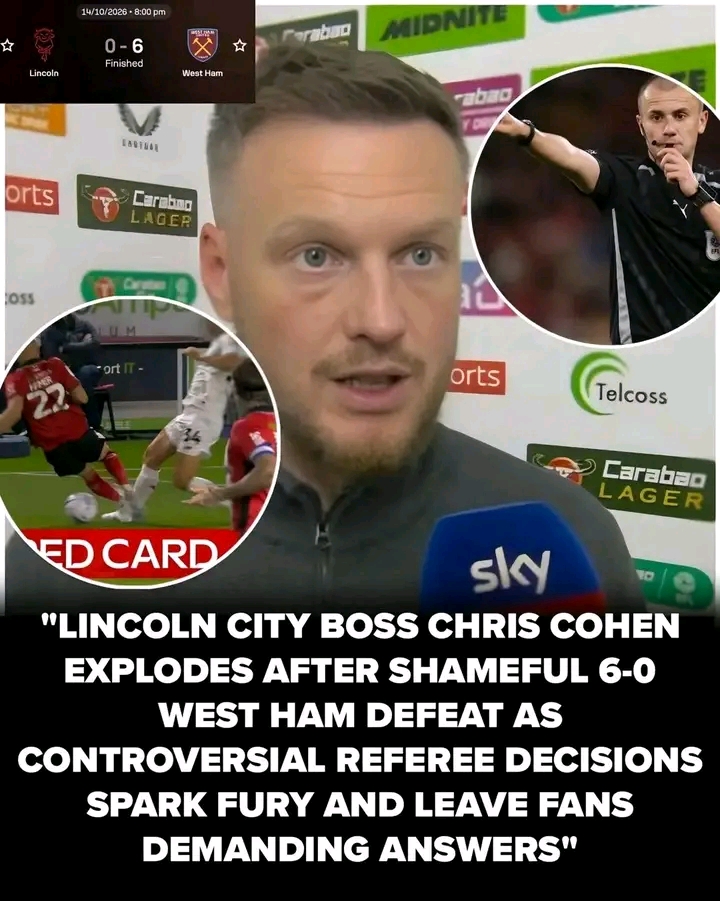
🗣️ “I’ve never heard a manager say that after a game before.”
🗣️ “Six goals… and he’s still talking about the referee.”
Lincoln’s boss didn’t hold back after the 6-0 defeat to West Ham, branding the result “pure ROBBERY” and “UNACCEPTABLE” as he questioned whether his side got a fair deal from the officials.
👀 Was it just frustration, or does he have a point? Fans are divided, and everyone’s talking. Football post-match press conferences are rarely quiet affairs, but every now and then a manager delivers a performance that completely eclipses what actually took place on the pitch. Standing on the wrong end of a heavy 6-0 scoreline against Premier League opposition is a bitter pill to swallow for any lower-league side, yet the narrative shifted entirely the moment the microphone was turned on. Instead of dissecting defensive lapses or praising West Ham’s ruthless clinical edge, the focus was thrust squarely onto the officiating, sparking a fiery debate across the footballing world.
To claim a six-goal defeat was a product of refereeing decisions certainly takes audacity, and it is precisely why supporters are so split in their reactions. On one hand, critics argue that using such incendiary language after a decisive loss comes across as an effort to deflect accountability. When a team concedes six goals, fundamental issues in structure, concentration, and execution usually take center stage. For many neutral observers and rival supporters, calling the match a “robbery” under those specific circumstances feels out of touch with the reality of the scoreboard. In top-tier football, heavy scorelines rarely hang on marginal calls alone, leaving many to wonder if the rant was simply heat-of-the-moment venting.
On the other hand, football matches are governed by key moments that dramatically alter momentum and team psychology. Supporters who defend the manager’s outburst suggest that early controversial decisions—whether a missed foul in the buildup to an opening goal, a debatable penalty call, or an unfair dismissal—can completely dismantle a game plan. When an underdog is fighting against high-caliber opposition like West Ham, every single crucial whistle matters. If key decisions go against you early on, the emotional wind is pulled right out of your sails, opening the floodgates for a scoreline to spiral quickly out of hand. From this perspective, the anger stems not from the total number of goals conceded, but from the initial spark that set the collapse in motion.
Ultimately, whether you view the post-match tirade as an unhinged distraction or a brave stand for fairness, it achieved one clear outcome: it got everyone talking. Managers often use the media spotlight strategically to draw heat away from their players after a painful evening, shifting the headline away from squad performance and onto officiating standards. Whether this fiery post-match response will galavanize the squad or serve as an unwelcome distraction remains to be seen, but one thing is certain—this electric press conference will be remembered far longer than the six goals that preceded it.








