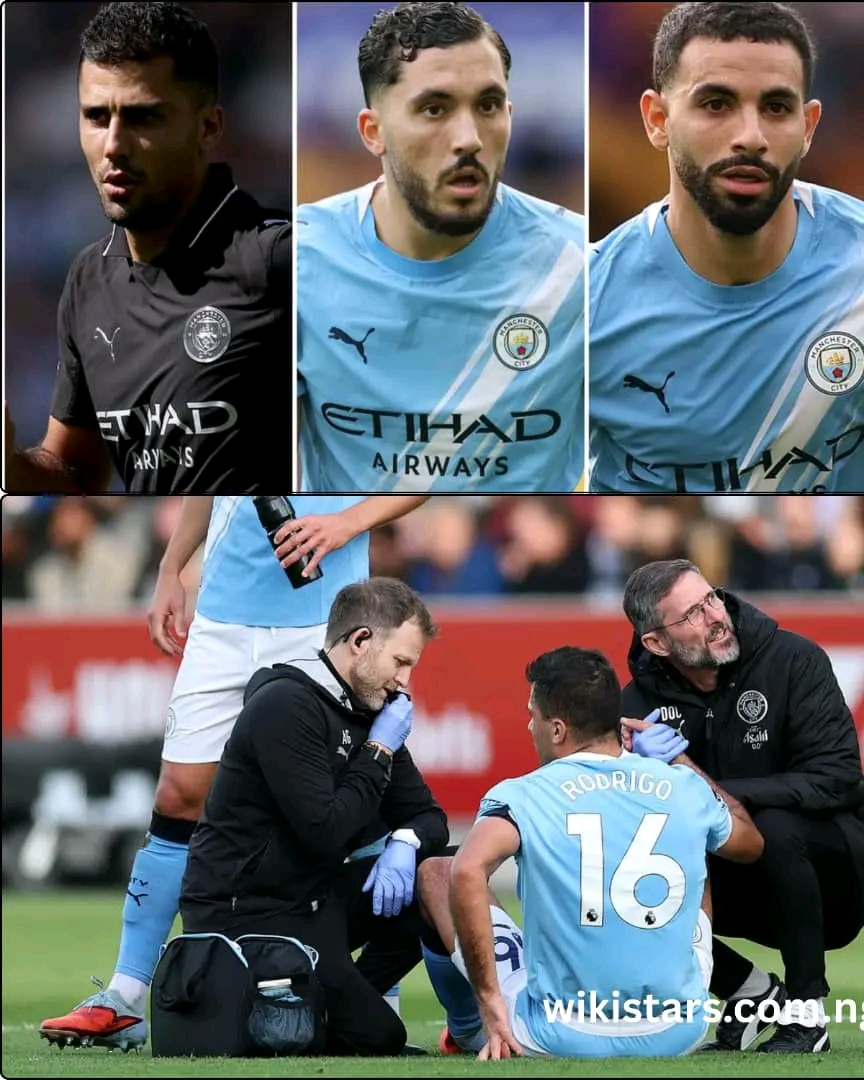
Man City injury update: Rodri and Mateo Kovacic latest news and return dates officially confirmed🔥🔥 🚨 He is back and will play tomorrow

Manchester City finally enjoyed something that had been missing for weeks when they stepped onto the pitch at the Etihad Stadium on a calm Saturday afternoon. For the first time in what felt like a long time, the team produced a performance that looked controlled, balanced, and defensively solid. The opponents were Sunderland, and while the scoreline suggested a routine and comfortable victory, the story behind the match was more complicated than the result itself.
Pep Guardiola’s side secured a clean sheet, something that had become surprisingly rare in recent weeks. The crowd celebrated every goal with relief and excitement, and the players looked confident again. For a moment it felt like Manchester City had rediscovered the calm authority that made them one of the most dominant teams in modern football.
But even during the celebrations, there was another conversation quietly running through the stadium and across social media. Many supporters were not only thinking about the victory. Instead, they were asking the same questions that have followed Manchester City throughout the season.
Where is Rodri, and when will Mateo Kovacic return.
Those two names have become central to City’s current story. Injuries are part of football, but when key midfield players are missing for long periods, the effect can be huge. Manchester City built their recent success on total control in midfield. That control allows the defenders to stay calm, the attackers to move freely, and the entire team to dictate the rhythm of the match.
Without Rodri and Kovacic fully available, that balance has sometimes looked fragile.
Rodri’s absence is the one that has caused the most concern among supporters and analysts. Over the past few seasons he has grown into one of the most important players in the world. When he first arrived at Manchester City, he was seen as a talented defensive midfielder with potential. Today he is viewed as the heartbeat of Guardiola’s team.
Rodri is the player who sits in front of the defence, reads the game, breaks up attacks, and starts City’s own movements forward. He is calm under pressure, intelligent with the ball, and physically strong enough to dominate midfield battles.
Last season he confirmed his status as one of football’s most influential players. His performances helped Manchester City win major trophies and dominate opponents across Europe. Many fans still remember the crucial moments when Rodri stepped up during important matches.
His influence was so great that he eventually won the Ballon d’Or, a recognition that confirmed his place among the world’s elite players.
Because of that importance, any injury to Rodri immediately becomes a huge concern.
The first major problem appeared last season when he suffered a serious ACL injury. That moment shocked Manchester City supporters. Losing such a key player for a long period raised fears about how the team would cope.
Guardiola and his squad tried to adapt. Other players stepped into midfield roles, tactical adjustments were made, and the team continued competing. But it was obvious that something was missing. Rodri’s ability to control matches cannot easily be replaced.
Despite the difficulty of the injury, Rodri showed determination during his recovery. The Spanish midfielder worked hard in rehabilitation, focusing on returning stronger and helping his team again.
Eventually he managed to make his comeback in time to feature during the Club World Cup period. His return felt like a massive boost for Manchester City supporters. Seeing him back on the pitch created optimism that the worst was finally over.
Unfortunately, football rarely follows a simple story.
Just when it seemed like Rodri had fully recovered, another setback arrived.
During a Premier League match against Brentford in October, Rodri suffered a hamstring injury. At first the problem did not look extremely serious, but hamstring injuries can be complicated. They often require careful treatment and patience.
For a midfielder who covers large areas of the pitch and constantly changes direction, a hamstring issue is especially worrying.
Manchester City’s medical team immediately decided to take a cautious approach. They knew that rushing Rodri back too early could make the situation worse and potentially lead to another long-term injury.
Since that Brentford match, Rodri has barely appeared on the pitch.
His only competitive involvement came on November 2 during a home match against Bournemouth. Guardiola introduced him as a substitute, and supporters hoped that this was the beginning of his full return.
Instead, it turned out to be a very brief cameo.
After that short appearance, Rodri disappeared from the matchday squads again. Week after week passed, and fans kept waiting for updates about his fitness.
Every press conference involving Pep Guardiola began to include the same question.
When will Rodri be back.
Guardiola, known for his careful communication with the media, did not provide clear answers. Before the Sunderland match he was asked directly if Rodri was ready to start.
His response was simple.
No.
But he also added something that gave supporters a small piece of hope. He said Rodri was getting better.
That short sentence sparked speculation. What exactly did “getting better” mean. Was he close to returning, or was it still a long process.
When journalists asked Guardiola if Rodri could be ready for the Champions League clash against Real Madrid, the manager smiled slightly and replied with a mysterious comment.
Ask me in Madrid.
That response captured Guardiola’s personality perfectly. He likes to keep opponents guessing, and he rarely reveals his full plans before a big game.
But the answer also suggested that Rodri’s situation was still uncertain.
The potential return date being discussed inside the club was the away match against Real Madrid on December 10. However, even that possibility was not guaranteed.
Being fit enough to train is one thing. Being ready to play against Real Madrid at the Santiago Bernabéu is something completely different.
Matches between Manchester City and Real Madrid have become one of the most exciting rivalries in modern Champions League football.
Whenever the two clubs meet, the tension is intense. Both teams are filled with world-class players, tactical masterminds, and supporters who expect victory.
Small details often decide these games.
In that context, Rodri’s presence or absence could have a huge impact.
He is the type of midfielder who can slow the tempo, block dangerous attacks, and give his teammates confidence. Against a team like Real Madrid, those qualities are incredibly valuable.
Without Rodri, Guardiola has to find other solutions.
Players such as John Stones, Bernardo Silva, or other midfield options can step into deeper roles, but none of them replicate Rodri perfectly.
That is why his potential return remains such an important story.
While Rodri’s injury dominates most discussions, Mateo Kovacic’s situation has also created frustration inside the club.
The Croatian midfielder joined Manchester City with strong expectations. After successful years at Chelsea and Real Madrid earlier in his career, Kovacic was seen as a player who could bring experience, technical ability, and composure to Guardiola’s system.
His ability to carry the ball through midfield and escape pressure made him an attractive option.
However, Kovacic’s time at Manchester City has been interrupted by injuries almost from the beginning.
During the summer he underwent surgery to deal with an Achilles injury. Achilles problems are notoriously difficult for footballers because they affect running, acceleration, and overall movement.
Because of this, Manchester City decided to manage his recovery carefully.
When Kovacic eventually returned to action earlier in the season, there was cautious optimism. Guardiola began giving him minutes in matches so he could rebuild his match fitness.
For a short period, things seemed positive.
But once again, injury concerns appeared.
Kovacic’s most recent appearance came in late October during a Champions League match against Villarreal. He played roughly thirty minutes and looked comfortable on the ball.
Unfortunately, that would be his last appearance for weeks.
Since that game, he has not been included in matchday squads.
Supporters began wondering whether another injury problem had occurred.
The situation became clearer when Kovacic posted a picture on social media on December 3. In the image he was at Manchester City’s training facility, balancing a football on his head.
But there was something else noticeable in the photo.
Kovacic was wearing a large protective boot on his right leg and using crutches.
For fans hoping for positive news, the image was worrying. It suggested that his recovery was far from complete.
Later, Guardiola explained the situation during a press conference.
The manager revealed that Kovacic was dealing with calcification in his ankle. This condition can cause pain and restrict movement, especially for players who rely on quick turns and sharp changes in direction.
Guardiola admitted that Kovacic would be out for a while and that the club would have to wait patiently.
Unlike Rodri, who at least has a possible return date connected to upcoming matches, Kovacic’s recovery timeline remains unclear.
There is no confirmed target for his comeback.
That uncertainty adds another challenge for Manchester City as they move through a busy part of the season.
The football calendar is relentless. Domestic league matches, cup competitions, and European fixtures all demand full concentration and energy.
Guardiola has always been praised for his tactical flexibility and ability to adapt. Throughout his career he has found creative solutions when players are missing.
But even the best managers cannot completely ignore the impact of losing key midfielders.
Midfield is the engine of Guardiola’s system. The team relies on quick passing, intelligent positioning, and constant movement.
When players in that area are absent for long periods, the rhythm of the entire team can change.
Against Sunderland, Manchester City managed to perform effectively. The opponents allowed Guardiola’s players to control possession and dictate the tempo.
However, not every match will offer that level of comfort.
In the Champions League, especially against Real Madrid, every mistake is punished.
Real Madrid’s attacking players thrive on quick transitions and moments of weakness from their opponents. That is why having a player like Rodri in midfield can make such a difference.
He acts as a shield in front of the defence and provides stability during chaotic moments.
The psychological side of these injuries is also important.
For Rodri, returning from a serious ACL injury only to face another physical problem can be mentally exhausting. Athletes often speak about the emotional challenge of rehabilitation.
There are long days of training alone, uncertainty about the future, and the constant pressure to return quickly.
Manchester City’s medical team will want to make sure that Rodri returns only when he is fully confident and physically ready.
Kovacic faces a different type of challenge.
As a new player at the club, he has not yet had the opportunity to establish himself fully in the team. Injuries have limited his chances to build chemistry with his teammates and understand Guardiola’s complex tactical system.
For him, the priority will be long-term health rather than rushing back too soon.
Guardiola’s comments suggest that the club views Kovacic as a player who could become important later in the season once he is completely fit.
For Manchester City supporters, this period has created mixed emotions.
The team continues to win matches and compete for trophies. That success shows the depth and quality of the squad.
But there is always a sense that something is missing.
Fans know how powerful the team can be when every key player is available. They have seen Manchester City dominate opponents with total control and precision.
Until Rodri and Kovacic return, there will always be a feeling that the squad is not yet complete.
As the Champions League clash with Real Madrid approaches, all attention will be focused on Guardiola’s next injury update.
Even a small hint that Rodri is ready could change the mood among supporters.
If he is unavailable, Guardiola will once again need to rely on tactical adjustments and the versatility of his squad.
Manchester City have shown many times that they can adapt to difficult situations.
But there is no doubt that they are stronger when their midfield general is on the pitch.
Looking ahead, the club hopes that both Rodri and Kovacic will eventually return to full fitness during the crucial months of the season.
Football championships are often decided in the spring when fatigue increases and pressure reaches its highest point.
Having experienced midfielders available during that period could make the difference between success and disappointment.
For now, patience remains the most important word inside the Manchester City camp.
Rodri is improving, but his exact return date remains uncertain.
Kovacic is recovering, but no clear timeline has been confirmed.
As Manchester City prepare for another huge European night, they travel knowing that two important players are still fighting their own battles away from the spotlight.
The team will continue moving forward, but everyone inside the club is waiting for the moment when both midfielders can finally step back onto the pitch and restore the balance that made Manchester City one of the most feared teams in world football.