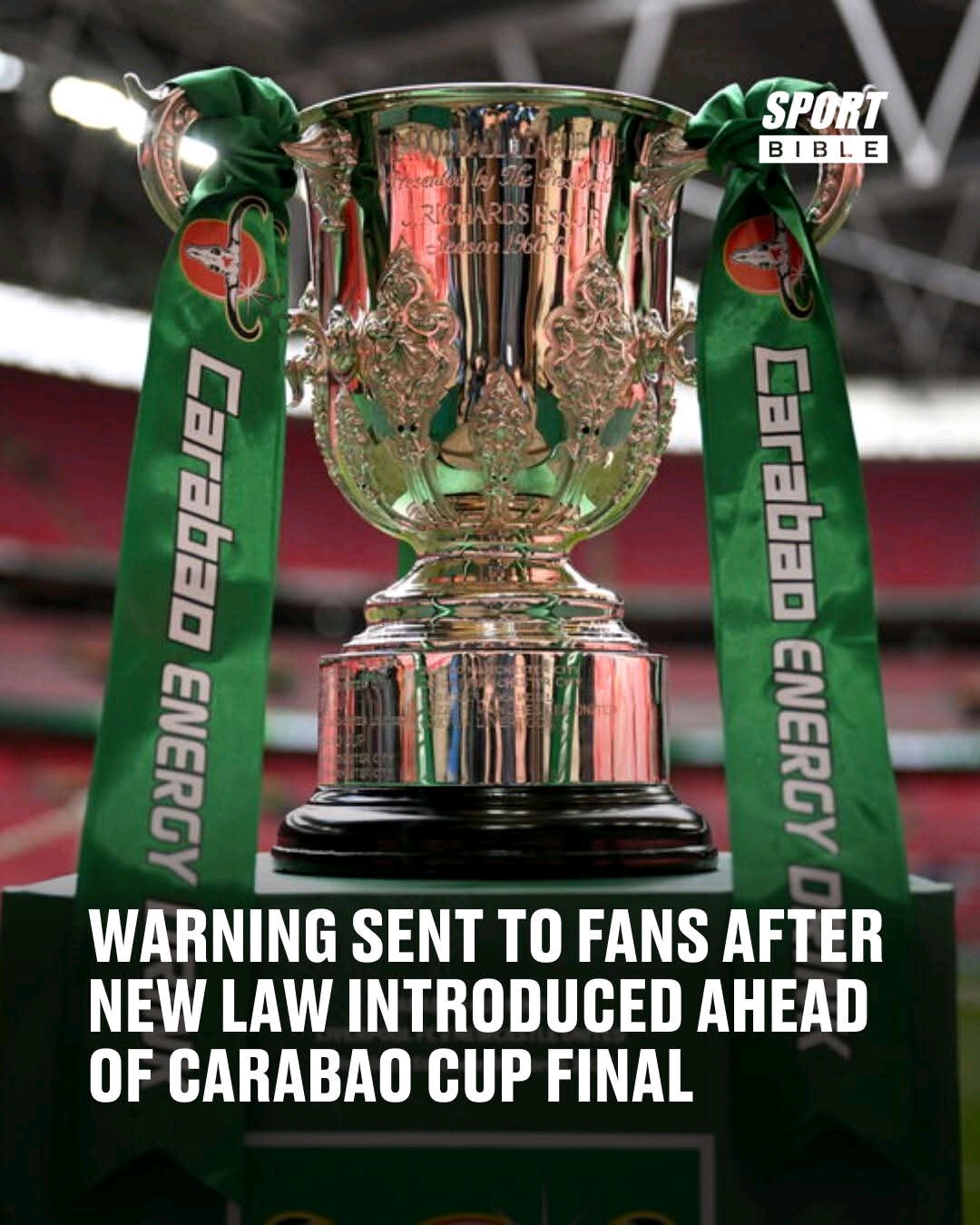
The warning did not come quietly, and it did not come as a suggestion. It came like a final message, strong, direct, and impossible to ignore. Just days before one of the biggest matches in English football, a new law was introduced that has completely changed the atmosphere around the Carabao Cup final. What was supposed to be a celebration of football, a day of excitement, passion, and unforgettable moments, has now been surrounded by strict rules, serious consequences, and a clear message from the government — this time, there will be no chaos.
The match itself is already massive. Arsenal and Manchester City are preparing to face each other at the iconic Wembley Stadium, fighting for the first major trophy of the English football season. For both clubs, it is more than just a cup final. It is about pride, momentum, and making a statement early in the year. Fans have been counting down the days, dreaming of victory, imagining the celebrations, and hoping to be part of something special.
But while players prepare on the pitch, something else has been happening off it. Behind the scenes, authorities have been working hard to make sure that what happened in the past never happens again. And this time, they are not taking any chances.
Both Arsenal and Manchester City have already sold out their ticket allocations. Around 32,000 fans from each club will be inside the stadium, with the rest of the seats filled through official hospitality. That means every single seat has been accounted for. Every ticket has an owner. There is no space for anyone else. And yet, history has shown that this does not always stop people from trying.
The problem is not new. In fact, it has been growing over the years. Big matches attract huge crowds, and not everyone who wants to be there can get a ticket. Some fans travel anyway, hoping to find a way in. Some try to buy tickets illegally. Others attempt something even more dangerous — forcing their way into the stadium without permission.
One method that has become increasingly common is something known as “tailgating.” It might sound harmless, but it is anything but. It happens when a person without a ticket follows closely behind someone who has one, trying to slip through the turnstiles before security can react. It is quick, it is risky, and it can create serious safety issues.
Now, for this final, that behavior has officially been made illegal.
The UK government has introduced a new law specifically targeting ticketless entry into football matches. It is not just a warning. It is a legal change with real consequences. Anyone caught trying to enter a stadium without a valid ticket will face serious punishment. This includes arrest, a fine of up to £1,000, and even a football banning order that could last up to five years. Five years away from matches, from stadiums, from the sport they love — all because of one reckless decision.
The message is clear. Do not try it.
This decision did not come out of nowhere. It was not random. It was not unnecessary. It was a direct response to something that shocked the country and embarrassed football on one of its biggest stages.
Back in 2021, during the UEFA Euro 2020 Final, also held at Wembley, the situation got completely out of control. Thousands of fans without tickets gathered outside the stadium. Despite repeated warnings from police, many of them tried to force their way inside. What followed was chaos.
Security was overwhelmed. Barriers were breached. People were pushed, crushed, and put in danger. Some fans managed to get in without tickets, while others were left outside in dangerous conditions. It was a moment that should have been remembered for football, for the match, for the atmosphere. Instead, it became known for disorder, fear, and failure.
More than 500 police officers were deployed that day, trying to keep control of a situation that was quickly slipping away. But even that was not enough. Reports later revealed that over 2,000 people entered the stadium without tickets. There were multiple large-scale breaches of security, with some individuals even targeting disabled entrances as a way to gain access.
It was not just a problem of numbers. It was a problem of safety.
A full review led by Louise Casey found that the situation could have ended in disaster. There were what she described as “near misses” — moments where things could have gone terribly wrong. Injuries were possible. Even deaths were a real risk. That is how serious it was.
Outside the stadium, thousands more people remained gathered, watching, waiting, hoping for a chance to get in. It was estimated that around 6,000 fans were still outside during the match itself. If England had won, many feared that those crowds would have surged forward, trying to enter all at once.
It was a situation that nobody wanted to see again.
And that is why this new law exists.
According to Sarah Jones, the goal is simple — to make football safe again. She made it clear that fans should be able to enjoy matches without fear, without pressure, and without the risk of being caught in dangerous situations created by others.
Her words carried weight. She spoke about giving the police the tools they need to prevent chaos. She spoke about responsibility. And most importantly, she spoke about consequences.
Because this time, there will be no excuses.
For fans planning to attend the Carabao Cup final, the rules are simple. If you have a valid ticket, you can enter the stadium and enjoy the match. If you do not, you must stay away. There is no middle ground. There is no second chance at the gate. There is no slipping through unnoticed.
Security will be tighter than ever. Police presence will be stronger. Surveillance will be more advanced. Every entry point will be monitored. Every movement will be watched. The goal is not just to stop illegal entry, but to prevent any situation that could lead to danger.
And for many fans, this is actually a positive step.
Because while football is about passion, it is also about safety. It is about families, friends, and communities coming together to enjoy something they love. It should not be about fear. It should not be about pushing, fighting, or risking lives just to get inside a stadium.
Still, not everyone is happy.
Some fans believe the measures are too strict. They feel that the joy of football is being controlled, limited, and turned into something overly regulated. They worry that the atmosphere could change, that the spontaneity of big matches could be lost.
But others argue that this is the price of safety. That without these rules, the risks are simply too high. That what happened in 2021 cannot be allowed to happen again, no matter what.
As kickoff approaches, the tension continues to build. Not just on the pitch, where Arsenal and Manchester City are preparing for battle, but outside it as well. The eyes of the country will be watching, not just to see who wins the trophy, but to see how this new system works.
Will it be successful?
Will it prevent the chaos of the past?
Will fans respect the rules, or will there still be those who try to take the risk?
These are the questions that remain unanswered.
But one thing is certain.
This final will be different.
The excitement is still there. The passion is still there. The importance of the match has not changed. But now, there is something else in the air — a sense of control, a sense of caution, and a clear understanding that football is entering a new era.
An era where safety comes first.
An era where rules are enforced.
An era where the mistakes of the past are not repeated.
As fans make their way to Wembley, as scarves are raised and songs are sung, as the teams step onto the pitch, the game will go on as it always does. But behind the scenes, everything has changed.
And for everyone involved, from the players to the supporters, from the police to the officials, there is one shared responsibility.
Make sure this time, the story is about football.