The noise inside the Etihad Stadium had not even settled when the story of the night took another dramatic turn, not on the pitch this time, but in front of the cameras. Manchester City had just delivered a huge statement in the title race, defeating Arsenal in a match that carried pressure, emotion, and consequences far beyond the ninety minutes. The players were still full of adrenaline, still running on pure emotion, and that energy followed them straight into the post-match interviews.
At the centre of it all, once again, was Erling Haaland.
He had done what he always seems to do when the moment demands it. He had stepped up. He had scored. And not just any goal, but the winning goal, the decisive moment that could change the direction of the entire Premier League title race. It was the kind of contribution that turns a player into a hero for the night, the kind of moment that fans remember long after the final whistle.
But what happened after the game quickly became just as talked about as the goal itself.
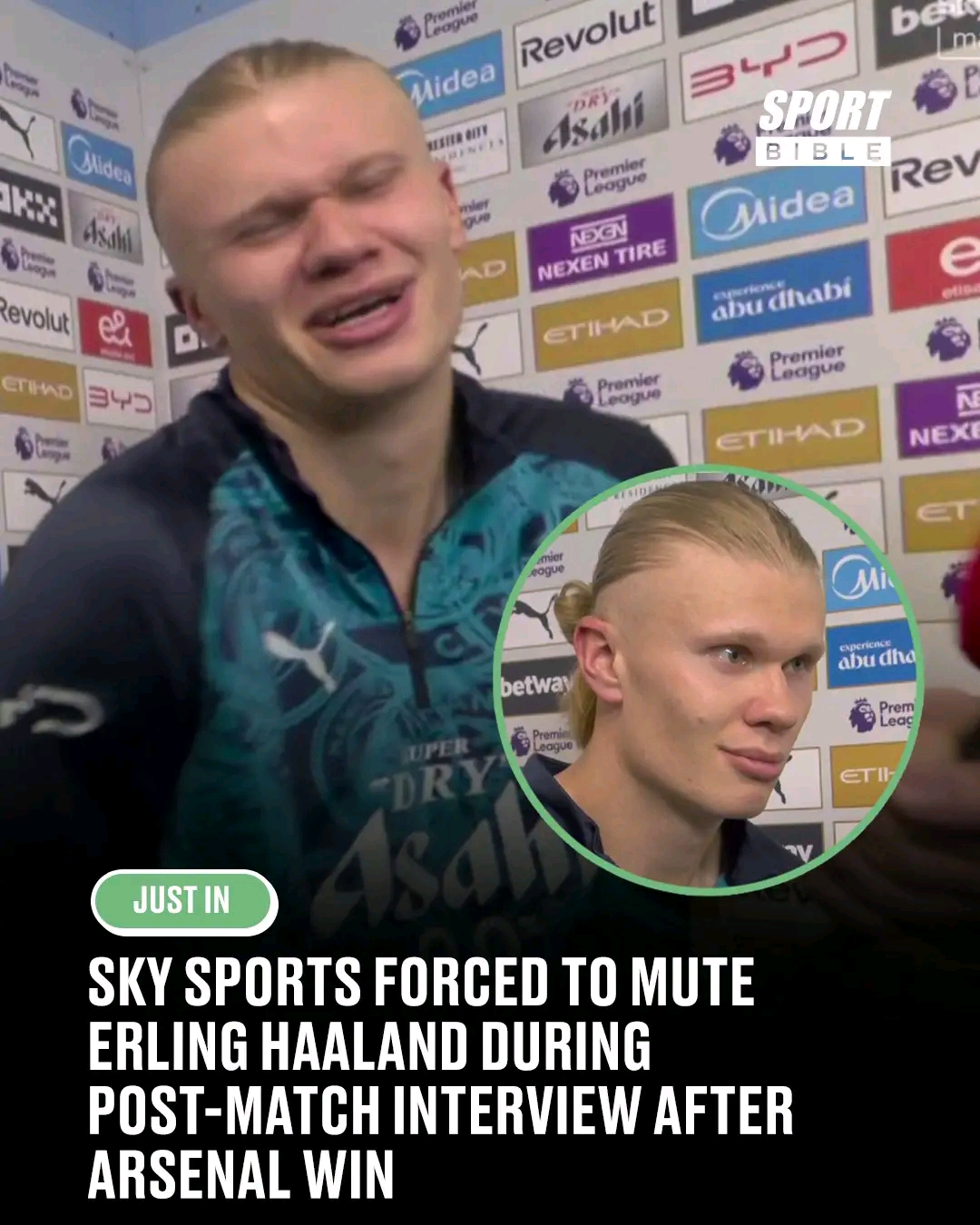
As Haaland walked over for his post-match interview with Sky Sports, there was already a sense that something interesting might happen. This was not a calm, controlled game where players could easily switch off their emotions. This was intense. This was heated. This was personal.
Standing beside him was Bernardo Silva, who had just been named man of the match after an incredible performance. While many expected the spotlight to remain fully on Haaland because of his winning goal, those who watched closely knew that Silva’s contribution had been just as important. His work rate, his defensive effort, his intelligence on the ball—it was a complete performance.
Haaland clearly agreed.
When he started speaking, you could immediately feel the energy in his voice. He was still in match mode, still feeling every moment, still reacting to everything that had just happened on the pitch. And as he tried to praise Silva for one particular moment during the game, things suddenly took an unexpected turn.
He said he remembered a cross, a defensive moment, and then compared Silva to one of football’s greatest defenders, Fabio Cannavaro. But in doing so, he used language that could not be broadcast on live television.
The word slipped out naturally, without hesitation, without filter.
For a second, there was a pause. Then the interviewer, Patrick Davidson, quickly stepped in.
“Erling, language please.”
It was a moment that perfectly captured the rawness of football. Players are not robots. They are human beings, full of emotion, especially after games like this. The adrenaline, the passion, the tension—it all comes out. And sometimes, it comes out in ways that broadcasters are not ready for.
Haaland, however, did not seem too concerned.
He responded almost immediately, brushing it off in his own confident style. He pointed out that everyone swears at some point in their lives, almost laughing at the situation, before continuing his praise for Silva. He made it clear that his words were not meant to offend, but to highlight just how incredible his teammate had been.
And in truth, that was the heart of it all.
Haaland was not trying to cause controversy. He was simply expressing admiration in the most emotional, honest way possible.
Still, television rules are television rules.
Back in the studio, the presenters at Sky Sports had no choice but to react. The microphone had already been muted during the moment, and an apology quickly followed. It was one of those classic live TV situations—unexpected, slightly chaotic, but also strangely entertaining.
Fans watching at home could not help but react.
Clips of the moment spread quickly across social media. Some found it hilarious. Others pointed out how it showed the passion of the game. A few criticised it, saying players should be more careful. But overall, it became one of those moments that adds to the drama of football, something people talk about long after the match is over.
But the interview did not stop there.
As the conversation continued, attention shifted back to the match itself, and one of the most talked-about incidents of the night—Haaland’s battle with Gabriel Magalhaes.
Throughout the game, the two had been locked in a physical, intense duel. It was not just about football. It was about dominance, about pride, about who would come out on top. There were pushes, challenges, moments where things threatened to boil over.
At one point, there was a particularly heated exchange where Gabriel appeared to move aggressively towards Haaland. Many watching felt that it could have resulted in a red card. In modern football, similar incidents have often been punished more severely.
But on this occasion, nothing more than a booking came from it.
Haaland was asked about it, and his response was as confident as ever.
He made it clear that he does not believe in exaggerating contact or falling to the ground easily. In his view, if he had gone down dramatically, the outcome might have been different. Perhaps the referee would have shown a red card. Perhaps the situation would have escalated further.
But that is not who he is.
He insisted that he would only go down if there was genuine contact, real force, something that truly deserved that reaction. Otherwise, he prefers to stay on his feet, to fight, to continue.
It was a statement that revealed a lot about his mentality.
In a time when many players are criticised for diving or exaggerating fouls, Haaland positioned himself as the opposite. Strong. Direct. Unwilling to play for sympathy.
At the same time, he did not hide his confusion about receiving a yellow card himself. From his perspective, he had been confronted, not the other way around. But as he said, “it is what it is.”
And that phrase seemed to summarise the entire night.
Because this match was full of moments like that. Moments where things could have gone one way or another. Moments decided by small details, by quick decisions, by human judgement.
In the end, what mattered most was the result.
Manchester City had won.
Haaland had scored.
The title race was alive again.
For Arsenal, it was a painful blow. They had come into the game knowing that even a draw would have kept them in control. They had responded well after going behind, showing character, showing belief. But in the end, they could not hold on.
And against a team like Manchester City, that is often the difference.
For City, this was more than just three points.
This was a message.
A message that they are still here. A message that they are still chasing. A message that they will not give up their crown easily.
And for Haaland, it was another chapter in what is becoming a legendary story.
A player who thrives in big moments.
A player who delivers when it matters most.
A player who, even after the final whistle, continues to create headlines.
Because that is who he is.
Whether it is through his goals, his physical battles, or even his unfiltered words in a live interview, he remains at the centre of attention.
And as the season moves towards its final stages, one thing is certain.
If Manchester City are going to complete another incredible comeback in the title race, Erling Haaland will be right at the heart of it.
Not just scoring goals.
But creating moments.
Moments of brilliance.
Moments of drama.
Moments that remind everyone why football is more than just a game.