🗣️ “He’s not even trying to hide it…” Fans aren’t happy and are close to hitting the mute button 😮

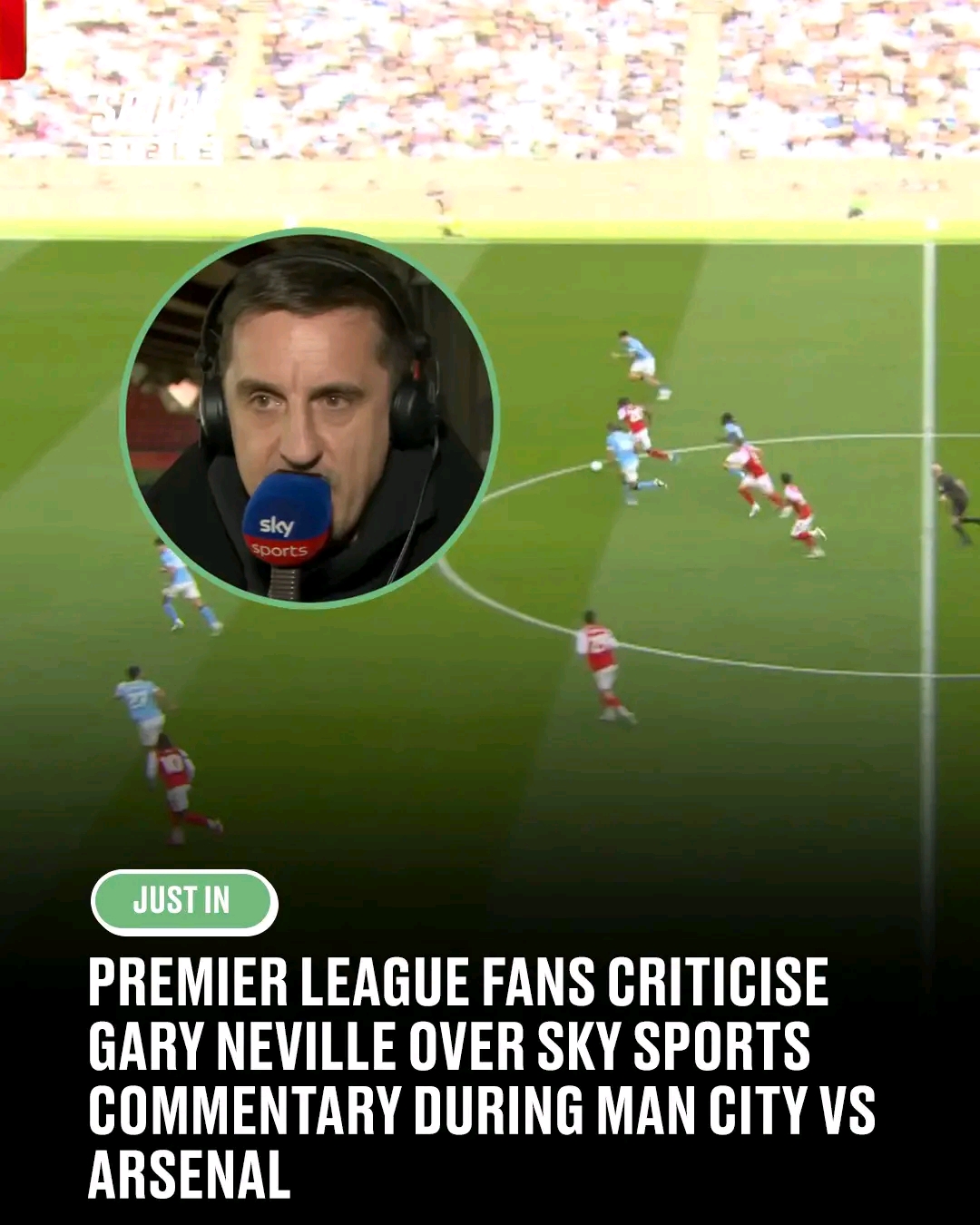
The atmosphere around the Etihad Stadium was already intense before kick-off, but what unfolded during Manchester City vs Arsenal was not just about goals, tactics, or title pressure. It also became a night where voices off the pitch—especially in the commentary box—sparked just as much debate as the action on the field.
At the centre of that debate was former England defender turned pundit Gary Neville, who was on co-commentary duty for Sky Sports alongside renowned commentator Peter Drury.
The match itself was everything fans expected and more. A high-stakes Premier League clash, widely described as a potential title decider, filled with intensity, emotion, mistakes, brilliance, and controversy. But while the players battled on the pitch, another battle was quietly taking place online—between fans and the voice describing the action.
From the very beginning, viewers noticed something unusual: strong reactions to Neville’s tone, his excitement, and his interpretation of key moments.
When Rayan Cherki opened the scoring with a brilliant solo goal for Manchester City, the commentary box reacted instantly. It was a moment of individual brilliance, the kind that lifts a stadium and shifts momentum. Neville, known for his emotional style of analysis, reacted with energy, describing the move with visible excitement.
But the reaction from fans watching at home was divided almost immediately.
Some felt his tone leaned too far in one direction. Others believed he was simply reacting naturally to a big moment in a massive game. But in the age of social media, every word spoken during a high-profile match is instantly dissected, replayed, and judged.
Things escalated further just minutes later.
Arsenal responded quickly. A mistake from Manchester City goalkeeper Gianluigi Donnarumma allowed Kai Havertz to pounce and equalise. The stadium erupted. The momentum shifted. And the commentary box followed suit.
Neville’s reaction was loud, immediate, and emotional.
A sharp, almost shocked “WOAHHHH” echoed through the broadcast as Havertz capitalised on the error. He followed it with praise for the moment, highlighting how quickly the game had changed.
“This is what we wanted… brilliance cancelled out,” he said, reacting to the shift in momentum.
For many neutral viewers, this was classic football commentary—reactive, emotional, and reflective of the chaos unfolding on the pitch. But for others, especially on social media, it became a talking point for a very different reason.
Within minutes, platforms like X (formerly Twitter) were flooded with reactions. And a pattern quickly emerged: accusations that Neville was not neutral enough in his commentary.
Some fans claimed he was leaning towards Arsenal. Others suggested he was emotionally invested in seeing them succeed in the title race. A few even questioned whether his analysis was influenced by personal opinions rather than professional neutrality.
One viewer wrote that Neville appeared to be “the worst and most biased commentator,” while another said they could “hear envy and contempt” in his voice during certain moments of the match.
Another comment went further, saying they could no longer tolerate listening to his analysis, suggesting frustration with his style of commentary rather than just disagreement with his opinions.
There were also harsher reactions, with some accusing him of openly wanting Arsenal to win the Premier League title. Others described his commentary as “desperate” or lacking balance.
One particularly critical fan argued that the commentary pairing of Neville and Drury was difficult to listen to, suggesting that Drury’s poetic style combined with Neville’s emotional analysis created an experience they found frustrating.
The criticism highlighted a wider issue in modern football broadcasting: the fine line between passion and perceived bias.
In today’s football environment, pundits are expected to provide insight, emotion, analysis, and neutrality all at once. But when emotions run high in matches like this—especially title-defining clashes—those expectations become harder to balance.
Neville, in particular, has long been known for his outspoken and emotional commentary style. As a former player who spent his entire career at Manchester United, his perspective is often shaped by deep knowledge of the Premier League’s intensity, rivalries, and pressure.
However, that same emotional style is also what divides opinion.
For some fans, it makes matches more engaging. It adds colour, excitement, and personality. For others, it crosses the line into bias, especially when big clubs like Arsenal and Manchester City are involved in title races.
This match was particularly sensitive because of what it represented.
Arsenal, led by Mikel Arteta, are chasing a long-awaited Premier League title, trying to overcome the dominance of Pep Guardiola and his Manchester City side. Every decision, every goal, every reaction feels magnified under that pressure.
So when a commentator reacts strongly to a goal, or shows visible emotion during key moments, it is interpreted differently depending on which side of the debate fans are on.
After Arsenal’s equaliser, the match continued at a frantic pace. Both teams created chances, both teams hit the post, and both teams felt they could win it. The tension was visible not just on the pitch, but in the tone of the broadcast itself.
Neville continued to analyse the game in real time, pointing out tactical shifts, mistakes, and momentum swings. But by this stage, the conversation online had already moved beyond football analysis and into commentary criticism.
It became less about what was happening in the match and more about how it was being described.
This is not new in modern football broadcasting.
Every major game now comes with a second screen of commentary: social media reactions, instant clips, and fan debates happening in real time. A single word, a tone of voice, or a moment of excitement can quickly turn into a trending topic.
And Neville, due to his high profile, often finds himself at the centre of that storm.
Despite the criticism, many viewers defended him. They argued that football commentary is meant to reflect emotion, especially in games of this magnitude. They pointed out that expecting total neutrality in a match filled with passion, controversy, and pressure is unrealistic.
Others said that the real issue was not bias, but perception—how fans interpret tone depending on which team they support.
A neutral fan might hear excitement. A frustrated supporter might hear bias.
Meanwhile, the match itself continued to deliver drama worthy of the debate surrounding it. Chances came and went. Defensive blocks saved goals. Tactical adjustments changed momentum. Every moment carried weight.
And yet, even as the final whistle approached, discussion around the commentary remained alive online.
This reflects a broader shift in football culture. Matches are no longer just 90 minutes on the pitch. They are multi-layered events involving analysis, opinion, reaction, and instant judgment from millions of viewers worldwide.
For broadcasters like Sky Sports, this creates a constant challenge: how to balance passionate storytelling with perceived neutrality in an era where every word is recorded, clipped, and debated.
For pundits like Gary Neville, it means operating under constant scrutiny, where even natural reactions to goals can be turned into controversy.
And for fans, it means that football is no longer just something to watch—it is something to analyse, debate, and react to in real time.
As Arsenal prepare for their next challenge against Newcastle United, and Manchester City continue their pursuit of the title in their remaining fixtures, one thing is clear.
The battle for the Premier League is not only being fought on the pitch.
It is also being fought in commentary boxes, on social media timelines, and in the opinions of millions watching every pass, every goal, and every reaction.
And in that world, even a single voice—like Gary Neville’s—can become as talked about as the match itself.