The tension inside the Etihad Stadium was already boiling long before the moment happened, the kind of tension that only comes when two teams fighting for the Premier League title collide, when every pass matters, every tackle feels personal, and every small incident can suddenly explode into something bigger. This was not just another game between Manchester City and Arsenal, this was a battle for control, a fight for dominance, and a test of mentality under the brightest pressure.
In the middle of all that chaos stood two powerful figures, Erling Haaland and Gabriel Magalhães, two players known not just for their ability, but also for their physical presence, their aggression, and their refusal to back down from any challenge. When players like that come face to face in a high-stakes match, something is always waiting to happen.
And it did happen.
The second half had already become heated, with challenges flying in, players arguing, and emotions rising with every minute. Arsenal were trying to hold onto their title dreams, while Manchester City were pushing hard, knowing that a win could completely change the direction of the season. Every duel felt like a mini battle, and when Gabriel and Haaland came together, it was like two storms crashing into each other.
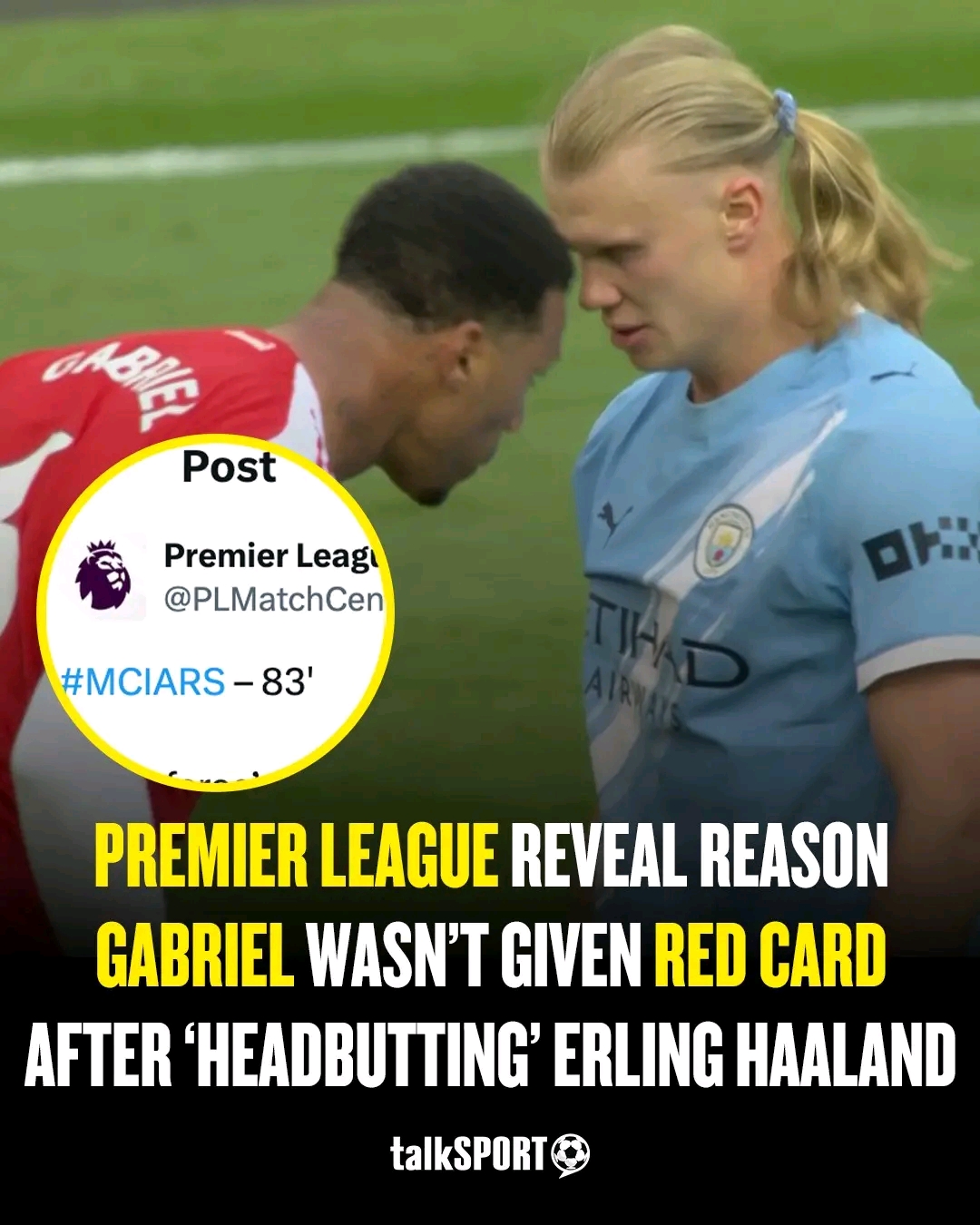
They stood face to face, neither willing to step back, neither willing to show weakness. Then came the moment that shocked everyone watching. Gabriel leaned forward and pushed his head into Haaland. It was not a full, violent strike, but it was clear enough to spark immediate reactions. Players rushed in, voices rose, and the stadium filled with noise as fans tried to understand what they had just seen.
For many watching, the decision seemed obvious. Head movement towards an opponent, especially in a heated moment, usually leads to a red card. It is one of the clearest rules in football, something players are taught from a young age. You simply do not raise your head into another player like that.
But the referee, Anthony Taylor, saw things differently.
Instead of reaching for a red card, he chose to show a yellow card to both players. It was a decision that immediately split opinion. Some players accepted it and moved on, but others were clearly surprised. Fans inside the stadium reacted loudly, and those watching around the world began to debate instantly.
The situation did not end there, because in modern football, every controversial moment goes through another layer of judgment. The Video Assistant Referee, often simply called VAR, stepped in to review what had happened. John Brooks was the official in charge of that review, and all eyes were now on him.
The key question was simple. Did Gabriel’s action count as violent conduct?
If the answer was yes, then a red card should have been given. If not, then the yellow card could stand.
After reviewing the footage, VAR decided not to overturn the referee’s decision. They judged that the action was not “excessively aggressive or violent.” That phrase would soon become one of the most talked-about parts of the match, repeated again and again as fans and experts tried to understand what it really meant.
The official explanation later confirmed it clearly. The referee’s original call was checked, and it was decided that there was no clear and obvious error. That meant the yellow card stayed, and Gabriel remained on the pitch.
But not everyone agreed with that decision.
Former players and pundits watching the game reacted strongly. Perry Groves was one of those who felt Gabriel had been lucky. He pointed out how Haaland did not react, did not fall to the ground, and did not try to exaggerate the contact. In his view, that may have played a role in the final decision.
It raised an interesting point about modern football. Sometimes, the reaction of a player can influence how serious an incident looks. If Haaland had fallen dramatically, would the referee have made a different call? It is a question many fans began asking immediately.
Groves believed Gabriel “got away with one,” suggesting that on another day, or with another referee, the outcome could have been very different.
Another strong voice came from Alan Pardew, who spoke from personal experience. He once faced heavy punishment for a similar incident earlier in his career, when he headbutted a player during a match. That moment led to a large fine and multiple bans, something that clearly stayed in his memory.
Pardew admitted that Gabriel had put his head in a place it should not have been. He understood the situation well because he had lived through the consequences himself. For him, the decision not to send Gabriel off felt surprising.
While the debate continued off the pitch, the game itself moved on quickly. That is the nature of football. Even the most controversial moments do not stop the clock. Players must refocus, teams must adjust, and the result still has to be decided.
Haaland, who had been at the center of the incident, stayed calm. He did not lose control, did not react angrily, and continued to focus on the game. That mental strength would soon prove important.
After the match, he shared his thoughts in a calm and honest way. He suggested that if he had fallen to the ground, maybe the outcome would have been different. But he made it clear that he does not believe in going down easily. He prefers to stay on his feet unless there is real contact.
It was a statement that many fans respected. In a time where players are often criticized for diving or exaggerating, Haaland’s approach felt refreshing. But at the same time, it also highlighted a strange reality of the game. Sometimes, staying honest might not always work in your favor when it comes to decisions.
Despite all the controversy, the final result of the match was what truly mattered. Manchester City managed to secure a huge 2-1 victory, with Haaland scoring the winning goal. It was a moment of power, precision, and perfect timing, showing exactly why he is one of the most feared strikers in the world.
That goal did more than just win the match. It sent a strong message in the title race.
Arsenal had come into the game knowing that a win would strengthen their position at the top. Instead, they left with defeat, and suddenly, the pressure increased. The gap between the two teams became tighter, and with Manchester City having a game in hand, the balance of power started to shift.
For Arsenal, it felt like a crushing blow. Not just because they lost, but because of how much was at stake. Every point matters at this stage of the season, and losing in such a big match can affect confidence as well as the table.
For Manchester City, it was a moment of belief. They showed once again that they know how to handle pressure, how to win important games, and how to stay calm even when things get heated.
The Gabriel incident remained a big talking point even after the final whistle. Fans continued to argue online, experts shared different opinions, and the debate showed no signs of slowing down.
Some believed the decision was correct, saying the contact was not strong enough to be considered violent. Others felt that the rules should be stricter, that any head movement towards an opponent should be punished more seriously.
It is one of those moments that shows how complex football decisions can be. The rules are written clearly, but their interpretation can change depending on the situation, the referee, and even the reaction of the players involved.
And that is what makes football so dramatic.
One small moment can change everything. One decision can create endless debate. One action can follow a player for weeks.
For Gabriel, it was a moment he will likely remember for a long time. Not just because of what he did, but because of what could have happened. A red card would have changed the entire game, leaving Arsenal with ten men in a crucial match.
Instead, he stayed on the pitch, but the team still lost. That is another painful reality of football. Sometimes, even when you avoid punishment, the result still does not go your way.
For Haaland, it was another chapter in his growing story. A player who not only scores goals but also stands strong in difficult moments. A player who refuses to fall, refuses to be distracted, and focuses on what matters most.
As the season continues, both teams will have more challenges ahead. Arsenal will need to recover quickly, to rebuild confidence, and to keep fighting for the title. Manchester City will look to build on this momentum, knowing that every win brings them closer to another trophy.
But this match, and especially this moment, will not be forgotten easily.
It will be discussed in studios, debated by fans, and remembered as one of those incidents that show just how intense football can be.
Because in the end, football is not just about goals and results.
It is about emotion, conflict, decisions, and moments that leave everyone talking long after the final whistle is gone.