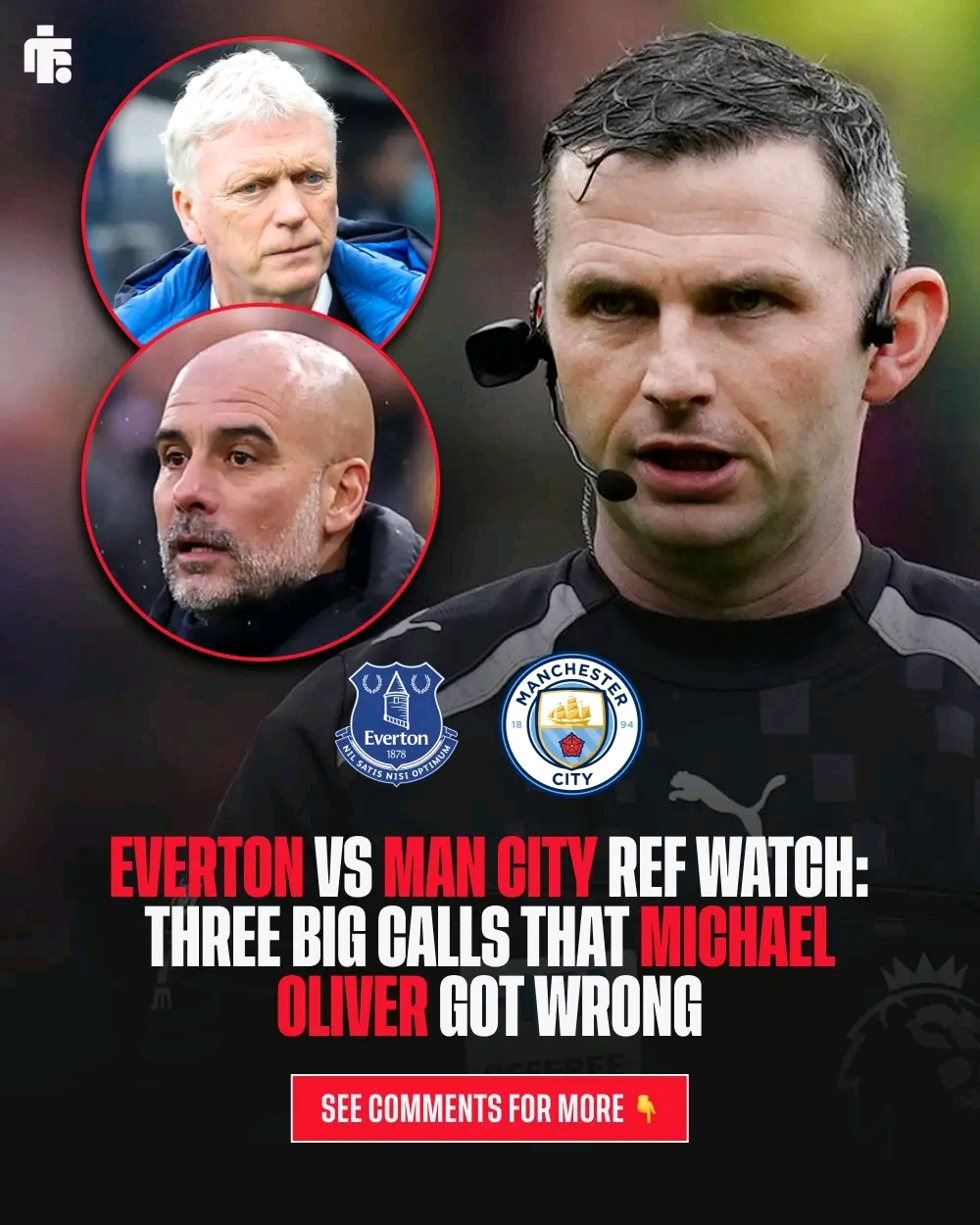
Michael Oliver got three major decisions wrong as Everton dealt a significant blow to Man City’s title chances – our correspondent takes a look at them in full detai

The night at Goodison Park did not feel like a normal football match. It felt like chaos, emotion, tension, and drama all mixed into one long, painful story that refused to settle until the very last second. When the final whistle finally came, the scoreboard read 3-3, but the real story was much deeper than just the numbers.
For Everton F.C., it felt like something had been stolen. For Manchester City F.C., it felt like survival. And standing right in the middle of it all was Michael Oliver, the referee whose decisions would become one of the biggest talking points after the game.
Because this was not just a match.
This was a night of controversy.
This was a night where every decision felt heavy.
This was a night where small moments turned into big arguments.
From the very beginning, the intensity was clear. Everton came into the game with belief, with energy, with a desire to finally change their poor record against Manchester City. Nineteen games without a win against City had created frustration, and this match felt like a chance to break that painful run.
On the other side, Pep Guardiola and his players knew exactly what was at stake. The title race was tight. Every point mattered. Every mistake could be costly. They could not afford to slip.
And yet, as the game unfolded, it became clear that control was not going to be easy.
Manchester City started the stronger side. They dominated possession, moving the ball with their usual calmness, stretching Everton, forcing them to chase shadows for long periods. The numbers told the story clearly. City had around 75 percent of the ball. They were constantly inside Everton’s half. They created pressure that slowly built like a storm.
But football is not always about control.
Sometimes it is about moments.
And Everton waited for theirs.
Before that, though, came the first moment of controversy. Just five minutes into the game, something small happened, but it set the tone for what was to come.
Rayan Cherki and Kiernan Dewsbury-Hall were battling near the touchline. It was nothing unusual. Just two players fighting for the ball, using their bodies, trying to gain position.
There was slight contact. Nothing serious. Nothing dangerous.
But suddenly, Cherki went down.
Not just down.
Dramatically down.
He fell in a way that immediately caught attention, as if the contact had been much stronger than it really was. And in that moment, Michael Oliver made his decision.
He blew the whistle.
Free-kick.
Everton players were not happy. David Moyes reacted immediately from the touchline, clearly frustrated. From his point of view, it was soft. Too soft. The kind of decision that can slowly build tension in a game.
And that is exactly what happened.
Because when players feel that decisions are going against them, even small ones, it stays in their minds. It changes how they react. It adds anger. It adds pressure.
The game continued, but that early moment did not disappear.
It stayed.
Then came the next big moment.
Just before half-time.
The game was still tight, still intense, still balanced in its own chaotic way. Manchester City were pushing, Everton were defending, and both sides were fighting for control.
Then Jeremy Doku got the ball near the wing.
He moved quickly, as he always does, trying to create space, trying to beat his defender. And then came the challenge.
Michael Keane charged in.
It was not a gentle challenge.
It was not controlled.
It was strong, aggressive, and dangerous.
Doku had already played the ball when Keane’s studs made contact. The impact sent the City winger crashing to the ground. For a moment, everything stopped. Players looked at the referee. Fans reacted loudly. The tension exploded.
Michael Oliver ran over.
He reached into his pocket.
Yellow card.
That was the decision.
VAR checked it.
And confirmed it.
But the debate started immediately.
Was it enough?
Many felt it was not.
Because when you look at the challenge again, when you slow it down, when you see the angle, it looks worse. It looks like something that could have caused serious injury. It looks like a moment where control was lost completely.
And in modern football, those moments are often punished with a red card.
But not this time.
Keane stayed on the pitch.
And that decision would not be forgotten.
Because later in the game, every action involving him carried that memory. Every challenge, every touch, every involvement reminded people that he could have been sent off.
Football is like that.
Moments connect.
Decisions build.
Nothing exists alone.
Then came the football itself.
And suddenly, everything changed.
Right before half-time, Manchester City found their breakthrough. Jeremy Doku, the same player who had been fouled earlier, produced something special. He cut inside, created space, and curled a beautiful shot into the net.
It was a moment of quality.
A moment that showed why City trust him.
A moment that gave them the lead.
At that point, it felt like the game was going in one direction.
City in control.
Everton struggling.
But football has a way of surprising everyone.
The second half started, and within just 13 minutes, everything turned upside down.
Thierno Barry stepped forward.
First goal.
Then another.
In between, Jake O’Brien rose high to score with a powerful header.
Suddenly, Everton were leading.
The stadium erupted.
The fans believed.
The players believed.
The impossible started to feel possible.
Manchester City looked shaken.
Their control disappeared.
Their confidence dropped.
And Everton pushed forward with energy, with passion, with determination.
But even in that chaos, controversy returned.
In the 80th minute, another moment added fuel to the fire.
Barry chased Doku down near the corner flag. It was a strong, determined run. He used his body well, applied pressure, and managed to take the ball.
It looked like good defending.
Strong, but fair.
But once again, the whistle blew.
Free-kick to Manchester City.
Michael Oliver judged that Barry had used too much force.
Everton players could not believe it.
From their perspective, it was just strength.
Just determination.
Just football.
Not a foul.
And at that stage of the game, with everything on the line, that kind of decision felt huge.
Because it stopped momentum.
It gave City relief.
It changed the flow.
And in matches like this, those small shifts can decide everything.
As the clock ticked on, Everton were still leading.
The dream was alive.
Breaking the long winless run.
Beating Manchester City.
Boosting their hopes.
Everything was within reach.
But then, the pressure returned.
City pushed forward again.
Relentless.
Focused.
Desperate.
And then, Erling Haaland scored.
The deficit was reduced.
The tension increased.
The clock kept moving.
But the game was not done.
Not even close.
Deep into stoppage time, when it felt like Everton might finally hold on, when the fans were already preparing to celebrate, it happened.
Jeremy Doku again.
Another strike.
Another moment of brilliance.
The ball flew into the net.
3-3.
Silence.
Shock.
Heartbreak.
For Everton, it felt like everything had been taken away in one second.
For Manchester City, it felt like a point saved from nowhere.
But after the final whistle, the focus quickly returned to the referee.
Because when a game has this much drama, this many moments, this many emotions, people look for explanations.
They look for decisions.
They look for mistakes.
And Michael Oliver’s performance became the centre of attention.
Three moments stood out.
The early foul given to Cherki.
The yellow card instead of red for Keane.
The soft free-kick against Barry.
Each one small on its own.
But together, they created a story.
A story of frustration.
A story of what could have been different.
Because football is not just about goals.
It is about decisions.
And decisions shape outcomes.
For Everton, the feeling was clear.
They believed some calls went against them.
They believed the game could have been different.
They believed they deserved more.
For Manchester City, the focus was different.
They saw resilience.
They saw a team that refused to give up.
They saw a point that could still matter in the title race.
And that is the beauty and pain of football.
Two teams.
One match.
Completely different emotions.
As for Michael Oliver, this was another reminder of how difficult refereeing can be.
Every decision is judged.
Every mistake is analysed.
Every moment is replayed again and again.
And in games like this, there is no hiding.
Because the spotlight is too bright.
The pressure is too high.
The expectations are too big.
In the end, the match will be remembered for many things.
The goals.
The comeback.
The late equaliser.
But also the controversy.
The arguments.
The decisions that left people talking long after the game ended.
And maybe that is what makes football so powerful.
Not just what happens.
But how it makes people feel.
On this night, at Goodison Park, it made people feel everything.
Joy.
Anger.
Hope.
Frustration.
And above all, it left one question that will not go away easily.
What if things had been called differently?