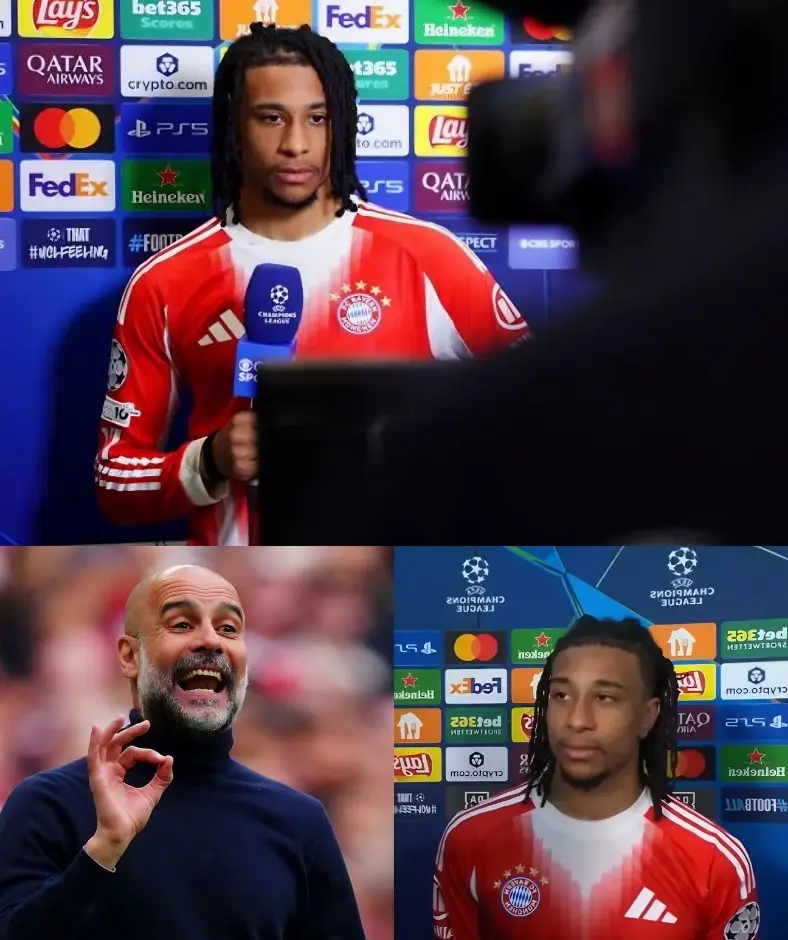
The message dropped suddenly, like a spark in a room already filled with tension.
At first, it looked like just another bold headline. The kind of statement football fans scroll past every day without thinking too deeply. But this one felt different. It carried weight. It carried attitude. And more importantly, it carried a clear message directed at one man.
Pep Guardiola.
Because in modern football, when a player makes a statement like that, it is never just noise. It is strategy. It is negotiation. It is power.
And when it involves Manchester City, everything becomes even more serious.
The situation quickly became one of the hottest talking points across football discussions. Fans began asking questions immediately. Who is the player? What is the wish? Why is he making such a demand publicly? And most importantly, will Pep agree?
Because one thing everyone knows about Guardiola is simple: he does not bend easily.
At Manchester City, there is a system. There is a philosophy. There is a structure built over years of dominance. Players do not just walk in and start making demands. Even the biggest stars have had to adapt, sacrifice, and sometimes even sit on the bench.
So for a player to come out and say, *“I will only join if Pep grants my wish,”* it immediately creates tension.
It becomes a battle of authority.
On one side, a player confident enough to set conditions before even signing.
On the other side, a manager known for total control over his squad.
And in the middle, a club chasing success on every front.
As the story spread, different reports began to paint a clearer picture. The unnamed player, believed to be a top-level talent, is not just interested in joining Manchester City for trophies or money. He wants something specific. Something personal. Something that could define his role in the team.
It could be guaranteed playing time.
It could be a specific position.
It could be tactical freedom.
Or even influence over how he is used in big matches.
Whatever the exact request is, one thing is certain: it is big enough to become a condition.
And that alone says everything about the confidence of the player involved.
In football today, players are no longer just signings. They are brands. They are decision-makers in their own careers. They choose not just clubs, but environments. Managers. Systems. Styles.
So when a player draws a line before joining, it shows he is not desperate.
He is choosing.
And that choice now rests heavily on Pep Guardiola.
For Guardiola, this kind of situation is delicate. On one hand, he always wants top talent. Manchester City’s success has been built on bringing in players who can elevate the team to another level.
But on the other hand, he cannot allow one player to disrupt the balance.
Because the moment one player gets special treatment, it sends a message to the rest of the squad.
And in a dressing room full of elite professionals, that message can be dangerous.
That is why Pep has made tough decisions in the past. Big players have been benched. Some have even been allowed to leave. Not because they lacked quality, but because they did not fit perfectly into the system.
That is the Guardiola way.
No player is bigger than the idea.
So now, the big question is simple: will he accept the condition?
If he says yes, it could mean the player is truly special. Someone worth adjusting for. Someone who could bring something unique to the team.
If he says no, it could mean the deal collapses completely.
And that is what makes this story so intense.
Because it is not just about a transfer.
It is about control.
Fans have already started taking sides. Some believe Pep should never agree to such demands. They argue that Manchester City is already a winning machine, and no single player should come in and start setting rules.
Others believe football is evolving. They say top players deserve clarity before joining. They want to know their role, their importance, and how they will be used.
And honestly, both sides have valid points.
Because modern football is a balance between structure and individuality.
Too much control can limit creativity.
Too much freedom can destroy discipline.
The challenge for Guardiola is finding the perfect middle ground.
Behind the scenes, negotiations are likely intense. Agents, club officials, and representatives are all involved. Every word matters. Every condition is being discussed carefully.
Because one wrong move could change everything.
If the deal goes through, it could reshape Manchester City’s squad.
If it fails, it could send the player in a completely different direction, possibly to a rival club.
And that is where things get even more interesting.
Because when a top player publicly sets conditions and a club refuses, other clubs start watching closely. They see opportunity. They see a chance to step in and say, *“We will give you what you want.”*
And suddenly, the entire transfer landscape shifts.
For Manchester City fans, this situation creates both excitement and concern.
Excitement because a big-name player is clearly interested in joining.
Concern because the condition attached could disrupt the harmony that has made the team so successful.
And for neutral fans, it is simply entertainment.
Because stories like this are what make football more than just a game.
It becomes drama.
It becomes emotion.
It becomes a battle of personalities.
As the hours pass and more details slowly emerge, one thing remains clear.
This is not a normal transfer story.
This is a test.
A test of Guardiola’s authority.
A test of the player’s ambition.
And a test of Manchester City’s identity.
Will they stay true to their structure?
Or will they adapt for a player who believes he deserves special consideration?
Only time will tell.
But one thing is certain.
When a player says, *“I will only join if Pep grants my wish,”* it is no longer just about football.
It becomes personal.
It becomes psychological.
And it becomes one of those stories that everyone will be watching closely until the very end.
Because in football, moments like this often define more than just transfers.
They define eras.
They define relationships.
And sometimes, they define legacies.