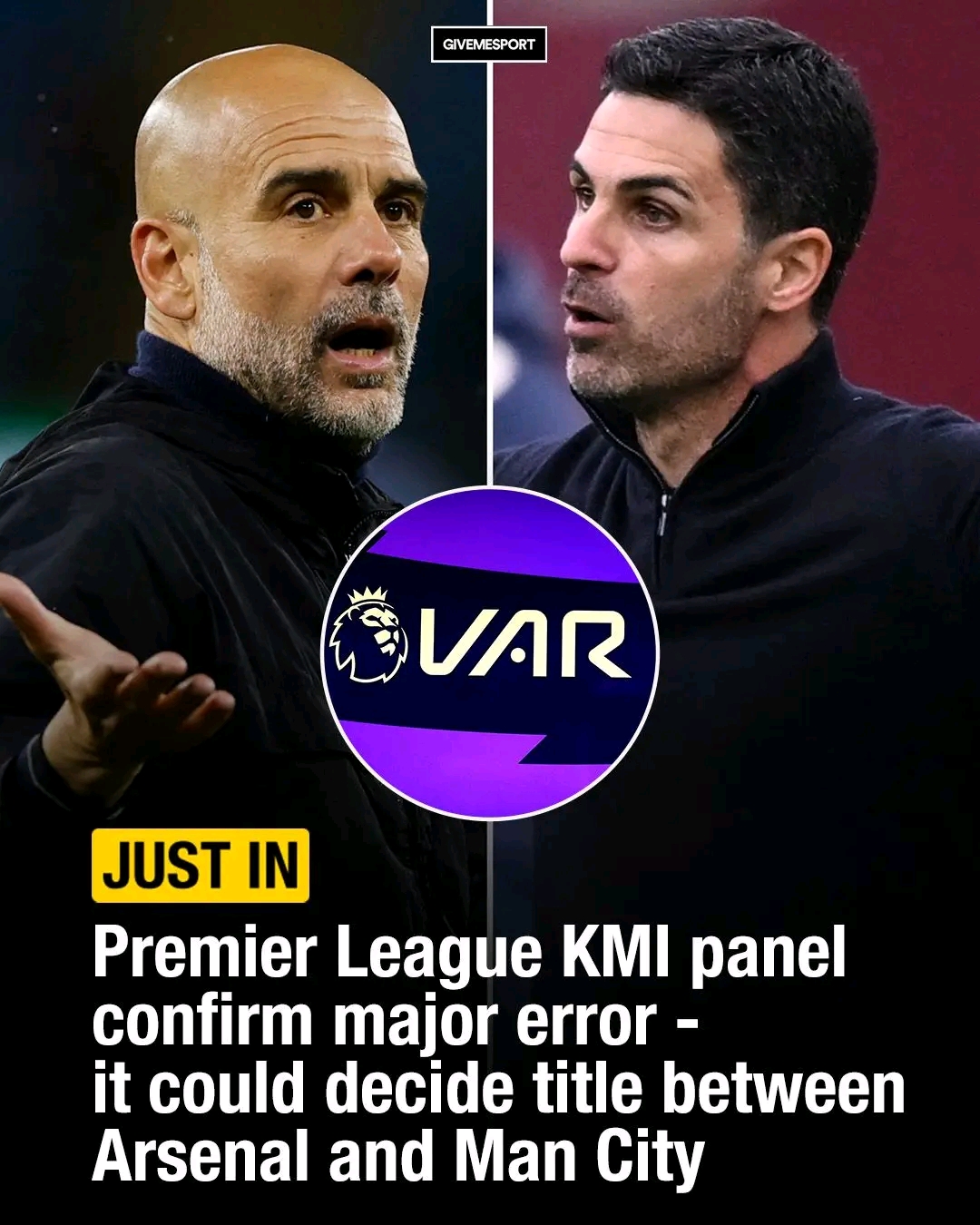
The Premier League title race has reached a level of tension that feels almost impossible to control, with every pass, every VAR decision, and every late goal now carrying the weight of an entire season. With just two matches left for most clubs, the margin between glory and heartbreak is razor thin, and both Arsenal and Manchester City are locked in a battle that could be decided by the smallest detail imaginable.
Arsenal currently sit at the top of the table, holding a narrow two-point advantage, but the pressure behind them is relentless. Manchester City, under Pep Guardiola, are once again pushing for the finish line with their usual calm dominance and experience in title races. Every fixture now feels like a final, and every incident is being analysed like it could define history.
Arsenal’s remaining fixtures see them hosting Burnley before travelling to Crystal Palace on the final day, while Manchester City face Bournemouth away and then return to the Etihad Stadium for a decisive clash against Aston Villa. On paper, both sides still control their fate, but the reality is far more complicated because of goal difference, momentum, and now controversial refereeing decisions.
Much of the current debate has been shaped by a recent incident involving VAR that has now become one of the most talked-about moments of the season. Arsenal’s controversial win over West Ham United sparked outrage when a late equaliser for West Ham was ruled out after a VAR review, with many fans still debating whether the decision was correct.
But according to a new confirmation from the Premier League Key Match Incidents (KMI) panel, another error—less discussed but potentially more important—may end up deciding the title race entirely.
This incident came during Manchester City’s dramatic 3-3 draw with Everton, a match that already felt like a turning point in the season even before the latest revelation. The game swung wildly, with Everton leading 3-1 at one stage before City mounted a late comeback. Goals from Erling Haaland and Jeremy Doku in stoppage time rescued a point for City, but what happened before that comeback is now under intense scrutiny.
At the centre of the controversy is a corner situation involving Bernardo Silva and Everton midfielder Merlin Rohl. During that moment, Silva was seen holding Rohl inside the penalty area in what appeared to be sustained contact. The referee, Michael Oliver, did not spot the incident, and VAR official Paul Howard chose not to intervene, judging that the holding began before the corner was taken and therefore fell outside the scope of VAR review.
However, the KMI panel has now confirmed that this interpretation was incorrect. All five members of the panel agreed that a penalty should have been awarded to Everton, stating clearly that there was “a clear, sustained holding offence which continues as the corner is taken and the ball comes into play.”
This statement has reopened a massive debate about consistency in VAR decisions and whether critical errors are being made at the worst possible moments in the season.
Everton manager David Moyes reacted strongly after the match, expressing frustration at what he saw as a clear missed penalty. His comments reflected a growing concern among managers that refereeing consistency is becoming increasingly unpredictable in high-pressure matches.
“If that doesn’t get given as a penalty, then it’s an absolute free-for-all from now on,” Moyes said after the game, clearly frustrated by the decision that went against his team.
Interestingly, the panel’s ruling now supports his argument, confirming that Everton were indeed denied a penalty that should have been awarded. And that single moment may now carry consequences far beyond just one match.
Because in a title race this tight, every point matters.
The Premier League table at this stage is so close that even a single missed decision can reshape the entire outcome. If Arsenal finish their final two matches with a win and a draw, they would end the season on 83 points. Manchester City, if they win both of their remaining fixtures, would also reach 83 points.
In that scenario, the title would likely be decided by goal difference. City currently hold a slight advantage in that department, and with their attacking power, they are expected to extend that margin further if they win both games.
But the key twist lies in that Everton match. If the penalty had been awarded and converted, Everton would likely have won the game. That would have meant Manchester City dropping two points instead of gaining one from their dramatic late comeback. In such a tight title race, that difference could be decisive.
Suddenly, Jeremy Doku’s stoppage-time equaliser looks far more significant than just a dramatic moment. It could be one of the defining goals of the entire season, not just for City’s campaign but for the balance of the Premier League title race.
This is where football becomes brutal. One decision in one match, in one moment, can echo across an entire season and influence who lifts the trophy.
Adding another layer to the controversy is Bernardo Silva himself, who was involved in the incident. Ironically, Silva had recently spoken publicly about concerns over how set-pieces are being officiated in modern football.
He suggested that corners and throw-ins have become overly physical, comparing the current style of defending in the box to rugby rather than football. His comments highlighted how players themselves feel the game is changing in terms of physical contact and refereeing tolerance.
In his remarks, Silva explained that holding and grappling during set-pieces has become increasingly common, and that referees have been inconsistent in punishing it. He also admitted that Manchester City had adapted to this environment because other teams were doing the same.
However, the irony is difficult to ignore. In the very match now under scrutiny, Silva was the player accused of committing the exact type of holding offence he had recently criticised.
This contradiction has added even more fuel to the debate, with fans and analysts questioning whether players and officials are operating under the same understanding of what is allowed in modern football.
Meanwhile, Manchester City’s position remains strong but not untouchable. Their experience in title races under Guardiola is unmatched in recent years, and they are used to handling pressure in the final weeks of the season. But Arsenal’s consistency has made this one of the closest finishes in recent memory.
For Arsenal, the pressure is different. They are trying to end a long wait for a Premier League title, and every match now carries emotional weight. Every decision, every goal, every missed chance feels magnified.
For City, the expectation is almost routine. They have been here before, they have won under pressure before, and they know how to close out seasons. But even for them, margins like this are dangerous.
Because when titles are decided by goal difference or a single point, every incident matters.
This is why the KMI panel’s confirmation has created such a strong reaction. It is not just about one mistake. It is about what that mistake means in the bigger picture of a title race that is still alive going into the final days of the season.
Fans are now looking back at every key moment of the season, wondering what might have been different if certain decisions had gone the other way. That is the nature of tight title races—they turn small moments into massive what-ifs.
As the final matches approach, Arsenal and Manchester City will continue their battle knowing that their fate may already have been influenced by events that cannot be changed.
All that remains now is performance.
Win the remaining games, score the goals, avoid the mistakes, and hope that history does not look back on a single VAR decision as the moment that decided everything.
Because in seasons like this, football is not just played on the pitch.
It is decided in moments that last only seconds—but echo forever.