The Etihad Stadium was supposed to be a place of celebration. Manchester City fans arrived wearing old shirts, holding banners, and singing the name of the man who changed everything for the club. After ten unforgettable years, this was the final game of Pep Guardiola’s incredible journey at Manchester City. It was meant to be a farewell party filled with joy, tears, and one last victory. Instead, it ended in heartbreak, frustration, and another painful debate about VAR.
The match against Aston Villa was already emotional before the first whistle. Supporters knew they were saying goodbye to one of the greatest managers football has ever seen. Guardiola had transformed Manchester City into a football machine. He brought trophies, unforgettable nights, beautiful football, and created legends at the club. The atmosphere inside the Etihad was electric. Fans wanted one final magical moment.
But football can sometimes be cruel.
Aston Villa arrived in Manchester with no interest in becoming part of Guardiola’s goodbye celebration. They came to win, and from the opening minutes they showed they were ready to spoil the party. The visitors played with aggression, energy, and belief. Manchester City looked nervous. There was emotion everywhere, and sometimes emotion can damage concentration.
The first shock arrived early. Antoine Semenyo stunned the Etihad by scoring the opening goal for Aston Villa. The stadium suddenly went quiet. City fans could hardly believe what they were watching. Guardiola stood on the touchline looking frustrated, waving his arms as his players struggled to control the game.
Despite the difficult start, there was still confidence among the supporters. Manchester City had come back from impossible situations many times under Guardiola. Fans believed there would be one final twist in the story. They expected heroes to rise again.
Phil Foden was one of the players trying hardest to make something happen. The England international carried the ball forward repeatedly, searching for openings and trying to lift the energy of the team. It has been a strange season for Foden. At times he looked unstoppable, reminding everyone why he is considered one of the most gifted players in Europe. At other moments he struggled for consistency and confidence.
This match felt personal for him.
With Guardiola leaving and several senior players preparing to move on, many supporters believe the next era of Manchester City football belongs to Foden. He is one of their own. A local boy who came through the academy. Fans wanted him to deliver a memorable moment on this emotional day.
But Aston Villa continued to punish City’s mistakes.
Ollie Watkins produced a brilliant performance and scored twice to completely change the mood inside the stadium. Every Villa attack looked dangerous. Manchester City’s defence appeared nervous and uncertain. The crowd became quieter as frustration grew. Guardiola looked emotional on the touchline, perhaps realizing his final afternoon in Manchester was slipping away from him.
Still, City kept fighting.
The final minutes turned into chaos as Manchester City pushed everyone forward searching for a miracle. The Etihad crowd desperately tried to inspire the players one last time. Every attack felt important. Every cross into the box created tension.
Then came the moment that should have changed everything.
In the 90th minute, Phil Foden finally found the back of the net. The stadium exploded. Fans jumped from their seats. Guardiola celebrated wildly on the touchline. Players ran toward Foden. For a few beautiful seconds, it felt like football had written the perfect script.
The local hero had rescued Manchester City on Guardiola’s farewell day.
But modern football always has another chapter.
The referee suddenly paused the celebrations. VAR was checking the goal for offside. Immediately the excitement inside the stadium turned into nervous silence. Players waited anxiously. Fans stared at the giant screens. Guardiola looked confused and frustrated.
Then the decision arrived.
No goal.
Offside.
The celebrations disappeared instantly. Aston Villa players celebrated the decision like they had scored another goal themselves. Manchester City supporters could not believe it. Foden stood there in disbelief as replays appeared on screens around the stadium.
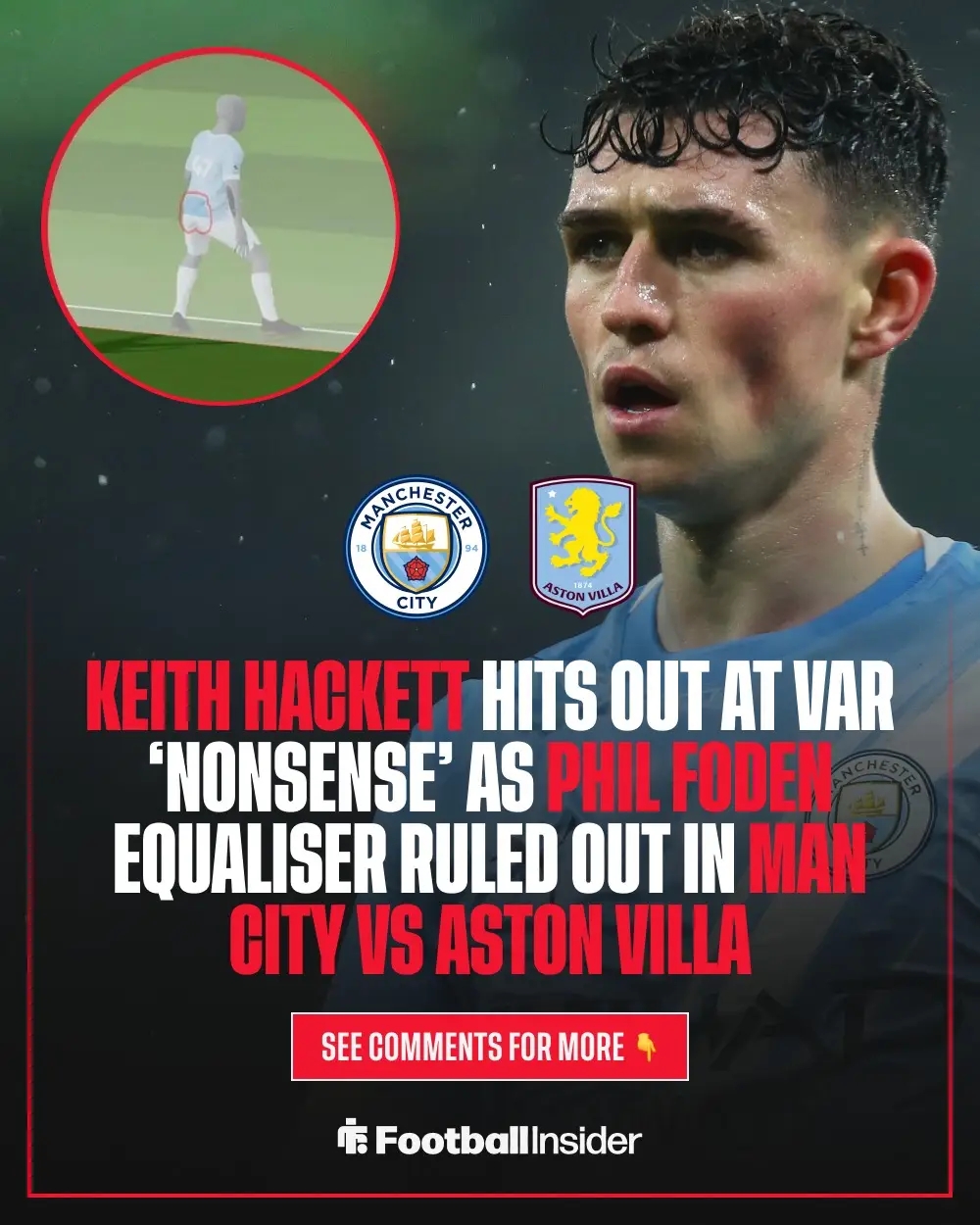
The images showed an incredibly tight decision. According to the semi-automated offside technology, a small part of Foden’s body was beyond the defensive line. The margins were tiny. Many fans watching inside the stadium and at home struggled to even understand how the goal had been disallowed.
That moment completely changed the atmosphere.
Instead of talking about a dramatic late equaliser, everyone was suddenly discussing VAR once again. Supporters booed loudly. Social media exploded immediately. Former referees, pundits, and football fans everywhere started debating whether the system was ruining the game.
One of the strongest opinions came from former PGMOL chief and ex-FIFA referee Keith Hackett. Speaking after the match, Hackett did not hide his frustration with the current semi-automated offside system being used in the Premier League.
Hackett believes the technology still has serious problems.
According to him, the current system does not provide the same level of speed and accuracy that fans expect. He argued that football needs a cleaner and more reliable version of offside technology, one that removes as much human involvement as possible.
His comments quickly attracted attention across English football.
Hackett explained that he believes the Premier League system is still behind the technology expected to be used during the upcoming World Cup. In his opinion, fans, managers, and players deserve a process they can trust completely.
He compared the situation to goal-line technology.
When goal-line technology was introduced, there was immediate clarity. The ball either crossed the line or it did not. Decisions became simple and fast. Hackett wants offside decisions to reach that same level of confidence and simplicity.
Instead, he believes football currently finds itself trapped in endless arguments over tiny body parts and impossible margins.
For many supporters, the images from Foden’s disallowed goal represented everything they dislike about modern VAR. The attacker was facing away from goal. His advantage appeared almost invisible. Fans asked the same question repeatedly: how can football punish attacking players for something so small?
Hackett even described parts of the current system as “nonsense,” a word that perfectly captured the frustration many supporters felt after the game.
The debate around VAR has become one of the biggest talking points in football over recent years. Some believe technology has improved fairness. Others argue it has damaged the emotional heart of the game.
This moment at the Etihad became another example for both sides of the argument.
Supporters defending VAR pointed out that the laws are clear. Offside is offside, no matter how small the margin. Technology exists to make accurate decisions, not emotional ones. According to that view, Foden was beyond the line, meaning the goal had to be disallowed.
But critics argued football was never meant to be decided by microscopic measurements.
Many former players have repeatedly said that attacking football is being punished too harshly. Fans do not want goals cancelled because of a player’s backside or shoulder being inches ahead. They believe common sense should still exist inside the game.
The emotional context of the moment made the situation even more painful for Manchester City supporters.
This was Guardiola’s final match. The fans wanted one last memory to celebrate. Foden’s goal felt like destiny. The stadium erupted with pure emotion before technology took everything away seconds later.
That emotional damage is one of the biggest complaints about VAR. Supporters no longer celebrate goals with complete freedom because they fear the decision may change moments later. Football celebrations used to be instant and natural. Now many fans wait nervously before fully reacting.
At the Etihad, that reality was impossible to ignore.
For Phil Foden personally, the moment was especially cruel. He had worked tirelessly throughout the match trying to inspire his team. Statistically, his performance showed mixed results. He played the full ninety minutes, had sixty-one touches, and created three chances. He attempted dribbles and tried to force openings despite Aston Villa’s defensive pressure.
Yet the game will mainly be remembered for the goal that never counted.
Foden’s season overall has also been complicated. Earlier in the campaign he looked unstoppable, producing goals and assists regularly. By the end of the season he finished with thirteen goals and eight assists in fifty-four appearances, respectable numbers for any attacking midfielder.
However, many supporters expected even more from him.
During the second half of the season his performances became less consistent. Confidence appeared to drop. There were matches where he looked frustrated and uncertain. Some critics questioned whether he could truly become the main superstar of the next Manchester City era.
Despite those doubts, the club clearly still believes in him.
Any speculation about a transfer away from Manchester was quickly ended when Foden signed a new contract at the Etihad Stadium. Manchester City see him as one of the key faces of the future. With Guardiola leaving and several experienced players preparing to depart, the responsibility on Foden’s shoulders will become even bigger next season.
Bernardo Silva is expected to leave alongside Guardiola this summer. That creates a huge gap in creativity and leadership inside the squad. Players like Foden must now step forward and become central figures in the team.
The talent has never been in doubt.
Foden possesses incredible technical ability. He can dribble in tight spaces, score goals from distance, create chances, and change matches with moments of brilliance. When confident, he is one of the most dangerous attacking players in the Premier League.
But confidence is everything at the highest level.
Moments like the disallowed goal against Aston Villa can either damage a player mentally or motivate them even more. Many Manchester City supporters hope this painful experience becomes fuel for Foden rather than another disappointment.
There is also the question of how Manchester City will evolve after Guardiola’s departure.
For ten years, Guardiola controlled almost every detail of the club’s football identity. His style defined Manchester City. Possession football, tactical intelligence, pressing, movement, and relentless standards became normal under his leadership.
Replacing him will be one of the biggest challenges in the club’s history.
Every player will face uncertainty during this transition period. Some may struggle without Guardiola’s guidance. Others could thrive under fresh ideas. For Foden, the next manager could completely shape the next chapter of his career.
Fortunately for him, his versatility makes him extremely valuable. He can play as a winger, attacking midfielder, central midfielder, or even deeper when necessary. Any new coach arriving at Manchester City will likely build major parts of the team around his qualities.
Still, the pressure will be enormous.
Being the local academy graduate carries special expectations. Fans see Foden differently because he represents the city itself. They want him to become the symbol of Manchester City’s future just as players like David Silva, Kevin De Bruyne, and Sergio Aguero symbolized previous eras.
Moments like the Aston Villa game only increase the spotlight on him.
The wider football world also continues debating whether the laws of offside themselves need to change. Some experts have suggested giving attackers more advantage. Others propose thicker lines or daylight rules that would reduce controversial decisions.
Hackett’s comments about artificial intelligence and advanced camera technology show how quickly football is moving toward even greater technological involvement.
He believes future systems could remove humans almost completely from the process. Cameras, AI, and software could potentially make decisions instantly without delays. In theory, that would reduce controversy.
But many fans fear the opposite.
Supporters worry football could become too robotic. The game has always been emotional, chaotic, and imperfect. Some believe those imperfections are part of what makes football beautiful. They fear endless technology could slowly remove the human feeling from the sport.
The scene at the Etihad captured that conflict perfectly.
On one side was pure emotion: Guardiola’s farewell, Foden’s dramatic late goal, and the eruption of joy inside the stadium. On the other side was cold technology measuring tiny distances and cancelling the moment.
Football is still trying to find balance between those two worlds.
For Aston Villa, however, the controversy mattered far less. They left Manchester with a massive victory and a memorable performance. Ollie Watkins was outstanding, leading the attack brilliantly and punishing City’s defensive mistakes.
Villa showed courage throughout the match. They refused to become spectators in Guardiola’s goodbye story. Instead, they created their own headlines.
Their victory also highlighted some growing concerns around Manchester City.
This season has not felt as dominant as previous years. Injuries, fatigue, emotional pressure, and uncertainty around Guardiola’s future all seemed to affect the squad. There were still moments of brilliance, but the unstoppable aura around City occasionally disappeared.
That makes the upcoming summer extremely important.
New leadership, tactical adjustments, and squad changes are all expected. Some legendary players may leave. Younger stars like Foden must now carry greater responsibility.
Supporters know a new era is beginning.
As fans slowly left the Etihad after the Aston Villa defeat, emotions were mixed. There was sadness about Guardiola leaving. Anger over the VAR decision. Concern about the future. But also gratitude for everything they experienced during the last decade.
Few managers in football history have transformed a club the way Guardiola transformed Manchester City.
The trophies alone are extraordinary, but his influence went beyond silverware. He changed expectations. He changed mentality. He made Manchester City one of the most feared teams in world football.
That is why the ending felt so strange.
Football stories rarely follow perfect scripts. Instead of a triumphant goodbye victory, Guardiola’s final afternoon became another example of modern football controversy.
And at the centre of it all stood Phil Foden.
A player desperate to give his manager and supporters one final magical memory. A player whose goal briefly created euphoria before technology crushed the moment. A player who now enters the biggest chapter of his career as Manchester City prepare for life after Guardiola.
The pain of that Aston Villa match will stay with fans for a long time.
Not just because City lost.
Not just because Guardiola’s farewell ended badly.
But because for one beautiful moment, everyone inside the Etihad believed football had delivered the perfect ending. Then VAR arrived and reminded everyone how cruel modern football can sometimes be.
Still, the future remains bright for Phil Foden.
At twenty-six years old, he still has many years ahead of him. He has already won major trophies, represented England on the biggest stages, and become one of the most recognizable players in the Premier League. Difficult periods happen to every elite footballer.
What matters now is how he responds.
Manchester City supporters will expect him to return stronger next season. They will expect leadership, consistency, and big performances in important matches. With Guardiola gone and experienced stars leaving, there is no hiding place anymore.
This team will need new leaders.
Foden has the talent to become one.
The disappointment against Aston Villa may actually become an important turning point in his career. Great players often use painful moments as motivation. The frustration of seeing that goal ruled out could push him toward even higher levels.
For now though, the debate around VAR continues louder than ever.
Every controversial decision adds more pressure on football authorities. Fans want clarity. Players want consistency. Managers want fairness. Referees want support. Yet nobody seems fully satisfied with the current system.
Keith Hackett’s criticism reflects growing frustration inside football itself. When former referees openly question the technology, it shows how complicated the situation has become.
The Premier League will almost certainly continue reviewing and improving the system in coming years. Whether that eventually removes controversy completely remains unlikely. Football arguments have existed forever and probably always will.
But moments like Foden’s disallowed goal prove the emotional cost of these decisions remains enormous.
The image of the Etihad celebrating wildly before suddenly falling silent perfectly captured the modern football experience.
Joy.
Confusion.
Anger.
Disbelief.
All within seconds.
And somewhere in the middle of that chaos stood Phil Foden, watching one of the most important goals of his season disappear because of the smallest possible margin.
That single moment told the story of Manchester City’s painful afternoon better than anything else ever could.