Rangers’ Lawrence Shankland says hamstring recovery going in ‘right direction’

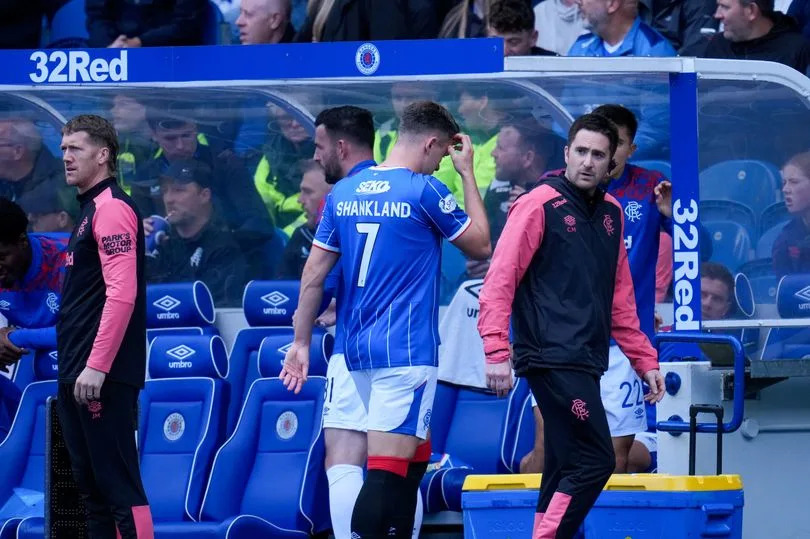
Rangers supporters have spent a few anxious weeks watching the treatment table fill up, and on Wednesday they finally got some good news. Lawrence Shankland is off his crutches following hamstring surgery and says his recovery is going in a positive direction. The captain was speaking publicly for the first time since going under the knife, and the picture he painted was calm and measured. He was not promising a miracle return or dropping any dates he could not keep. He was simply telling the Ibrox faithful that the healing is on track, that the specialist is satisfied, and that the long road back has begun. For a club that has lost two of its main attacking options in a matter of weeks, that kind of steady reassurance matters more than any headline-grabbing prediction.
The update came at the club’s training ground, where Shankland was promoting the Rangers Youth Development Company’s Rangers Lotto product and took the chance to bring everybody up to speed on how he is getting on. He explained that he got off the crutches this week, that it has been four weeks since the operation, and that things look good. He had also been back to see the specialist for feedback, and the verdict was that everything is moving the way it should. In his own words, the hamstring is healing well after the surgery. It is not the most dramatic sentence a footballer has ever delivered, but anyone who has followed a long-term injury knows that “boring” is exactly what you want to hear. No setbacks, no complications, no unexpected scans. Just a body doing what the surgeon hoped it would do.
To understand why this update lands the way it does, you have to go back to Saturday 5 September at Ibrox. Rangers were playing Motherwell, and by that stage Shankland was arguably in the best form of his short time in light blue. He had scored a winner at Pittodrie against Aberdeen and then notched a double against Falkirk in a 2-1 win later that week. The captain had in effect carried Rangers through the first stretch of the Derek McInnes era. He had scored Rangers’ previous three goals to secure their first two Premiership wins under McInnes, so there was a real sense that the striker and the manager, who knew each other well from their time together at Hearts, were starting to click at their new home. Then, within minutes of kick-off against Motherwell, everything changed. Shankland pulled up, clutching the back of his leg, and the Ibrox crowd knew immediately that this was not a precaution. Reports differ on the exact minute he went off, but all agree it was very early, and Ryan Naderi was sent on in his place
The game itself ended happily enough. Naderi struck the winner in a 1-0 victory, which kept the new manager’s unbeaten start to the league campaign alive and gave Rangers a third straight league win. But the mood around the stadium afterwards was sombre, and McInnes did not try to dress it up. The manager admitted that Shankland had reported a feeling in the hamstring similar to the one he suffered at Hearts the previous January, and that sort of comparison is never what a manager wants to say out loud. McInnes even suggested that there was some logic in the decision not to bring the captain on for more than a few minutes in the first place, because if a striker feels stiff and tight, the last thing you want to do is risk making a bad situation worse. It was a candid, slightly weary assessment from a manager who could already see what the next few months might look like.
The scan on the Monday confirmed the worst fears. McInnes revealed that the striker had suffered a 2c tear, similar to the one he sustained previously at Hearts in January. That grading is at the more serious end of the hamstring injury scale, and it brought with it a significant timeline. The manager said the best case was around three months and the worst case about four. There was also the question of surgery. McInnes explained that an operation would lessen the risk of the injury recurring, but it would likely add a few extra weeks to the recovery period. Rangers were effectively being asked to weigh up short-term pain against long-term security, and with a player who had already suffered this kind of injury once in the past year, the long-term view carried a lot of weight.
That “similar to Hearts” comparison deserves a closer look, because it explains much of the concern that surrounded the diagnosis. Shankland missed a spell in the second half of last season with a hamstring injury, picked up in a match against Falkirk on 17 January and returning in a Dundee fixture on 21 March. Different reports have described that earlier absence as lasting between two and three months, but the basic point is the same: this was a long layoff, and it happened to a player who had been in the form of his life in the capital. To suffer what felt like the same injury in the same area barely a year later was a cruel twist. McInnes even speculated, in the aftermath, about the physical demands placed on the striker during the previous week. He pointed out that Shankland’s output had been very high on the 4G surface at Falkirk, and that going from one type of pitch to another can leave a player a little more vulnerable. It was a thoughtful observation rather than a blame game, but it highlighted just how fine the margins are for modern strikers.
When the surgeon’s verdict arrived, Shankland has said the decision was effectively made for him. He told reporters that he never really had much of a choice, because the surgeon told him straight away it would need an operation to fix it, and a follow-up scan confirmed it. There is something almost reassuring about that. A player facing a major call about his own body can spend weeks agonising over second opinions and risk assessments. Shankland has said that having the matter made clear by the specialist actually made things easier. He was also able to draw on his own experience. He has previously said he was comfortable going into the procedure because of what he went through last year, although he conceded that this time the injury was a bit worse. That is a very honest piece of self-assessment from a man who is not going to talk down the severity of what he has been through.
So when can Rangers expect to see him back? That is the question every fan is asking, and Shankland is wisely refusing to be pinned down. He has said it is hard to put a timeline on a recovery like this, and that the real picture will only start to become clear somewhere around the three-month to four-month point after the injury. He also said he hopes to be back as quickly as possible, and that if he returns around January there will still be plenty of football left to be played. That last point is an important one. The Scottish Premiership season is long, and a striker who is back around the turn of the year still has a huge chunk of the campaign ahead of him, including the run-in, the stretch where titles and European places are decided. Shankland has made clear that he wants to be playing well before that final push. He also stressed that the decision will not be rushed, with the physios guiding the process and his own comfort levels playing a big part in when he steps back onto the pitch.
Outside voices have been trying to read between the lines as well. Rangers News published an exclusive in which a doctor, Dr Brar, analysed the injury and the captain’s comments. His view was that it is still too early to state an exact date for a return to individual training, but that on the basis of what Shankland has said, he could be looking at early to mid-November to at least be back on the grass. It is worth being clear that this is an outside estimate from someone who is not part of the club’s medical team, and it should be treated as informed speculation rather than a confirmed schedule. Still, it gives fans something to hold on to. Getting back on the grass is the first visible step of any rehabilitation, and the point at which a player stops being a patient and starts to feel like a footballer again.
It is also worth remembering just how well Shankland had started his Rangers career. He arrived from Hearts in the summer, a move that raised eyebrows across Scottish football given the Tynecastle connection, and he was handed the captain’s armband almost immediately. He has scored four goals in ten appearances for Rangers, a return that is respectable for any striker finding his feet in a new environment, and it came with the added burden of leading a rebuilt squad. The goals had also arrived at the right time. Rangers were still bedding in a new manager and a raft of new signings, and having a proven finisher who could deliver in tight games was a huge comfort. Shankland’s goals against Aberdeen and Falkirk were not just statistically useful; they gave a new-look team belief that it could win ugly when it needed to.
His absence has been felt all the more because it came on top of another blow in attack. Rangers were already without Youssef Chermiti, who suffered an ACL injury, leaving McInnes without his two top scorers. Chermiti’s injury was the reason the club spent around £9 million on Venezuelan international Kevin Kelsy from Portland Timbers. Kelsy arrived on deadline day and was handed a debut against Motherwell, which means he has been asked to learn the club, the league and the expectations of Ibrox while the main striker’s position was suddenly vacant. That is a lot to put on any new signing. It also means that for the first time under the new regime, the squad’s depth up front is being properly tested. Alongside Kelsy, the manager has Ryan Naderi, who scored the winner against Motherwell after replacing Shankland, and Bojan Miovski, who has struggled for game time but now has a clear route to a bigger role.
The numbers show why replacing Shankland is such a challenge. Naderi’s average for Rangers last season was a goal every 203 minutes, compared with Shankland’s average under McInnes at Hearts of a goal every 86.5 minutes. That is a striking gap, and it highlights the sort of finishing efficiency the club is trying to cover for. Of course, statistics from different teams in different seasons need to be treated with caution. Naderi is a young player still developing, and he has already shown he can deliver when it matters. But the comparison is a reminder that Shankland is not the kind of forward you simply swap out and carry on as normal. He is a specialist at turning half-chances into goals, and when he is absent, the team has to find a different way to create and score. That puts extra responsibility on the midfield and the wide players to supply more and better chances.
The injury has also had knock-on effects well beyond the Rangers dressing room. Shankland was part of Scotland’s World Cup squad, but his injury ruled him out of the Nations League campaign and the chance to impress new boss Sebastien Pocognoli in the Belgian’s first six games in charge. That is a real disappointment for a player who had enjoyed a major summer with his country and would have liked to make a strong first impression on a new national team manager. He also missed Rangers’ meetings with Celtic. Reports have noted that he was absent for the clashes with Celtic, which Rangers came through with a double win. Any player would hate to miss an Old Firm game, and for a captain it must have been particularly hard to watch from the sidelines, even if the results went the right way. On top of that, a planned return to Tynecastle on 28 October, where the former Hearts captain would have been facing his old club, had been thrown into doubt from the moment the scan came back.
There is a leadership dimension to all of this too. A captain who cannot play still has a role to play, and Shankland’s public appearances since the injury have shown a man who understands that. His update at the training ground was relaxed and positive without being flippant, and it provided a calm counterbalance to some of the more alarming headlines of the past month. Supporters tend to take their cue from the people wearing the armband. If the captain is relaxed about the recovery, the mood around the club stays steady. If he sounds worried, the anxiety spreads. By being open about the surgery, acknowledging how much it hurt to be sidelined, and refusing to commit to a deadline, Shankland has struck the right tone. It also gives McInnes something valuable: a senior voice in the building who can help the younger forwards while he waits to get back on the pitch himself.
For those who have never been through surgery on a major muscle, it helps to understand what the coming months actually involve. Recovery from a serious hamstring repair is not simply a matter of waiting for the pain to ease. It tends to be a staged process, beginning with protecting the repair, then gradually restoring movement, then building strength, and eventually reintroducing sprinting, kicking and the sudden changes of direction a striker needs. Coming off crutches is an early milestone, not a finish line. That is why Shankland and the medical team are careful to stress that the process will be judged by how the leg responds, rather than by the calendar. It is also why the club will be conscious of not repeating the mistakes that can lead to a relapse. Having already had a similar injury once, and having decided to have an operation partly to reduce the chance of it happening again, nobody at Ibrox will want to cut corners now.
In the meantime, McInnes and his coaching staff have a puzzle to solve. The manager has always been open about the fact that he did not expect to be dealing with two significant striker injuries this early in his tenure, and he has had to adapt. Kelsy is the obvious focal point for the long term, but his adaptation period will be tested by the speed with which he is needed. Naderi has the energy and the recent goal to build on, while Miovski must be ready for whatever minutes come his way. There is also the broader question of how the team shape might change if the club decides that a more fluid attack, with goals spread across the squad, is the best way to cope. Shankland’s absence could encourage more contribution from midfield runners and wide players, and if that happens it may leave Rangers better balanced once the captain returns.
None of this means the club should be complacent about the timeline. A return in January would be a good outcome, but it is far from guaranteed. Setbacks happen in rehab, and fans would be wise to remember that the three-to-four-month window the manager mentioned at the start was always a guide rather than a promise. What matters is that, four weeks after surgery, the signs are positive. The captain is walking without aids, the specialist is happy, and the player himself sounds upbeat. In a season that has already thrown a lot at Rangers, that counts as a small but meaningful victory.
Ultimately, this is the kind of update that rarely makes the front page but quietly shapes a season. Shankland said he is moving in the right direction, and everything we know so far backs that up. The injury was serious, the surgery was necessary, and the months ahead will test patience as much as fitness. But the early indicators are good, and Rangers have shown, through Naderi’s winner against Motherwell and the arrival of Kelsy, that the squad has options. When Lawrence Shankland does finally pull on the shirt again, whether it is in January or a little later, the captain will return to a team that has had to grow without him, and to a support that will be desperate to see the goals start flowing again. Until then, the message from Ibrox is simple: keep walking, keep healing, and keep heading the right way.










