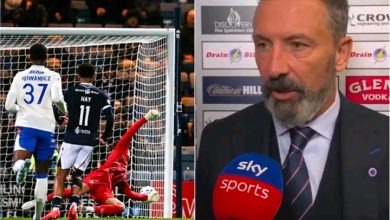
Few moments in a football match generate as much noise as a handball appeal, and few are as hard to settle on the strength of a single freeze-frame. When Minsu Kim struck a shot from the edge of the box in the first half at Dens Park on Saturday, the ball hit the arm of Dundee defender Ryan Astley, and Rangers wanted a penalty. VAR was consulted, the referee’s original decision stood, and play moved on. The 2-2 draw that followed, in which Rangers could have gone top of the Scottish Premiership, naturally sent plenty of supporters back to that moment. They were looking for an explanation for why a dominant performance produced only a point. Yet pundit James McFadden, speaking on commentary, had a clear view that the right decision had been made. His reasoning, and the wider logic of the handball law, is worth taking seriously, because the case against the penalty is stronger than the frustration of the evening might suggest.
Start with what actually happened, as far as the reports establish it. Rangers were looking for an early breakthrough when Gassama laid the ball back to Kim, who struck it from the edge of the area. McFadden’s description is the crucial detail. He called it a lovely knock down from Gassama and said Kim caught the effort well, but he also pointed out that the ball bounced up off the ground after hitting Kim’s boot. That small observation changes how the whole incident should be read. The shot did not travel cleanly through the air on a predictable path towards a defender who then raised an arm to block it. It came up off the turf at an awkward height, which is the kind of trajectory a defender cannot easily anticipate or adjust to. McFadden’s verdict was brief and unambiguous, and he called it the correct decision.
To understand why that matters, it helps to remember what the handball law is trying to punish. The modern interpretation, refined several times over the past decade, is not built around whether the ball touched a hand or an arm. It is built around whether the player did something to deserve a penalty. The questions are whether the defender deliberately played the ball with the arm, whether the arm was in a position that made the body unnaturally bigger, and whether the movement of the arm was a conscious attempt to block or gain an advantage. A ball that simply strikes an arm is not automatically an offence, and the law explicitly allows for accidental contact in many circumstances, particularly when the player has had little time to react or when the ball has been deflected unexpectedly. The distinction can feel frustrating to supporters who see a ball hit a limb and assume that means a spot kick, but it is the entire basis of the modern law.
Applied to this incident, the factors point in one direction. Astley was defending a shot struck from the edge of the box, which meant there was a crowd of players, a short distance and very little time. The ball arrived after bouncing up off the ground, which, as McFadden noted, means it did not follow the clean line a defender would expect. There is no suggestion in any of the match reports that Astley threw an arm at the ball or moved towards it, and no suggestion that his arm was extended away from his body in an unnatural way. Defenders in the penalty area, or at its edge, are constantly told to make themselves compact, to keep their arms tucked in and to avoid gestures that might invite a penalty. They are also expected to challenge for the ball, and challenging inevitably means that arms and hands are sometimes in the vicinity of a shot. The law was written to account for that reality, and it does not demand that defenders play with their arms behind their backs.
The involvement of VAR is also worth dwelling on, because it is often misunderstood. Rangers were not denied a review. The reports confirm that the referee communicated with VAR about the incident, which means the on-field decision was checked by the officials with access to the replays. VAR is designed to intervene only when there has been a clear and obvious error, and it is deliberately not meant to re-referee every marginal call. In the case of handball, the threshold for a clear and obvious error is high, because the interpretation involves judgement about arm position, intent and the unexpected nature of the contact. A decision that could reasonably go either way does not meet that threshold, and in this case the review process confirmed that the original call should stand. If the replays had shown a clear case of an arm in an unnatural position blocking a shot, the officials would have sent the referee to the monitor. They did not, which tells us something about how the incident looked from every available angle.
It is also fair to ask what supporters expect the law to look like. Over the last few seasons, handball decisions have been among the most controversial in the sport, and they have drawn criticism precisely because they sometimes punish defenders for contact that looks accidental. Fans and managers have complained about penalties given for balls that struck an arm from very close range, with no chance of reaction, and the game’s lawmakers have responded by softening the interpretation to some degree. The result is a law that tries to distinguish between genuine offences and unlucky contact. When a decision goes against a team, supporters tend to demand the harsher interpretation, but those same supporters rarely want the harsher interpretation when it is their own defender who is involved. The consistent application of a lenient standard to accidental contact is not a flaw in the system, and it protects every team in the league, including Rangers, from penalties that would feel deeply unfair if they were given against them.
The point about consistency deserves emphasis, because it is the real test of any refereeing decision. If a referee awards a penalty for a ball that bounces off the ground and strikes a defender’s arm at the edge of the box, then the same standard has to apply in every match, to every team, in every similar situation. That would produce a flood of penalties for contact that defenders have no realistic way of avoiding, and it would change the nature of the game in a way that few supporters would welcome. The more sensible approach, which the officials took at Dens Park, is to reserve penalties for handballs that involve something more than simple contact, such as a deliberate movement, an unnatural position or a clear advantage gained. The incident involving Kim’s shot, on the available evidence, did not meet that standard, and that is why McFadden was comfortable calling it correct.
It is worth being honest about the limits of what can be said here. A written description of a handball incident, however detailed, cannot capture the exact position of an arm or the precise moment of contact, and anyone who claims certainty from a headline or a summary is overreaching. The reports are consistent in saying that the ball struck Astley’s arm after Kim’s effort and that VAR was consulted without a penalty being awarded. McFadden, who watched the incident live and with the benefit of replays, judged the decision correct. A neutral pundit with a long career as a forward, who knows what it feels like to be on the receiving end of a decision that does not go his way, has no obvious reason to defend a poor call. His willingness to say that the officials got it right, in a match where the visiting team was the one hard done by, carries more weight than a supporter’s reaction in the heat of the moment.
There is, of course, a natural human tendency to look for an explanation outside the team when a result falls short of expectations. Rangers had around sixty per cent of the ball, took twenty-one shots to Dundee’s ten and led for a good part of the second half before Callum Jones equalised. A win would have put them top of the league, at least until Celtic played Hearts the next day. When a team that dominates in that way fails to win, supporters understandably search for the moment that changed the game, and a handball appeal in the first half is an easy candidate. But the actual turning points were elsewhere. Dundee scored their first goal when Rangers failed to deal with a routine long ball, which allowed Bradley Fink to round the goalkeeper and finish. They scored their second after Dan Neil, the stand-in captain, dwelt on the ball and allowed Jones to steal it. Both goals were gifts, and neither had anything to do with the referee.
Derek McInnes appeared to recognise that in his comments after the match. The reports of his post-match reaction focus on the quality of his side’s second-half performance, on the cost of Neil’s mistake, and on the need to move the ball more quickly to the wide players and to defend with greater certainty. He described the error that led to Dundee’s equaliser as having the effect of a balloon popping on Rangers’ momentum, and he spoke about the mental side of football and the way a mistake like that gives the opposition something to cling to. Nothing in the coverage suggests that he dwelt on the penalty appeal or blamed the officials for the result. That is a mark of a manager who understands where the real problems lie, and it is a useful corrective for supporters who might prefer to point the finger at the referee. A team that wins the title does so by controlling the things it can control, and Rangers failed to do that for the final twenty minutes on Saturday.
None of this means that the handball law is perfect, or that supporters are wrong to feel confused by it. The rules have changed repeatedly in recent years, and the changes have not always produced clearer outcomes. Different referees interpret arm position slightly differently, and VAR teams in different countries apply the threshold for intervention with varying degrees of strictness. The Scottish game has had its share of controversial handball decisions, in both directions, and the frustration that comes with them is genuine. But the fact that the law is imperfect does not make the decision in this case wrong. On the contrary, a defender who is hit by a bouncing shot from the edge of the box, with no deliberate movement and no obvious attempt to block the ball, is precisely the kind of situation that the law was reformed to protect.
There is also a tactical argument that is easy to overlook. Even if the penalty had been awarded, Rangers would still have needed to convert it, and there is no guarantee that a spot kick in the opening stages would have changed the shape of the match. It might have helped them settle, and it might have given them a lead that forced Dundee to open up, but it might equally have created a different set of problems. The truth is that the performance Rangers produced in the first half, before Bouanani’s equaliser, was uneven, with Ryan Naderi struggling as the lone striker and Minsu Kim himself looking lost in the number ten role behind him. A penalty would have masked those issues for a while, but it would not have solved them. The underlying questions about how the attack is structured, and about how quickly the ball is moved to players like Bouanani and Gassama, would still have been waiting for the manager to answer.
It is also worth acknowledging how much credit Dundee deserve. Steven Pressley’s side pressed aggressively, won second balls and made it difficult for Rangers to play their preferred game, particularly in the first half. They scored when they were given opportunities and they defended with the sort of commitment that is the hallmark of a well-organised team. Astley, the player whose arm was involved in the appeal, was part of a defensive effort that kept Rangers to a single goal from open play in the first half and restricted them to long-range efforts for large parts of the match. It would be unfair to suggest that the Dundee defender benefited from a favour by the officials, because the evidence is that he simply got in the way of a shot from the edge of the area, in a situation where the contact was almost impossible to avoid.
Looking at the incident in the broader context of how matches are decided, there is a useful lesson for Rangers supporters. A team that wants to win the league cannot afford to leave its fate in the hands of refereeing decisions, because there will always be incidents that go against it. The way to avoid being sunk by a marginal call is to make sure the margins are not that fine. If Rangers had defended the long ball for Fink’s goal more cleanly, or if Neil had played the simple pass in the sixty-ninth minute, the penalty appeal would be a footnote rather than a talking point. The best sides in the world have refereeing decisions go against them all the time, and they win titles anyway because they do not leave the result in doubt. That is the standard Rangers need to reach, and it is the standard McInnes appears to be demanding of his players.
For those who remain unconvinced, there is one final argument, which is that the officials followed the process they were supposed to follow. The referee made a decision on the pitch, VAR reviewed it, and the decision stood. That is how the system is meant to work, and it is a system that Rangers, like every other club in the league, has accepted. If supporters want to argue that the law should be changed, or that the threshold for VAR intervention should be lower, those are legitimate debates to have. But they are separate from the question of whether the officials got this particular decision right, and on that question, the informed opinion from the commentary box and the evidence of the match reports points towards the answer that McFadden gave. The ball came up off the ground, struck an arm that was not obviously doing anything unnatural, and the officials, after a check, concluded that it was not a penalty.
In the end, the case for the decision being correct rests on a combination of the law, the circumstances and the process. The law asks whether the contact was deliberate or whether the arm was in an unnatural position, and nothing in the reports suggests it was. The circumstances, a shot struck from the edge of the area that bounced up off the ground, point to a defender with little time to react. The process, which involved a VAR check and a decision to let the original call stand, confirms that the officials did not see a clear and obvious error. Put those three things together and the conclusion that McFadden reached is difficult to dispute. Rangers can feel unlucky that a good chance was blocked by an arm, but luck is not the same as injustice, and the difference between the two is what the handball law is designed to protect.
That leaves Rangers with the more uncomfortable truth, which is that the draw at Dens Park was a result of their own making. They controlled the ball, created the chances and scored two goals of real quality, but they also made two errors that Dundee punished. They will rightly focus on those errors in training this week, and they will rightly be annoyed with themselves for missing the opportunity to go top of the table. What they should not do is waste energy on a penalty decision that, on the balance of the evidence, was handled correctly. The Premiership race is tight, the margins are fine, and the teams that come out on top will be the ones that stop giving points away and start taking the chances that come their way. A handball appeal that was rightly turned down is not a reason for Rangers to feel hard done by. It is one more reminder that the match was theirs to win, and that they let it slip